St. Peter’s Church
Riga, Latvia
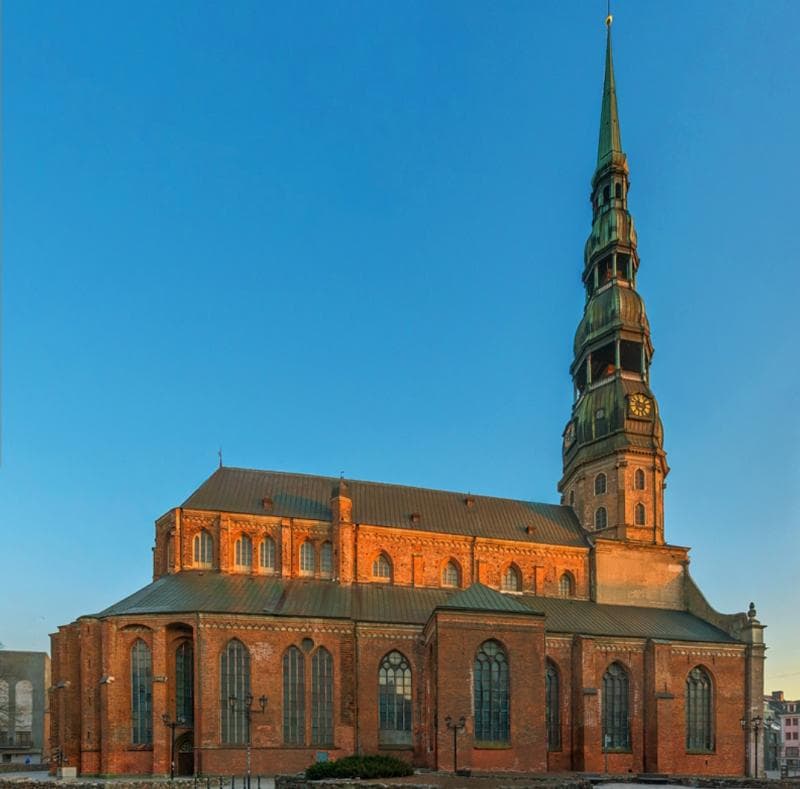
Explore St. Peter's Church in Riga Old Town, Latvia. Discover its rich history, stunning Gothic architecture, and panoramic city views from the tower.
Overview
Nestled within the enchanting cobbled streets of Riga Old Town, St. Peter's Church stands as an enduring symbol of Latvia's capital. This magnificent Lutheran church, dedicated to Saint Peter, is not merely an architectural marvel but a historical beacon, chronicling centuries of Riga's tumultuous past and resilient spirit. First mentioned in historical records in 1209, it is among the oldest and most significant sacred buildings of medieval monumental architecture in the Baltic States. Its towering spire, which has pierced the Riga skyline through numerous reconstructions, offers a breathtaking panoramic perspective of the city's red rooftops, the winding Daugava River, and the distant Gulf of Riga.
A visit to St. Peter's Church is a journey through time, revealing layers of history etched into its very foundations. While its exterior commands attention with its imposing Gothic and later Baroque features, the interior invites quiet contemplation, showcasing original elements that have survived fires, wars, and the relentless march of time. It serves as a vibrant cultural hub, hosting art exhibitions and concerts, enriching the experience for every curious traveler.
History & Cultural Background
The origins of St. Peter's Church date back to the early 13th century, with its first documented mention in 1209. Initially constructed as a place of worship for Riga's merchants, its early form was largely of masonry, which notably protected it from a devastating city fire in its foundational year. Over the centuries, the church has undergone a remarkable series of transformations, reflecting the prevailing architectural styles and responding to the ravages of conflict and natural disaster. Its history is often divided into three distinct periods: two associated with Gothic and Romanesque styles, and a third with the early Baroque era.
Significant renovations in the 15th century gave rise to the current basilica form, featuring three aisles and ornate vaulted ceilings. The church's iconic tower, a constant feature of Riga's skyline, has been rebuilt several times. A Gothic tower from the late 15th century collapsed in 1666, and a new Baroque-style tower, built in 1690, was reputedly the tallest wooden construction in Europe at the time. This tower, too, faced destruction, struck by lightning in 1721 and later burned down during World War II. Its most recent reconstruction, featuring a modern metal framework and an elevator, began in 1967 and was completed in the 1970s, making its observation deck accessible to all.
Culturally, St. Peter's Church transitioned from a Catholic church to a Lutheran one in 1523. Its inclusion in the UNESCO World Heritage list in 1997, as part of Riga's historic center, underscores its invaluable contribution to global cultural heritage.
What Makes It Special
St. Peter's Church is particularly distinguished by several features that make it a truly special destination. Firstly, its sheer height of 123.25 meters establishes it as the tallest church in Riga and a prominent landmark across the Baltics. The most compelling reason for many visitors is the observation platform, situated at a height of 72 meters. From this vantage point, an unparalleled 360-degree panorama unfolds, offering spectacular views of Old Town's medieval layout, the Daugava River's expanse, and the distant Riga Bay.
Beyond the views, the church’s architecture itself is a testament to enduring craftsmanship. Inside, travelers can explore a rich tapestry of historical elements, including original 13th-century outer nave walls and interior pillars, as well as remnants of later periods. Notable artifacts include ancient tombs, exquisitely restored stone and wooden memorial plaques, and a monumental bronze seven-branched candlestick dating back to 1596. The presence of the original statue of Knight Roland, which once graced the Town Hall Square, adds another layer of historical intrigue.
Stories, Fun Facts & Local Details
One of the most charming details of St. Peter's Church is its clock tower, which, according to tradition, features only an hour hand. Even more delightful is the carillon, installed during the 1970s reconstruction, which plays the melodic Latvian folk tune 'Rīga dimd' five times a day, echoing through the Old Town and adding a unique auditory experience to the city's ambiance. The bells also chime on the hour, a timeless rhythm in the heart of Riga.
Another fascinating local detail concerns the church's weather vane. For centuries, from the 15th century until 1941, the spire was topped by a wind vane in the shape of a rooster – a symbol of vigilance and faith. Over time, six different roosters have adorned the spire, each one a silent guardian watching over the city. The story of the 1690 tower being the tallest wooden structure in Europe at the time also highlights the ambition and engineering prowess of Riga's builders centuries ago.
Visitor Perspective
St. Peter's Church is centrally located within the UNESCO-listed Riga Old Town, making it incredibly easy to reach on foot from most central accommodations and other major landmarks like Dome Square and the House of the Blackheads. Its prominence means it's often visible from various points in the Old Town, drawing visitors towards its majestic presence. While the ascent to the observation platform is a key highlight, an elevator conveniently transports visitors up to the 72-meter viewing level, eliminating the need to climb countless stairs. This accessibility ensures that most travelers can enjoy the stunning vistas, though it's important to note that the church itself currently lacks wheelchair access. It is generally a paid attraction, with a fee to access the tower and its views, which many find well worth the cost for the unforgettable perspective it offers.
Coordinates: 24.10944, 56.9475
View on Google Maps💬 How Travelers Describe This Place
Based on community votes
Must See
963Beautiful
723Interesting
482Photogenic
396Unique
274
Traveler Stories
Discover memorable experiences shared by travelers who have visited this place.
No traveler stories yet.
Be the first traveler to share what made this place memorable.

Tour
By
Spot
Discover amazing places around the world. Your journey starts here.
Explore
© 2026 TourBySpot. All rights reserved.