St Giles’ Cathedral
Edinburgh, United Kingdom
Explore St Giles’ Cathedral, Edinburgh: Discover the High Kirk of Edinburgh, a historic Gothic masterpiece on the Royal Mile in the United Kingdom. Uncover Scotland's rich past, Reformation tales, and the iconic Thistle Chapel.
Overview
St Giles’ Cathedral, often revered as the High Kirk of Edinburgh, stands as a majestic and enduring landmark in the heart of Scotland's capital. Situated prominently on the historic Royal Mile, it acts as a pivotal point between Edinburgh Castle and the Palace of Holyroodhouse, embodying over 900 years of Scottish history, faith, and culture. Founded around 1124 by King David I, this venerable institution is the principal church of the Church of Scotland, yet it welcomes visitors from all walks of life. Its distinctive crown steeple, a prominent feature of Edinburgh's skyline, beckons curious travellers to explore the rich tapestry of stories held within its ancient walls. Entry to St Giles’ Cathedral is free, though donations are welcomed to support its ongoing preservation and mission.
History & Cultural Background
The origins of St Giles’ Cathedral trace back to approximately 1124, when King David I established a church on this site. The building you see today is largely Gothic, with sections dating back to the 14th and 15th centuries, though it has undergone numerous significant modifications and restorations over the centuries. Its journey has been far from tranquil. The church suffered damage from English armies in 1322 and again in 1385, with scorch marks from these raids reportedly visible on pillars until the 19th century. In 1467, it was elevated to collegiate status by Pope Paul II.
St Giles’ played an absolutely central role in the Scottish Reformation. In 1559, the fiery reformer John Knox became its minister, using the pulpit to spearhead the Protestant revolution that reshaped Scotland's religious landscape. A famous act of defiance unfolded here in 1637, when Jenny Geddes allegedly threw a stool at a minister who was introducing a new Anglican prayer book. This incident ignited a riot, which in turn contributed to the signing of the National Covenant and ultimately fuelled the Wars of the Three Kingdoms. While commonly known as a cathedral, it has only officially held that title during two brief periods when bishops were part of the Scottish Church, reflecting a nuanced history within Presbyterianism. After the Reformation, for many years, the building was internally partitioned, serving simultaneously as multiple churches, a prison, and even a meeting place for the Parliament of Scotland. Major Victorian-era restorations, particularly those led by Lord Provost William Chambers in the late 19th century, aimed to restore its grandeur, envisioning it as a 'Westminster Abbey for Scotland'. In more recent times, St Giles’ has continued to be a witness to national events, including the laying-in-rest of Her Late Majesty Queen Elizabeth II and the presentation of the Honours of Scotland to His Majesty King Charles III.
What Makes It Special
Beyond its ancient stones and historical narratives, St Giles’ Cathedral captivates visitors with several unique features. The most striking is its iconic crown steeple, a masterpiece of medieval architecture dating between 1460 and 1467. It is one of only two surviving medieval crown steeples in Scotland, a truly rare sight that defines Edinburgh's skyline. Inside, the Thistle Chapel, completed in 1911, is an exquisite example of Gothic Revival craftsmanship. This chapel serves as the spiritual home for the Knights of the Thistle, Scotland's highest order of chivalry, and is renowned for its intricately carved wooden stalls, elaborate heraldic shields, and even a charming angel playing bagpipes hidden among the carvings.
The cathedral also boasts a stunning array of stained-glass windows, each telling stories from biblical passages and pivotal moments in Scottish history. These vivid artistic displays bathe the interior in a spectrum of colours, contributing to its awe-inspiring atmosphere. The blend of various architectural styles, from its early Romanesque fragments to later Gothic additions and Victorian renovations, makes the building a living testament to centuries of design evolution. Its enduring role as the 'Mother Church of World Presbyterianism' underscores its profound spiritual and historical significance, making it a cornerstone of Scottish identity and faith.
Stories, Fun Facts & Local Details
St Giles’ is rich with intriguing tales and local lore. The legendary Jenny Geddes, whose spontaneous act of defiance with a stool is said to have sparked a revolution, is a firm part of its history. Another fascinating detail lies just outside the cathedral's west entrance: the 'Heart of Midlothian'. This heart-shaped mosaic on the pavement marks the site of the Old Tolbooth, a former prison and tax office. Tradition holds that locals would spit on it for good luck, or perhaps as a gesture of disdain for the prison it once represented. Inside, look for the plaque in a nearby car park that marks the approximate burial place of John Knox, reportedly fulfilling his dying wish to be buried near St Giles', though perhaps not quite in its current form.
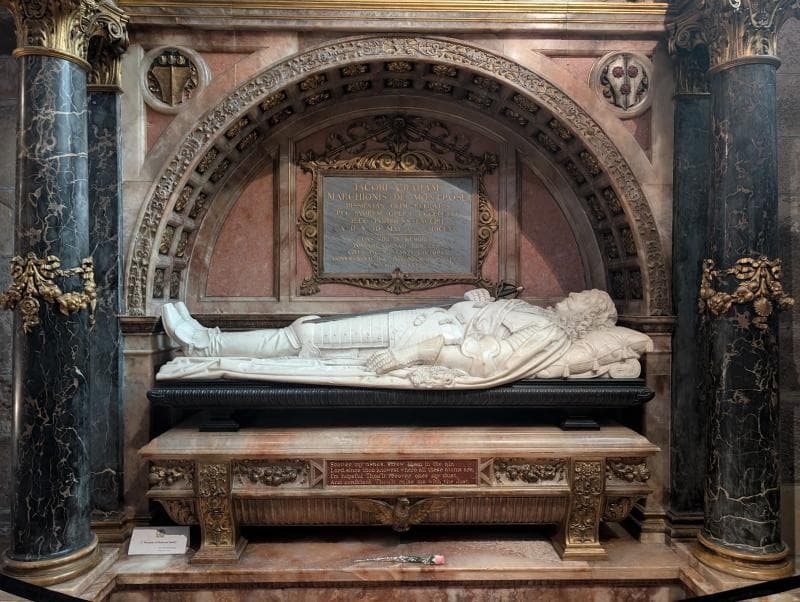
The cathedral is dedicated to Saint Giles, a 7th-century Greek hermit and a patron saint of lepers, beggars, and Edinburgh itself. Legend recounts his compassion for animals, particularly a deer he protected from a king's hunting party. The Thistle Chapel also holds a whimsical secret – an angel carved playing bagpipes, a delightful nod to Scotland's national instrument. Within the cathedral, visitors can find memorials to significant figures, including a bronze statue of John Knox and the 'Robert Burns window', a modern stained-glass tribute to Scotland's national poet, created by Icelandic artist Leifur Breidfjörd.
Visitor Perspective
Visiting St Giles’ Cathedral offers a profound experience for any traveller to Edinburgh. The cathedral is open daily, typically from 10am to 6pm on weekdays, 9am to 5pm on Saturdays, and 1pm to 5pm on Sundays. While general entry is free, visitors are encouraged to contribute donations to help maintain this historic site. For those wishing to delve deeper, guided tours and audio tours are available, often for a small charge, providing detailed insights into its history and architecture. A digital visitor guide can also be accessed via a QR code, available in multiple languages.
St Giles’ is committed to accessibility, offering ramp access to the building and providing manual wheelchairs. For those with sensory sensitivities or who prefer a quieter environment, 'Quiet Hours' are available on Saturday mornings from 9am to 10am. Beyond its historical and architectural marvels, St Giles’ remains an active place of worship, hosting regular services, concerts, and events. It serves as a spiritual home for its congregation and a peaceful place of reflection for countless visitors, making it an essential stop on any exploration of Edinburgh's Royal Mile.
Coordinates: -3.19083, 55.94944
View on Google Maps💬 How Travelers Describe This Place
Based on community votes
Photogenic
703Unique
521Must See
477Beautiful
157Interesting
28
Traveler Stories
Discover memorable experiences shared by travelers who have visited this place.
No traveler stories yet.
Be the first traveler to share what made this place memorable.

Tour
By
Spot
Discover amazing places around the world. Your journey starts here.
Explore
© 2026 TourBySpot. All rights reserved.