St. George’s Basilica
Prague, Czech Republic
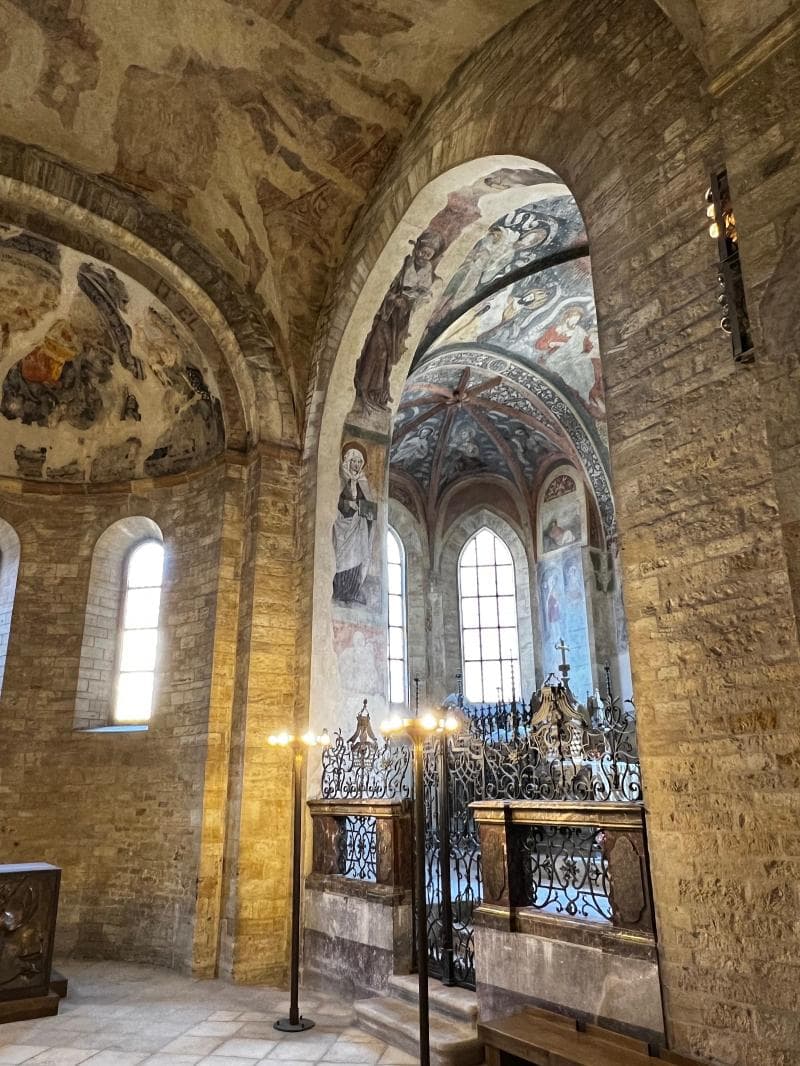
Explore St. George's Basilica in Prague Castle, Czech Republic. Discover its ancient Romanesque architecture, rich history, royal tombs, and unique legends.
Overview
Nestled within the vast and historic complex of Prague Castle, St. George's Basilica stands as a testament to Bohemia's enduring past. It is the oldest surviving church building inside Prague Castle, making it a cornerstone of Czech history and spirituality. Primarily Romanesque in style, its venerable walls have witnessed over a millennium of change, from its founding in the 10th century to its present-day role as an exhibition space and concert venue. The basilica's striking red Baroque facade, added in the 17th century, offers a captivating contrast to its ancient Romanesque interior, inviting visitors to step back in time.
As a key part of the Prague Castle complex, a UNESCO World Heritage site, St. George's Basilica offers a serene and monumental counterpoint to the more ornate structures surrounding it. Its simple yet powerful architecture speaks volumes of early Christian influence in the region and the resilience of its design through centuries of fires, rebuilds, and transformations.
History & Cultural Background
Founded around 920 AD by Prince Vratislaus I of Bohemia, father of Saint Wenceslaus, the basilica became a pivotal site for early Bohemian Christianity. After Vratislaus's death, his son Wenceslaus I completed the project and interred his grandmother, Ludmila of Bohemia, here in 925 AD, establishing her as the first Czech martyr and solidifying the basilica's spiritual importance.
A major turning point came in 973 AD with the adjacent Benedictine convent's establishment, transforming it into a convent church. This period brought enlargement and reconstruction in an early Romanesque, three-nave style. The convent, founded by Mlada, sister of Prince Boleslav II, became medieval Bohemia's oldest and most powerful female monastery, significantly impacting the region's culture and education.
Despite a devastating fire in 1142, the basilica was meticulously rebuilt, largely retaining its Romanesque character. Later additions included a Gothic chapel for St. Ludmila in the 13th century and the Baroque Chapel of St. John Nepomuk, designed by F.M. Kanka, in the early 18th century. The most striking external change is the vivid red Baroque facade from the late 17th century, contrasting with the Romanesque towers behind it.
What Makes It Special
What sets St. George's Basilica apart is its remarkable preservation of Romanesque architecture. While its exterior presents a prominent Baroque facade, the interior reveals an austere, monumental, and authentically Romanesque style, rare among Prague's more ornate churches. Its thick stone walls and simple design transport visitors to a distant past, offering a powerful sense of historical continuity.
The basilica serves as the final resting place for key figures of early Bohemian history, including Prince Vratislaus I and Saint Ludmila. Their tombs, in the main nave and the Chapel of St. Ludmila, underscore the basilica's deep royal and spiritual connections. The crypt beneath the chancel also houses the mausoleum of other Přemyslid dynasty members, reinforcing its significance as a dynastic burial ground.
Moreover, the basilica's two white marlstone towers, nicknamed 'Adam' (the wider southern) and 'Eve' (the narrower northern), add distinctive character to the Prague Castle skyline, unique features from the 12th-century reconstruction.
Stories, Fun Facts & Local Details
Beyond its grand history, St. George's Basilica holds intriguing stories. Legend tells of a large wooden crucifix that reportedly bled in the 13th century when Princess Anna prayed for her father, signaling his death and subsequent turmoil. This haunting tale adds mystique to the ancient artifact.
Another fascinating detail lies in the 12th-century crypt: a gruesome statue known as 'Brigita,' depicting a decaying female figure with a snake. An allegory for vanity and mortality, tragic legend attributes its creation to an 18th-century Italian sculptor, Spinetti, driven mad by guilt after murdering his lover.
Today, the basilica's excellent acoustics make it a favored venue for classical music concerts, offering a unique opportunity to experience Czech music in a historically rich setting. The former St. George's Convent, now an exhibition space, houses the 19th-century Bohemian Art Collection of the National Gallery Prague.
Visitor Perspective
Visiting St. George's Basilica offers a serene and introspective experience, a stark contrast to the bustling activity of other parts of Prague Castle. The simple, unadorned Romanesque interior provides a powerful sense of peace and antiquity. It's a place to quietly reflect on centuries of history, from the early Bohemian rulers to the Benedictine nuns who once lived and worshipped here.
As part of the Prague Castle circuit, access to the basilica is usually included with a general admission ticket. Remember that while the Baroque facade is eye-catching, the true historical essence lies within, in the monumental Romanesque design and the sacred resting places of Bohemia's ancestors. Its role as a concert hall also means checking local listings could offer a memorable evening experience within its ancient walls.
Coordinates: 14.4026, 50.0912
View on Google Maps💬 How Travelers Describe This Place
Based on community votes
Must See
545Unique
211Photogenic
123Interesting
74Beautiful
20
Traveler Stories
Discover memorable experiences shared by travelers who have visited this place.
No traveler stories yet.
Be the first traveler to share what made this place memorable.

Tour
By
Spot
Discover amazing places around the world. Your journey starts here.
Explore
© 2026 TourBySpot. All rights reserved.