Spanish Synagogue
Prague, Czech Republic
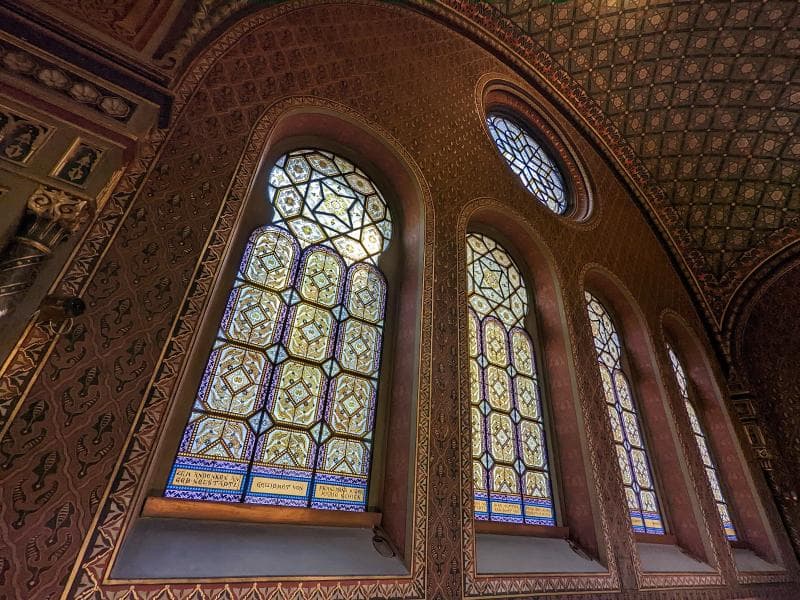
Discover Prague's Spanish Synagogue in the Jewish Quarter, Czech Republic. Explore its stunning Moorish Revival architecture and rich Jewish history.
Overview
Nestled within Prague's historic Jewish Quarter, known as Josefov, the Spanish Synagogue stands as a breathtaking testament to architectural beauty and a profound historical narrative. Often described as one of Europe's most beautiful synagogues, its stunning Moorish Revival interior captivates visitors with intricate patterns, rich colors, and gilded details. Built in 1868, it replaced an older house of worship and quickly became a vibrant center for Prague's Reform Jewish community. Today, it forms an integral part of the Jewish Museum in Prague, housing a significant permanent exhibition that delves into the modern history of Jews in the Bohemian Lands.
Its prominent location in the Jewish Quarter places it among a collection of remarkably preserved Jewish monuments, offering a unique window into centuries of Jewish life and culture in Central Europe. A visit here is not merely about admiring architecture; it's an immersive journey into the resilience and contributions of a community that shaped a vital part of Prague's identity.
History & Cultural Background
The Spanish Synagogue's origins trace back to the site of the 'Old School' (Altschul), believed to be the oldest synagogue in Prague, dating as far back as the 11th or 12th century. This ancient predecessor was demolished in 1867 to make way for a grander structure that would reflect the era of Jewish emancipation and cultural change in the 19th century.
The current synagogue, completed in 1868, was designed by architects Vojtěch Ignác Ullmann and Josef Niklas, with its famously elaborate interior decoration executed by Antonín Baum and Bedřich Münzberger between 1882 and 1893. Its distinctive Moorish Revival style, drawing inspiration from the Islamic art and architecture of Spain's Alhambra, symbolized a break from traditional synagogue designs and aligned with the Reform movement's forward-looking spirit. Unlike older synagogues with central bimahs, the Spanish Synagogue adopted a reform layout with seating in rows, akin to a church.
During the tumultuous years of World War II, the synagogue, like many other Jewish institutions, was tragically used by the Nazis as a warehouse for confiscated Jewish property. Post-war, it became part of the Jewish Museum in Prague. After periods of neglect under Communist rule in the 1970s and 80s, it underwent significant restoration after the Velvet Revolution, reopening in 1998, and most recently completed another extensive renovation between 2018 and 2020.
What Makes It Special
What truly sets the Spanish Synagogue apart is its unparalleled interior. Upon entering, visitors are enveloped by an explosion of color, detail, and light. The walls, arches, and ceilings are adorned with a dense array of polychrome geometric patterns, stylized plant motifs, and intricate arabesques in shades of red, blue, green, and shimmering gold. The square ground plan culminates in a majestic central dome, and galleries on three sides offer different perspectives of the ornate space.
The Torah ark, stylized as a mihrab, stands as a central feature, further enhancing the Moorish aesthetic. The inclusion of an organ in the southern gallery, contributing to its exceptional acoustics, underscores its modern and reformist approach. This blend of rich historical layers, from the ancient 'Old School' beneath its foundations to the 19th-century embrace of Moorish artistry, creates a profoundly unique spiritual and cultural space.
Stories, Fun Facts & Local Details
- A Name's Tale: Despite its name, the Spanish Synagogue was not built by Sephardic Jews. Its 'Spanish' designation refers purely to its Moorish architectural style, inspired by the grand Islamic architecture of medieval Spain.
- Composer's Connection: František Škroup, the composer of the Czech national anthem, served as an organist and choirmaster at the Old School, the synagogue that previously stood on this very spot, in the mid-19th century.
- Hitler's 'Museum': The fact that the Jewish Quarter's buildings, including the Spanish Synagogue, survived WWII largely intact is grimly attributed by some to Adolf Hitler's perverse plan to preserve the area as a 'Museum of an Extinct Race' after the extermination of the Jewish people. This twisted intention ironically saved the physical structures, allowing their stories to continue.
- Franz Kafka's Shadow: A modern statue of the renowned Prague-born writer Franz Kafka stands nearby, reflecting his connection to the rich cultural and intellectual life of Prague's Jewish community, a heritage explored within the synagogue's permanent exhibition.
Visitor Perspective
For any curious traveler exploring Prague's Jewish Quarter, the Spanish Synagogue is an essential and deeply moving stop. It's often considered one of the most visually impressive sites in Josefov. The synagogue is home to the Jewish Museum's permanent exhibition, 'Jews in the Bohemian Lands, 19th–20th Centuries', which offers a comprehensive look at the modern history of Jews in Czech lands, covering topics from emancipation to the Holocaust and post-war life.
Beyond its visual splendor and historical exhibition, the Spanish Synagogue is renowned for its exceptional acoustics, making it a popular venue for classical music concerts several nights a week. Attending a concert here offers a magical experience, combining cultural enrichment with the awe-inspiring beauty of the interior. The synagogue is wheelchair accessible, ensuring broad access to this significant site. Entry is typically part of the Prague Jewish Town ticket, which grants access to several other key Jewish monuments in the quarter.
Coordinates: 14.42082, 50.09037
View on Google Maps💬 How Travelers Describe This Place
Based on community votes
Beautiful
996Unique
726Interesting
717Photogenic
335Must See
193
Traveler Stories
Discover memorable experiences shared by travelers who have visited this place.
No traveler stories yet.
Be the first traveler to share what made this place memorable.

Tour
By
Spot
Discover amazing places around the world. Your journey starts here.
Explore
© 2026 TourBySpot. All rights reserved.