Soviet Era Collections
Tashkent, Uzbekistan
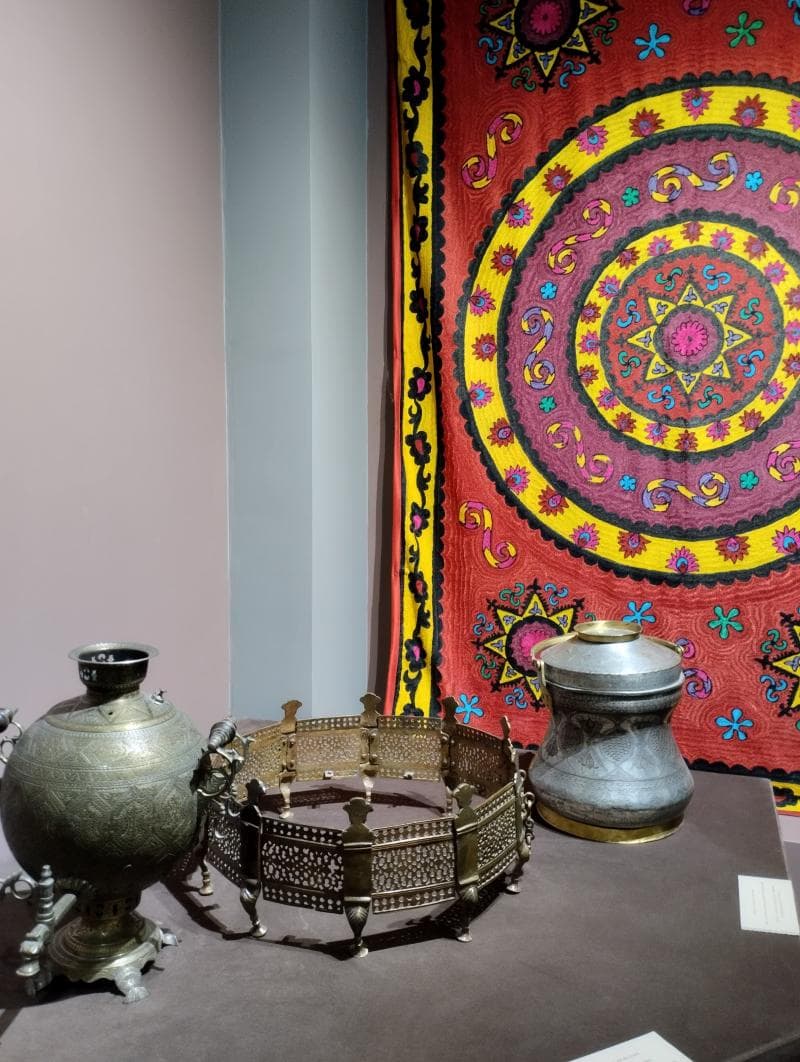
Explore the Soviet Era Collections at the State Museum of the History of Uzbekistan in Tashkent, uncovering Uzbekistan's complex 20th-century history.
Overview
The State Museum of the History of Uzbekistan, nestled in the heart of Tashkent, offers a profound journey through the nation's millennia-old past. Among its extensive collections, the section dedicated to the 19th and 20th centuries provides a vital window into the Soviet era, tracing Uzbekistan's complex trajectory under Soviet rule and its eventual emergence as an independent nation. Housed in a striking example of Soviet modernist architecture from 1970, the museum building itself stands as a testament to the period it partially chronicles, originally serving as the Lenin Museum before its transformation into the national historical institution it is today.
This particular collection, often integrated within the 'newest history' floor, invites visitors to explore the profound social, cultural, and political shifts that defined several generations. It's a space where the grand narratives of Soviet ideology meet the nuanced realities of Uzbek life, presenting a comprehensive, albeit sometimes reinterpreted, account of a pivotal historical period. The museum's vast holdings, exceeding a quarter-million exhibits, ensure that even this specific focus is rich with artifacts reflecting the era.
History & Cultural Background
Uzbekistan's history during the Soviet period (roughly 1924-1991) is a story of profound transformation, marked by both industrialization and cultural shifts, alongside political repression and the suppression of national identity. The State Museum of the History of Uzbekistan, founded in 1876 as the National Museum of Turkestan, underwent its own significant evolution during and after this epoch. Its current building, completed in 1970, was initially conceived as the Lenin Museum to commemorate the centenary of Vladimir Lenin's birth, reflecting the ideological priorities of the time.
Following Uzbekistan's independence in 1991, the museum's exhibits were 'completely updated,' reflecting a conscious effort to reinterpret the past through a national lens. This meant shifting from a Soviet-centric narrative to one that emphasized Uzbekistan's ancient heritage, the Turkestan region's contributions, and the nation's journey towards sovereignty. The collection covering the Soviet era, therefore, is not merely a display of artifacts but also a reflection of this historical re-evaluation, offering insight into how a nation grapples with its complex recent past.
What Makes It Special
What makes the Soviet Era Collections particularly special is its dual narrative. On one hand, it showcases tangible aspects of daily life and official culture under Soviet rule, including items like period newspapers, magazines of Jadists (early 20th-century reformers), first theatre bills, films, and photographs.
On the other hand, the presentation implicitly or explicitly addresses the post-independence perspective, sometimes highlighting the 'improvements' since 1991. Visitors might find this section particularly intriguing for its portrayal of how history is interpreted and presented by a newly independent state. One observation notes that the post-independence segment can be 'one-sided,' offering a fascinating glimpse into the construction of national memory.
Beyond the exhibits, the museum's building itself is a key artifact of the Soviet era. Its modernist 1970s architecture, designed by Yevgeny Rozanov and Vsevolod Shestopalov, incorporated traditional Uzbek 'panjara' latticework, making it a rare example of Soviet architecture blending international modernism with local cultural elements. This architectural style, a 'socialist remains,' adds another layer of historical context to the visitor's experience, especially for those interested in Soviet-era urban design.
Stories, Fun Facts & Local Details
A fascinating 'fun fact' embedded within the Soviet Era Collections is the very building's origin as the Lenin Museum. Imagine a space once dedicated to the founder of the Soviet state now carefully curating the narrative of its departure from that very system. This transformation speaks volumes about Uzbekistan's national journey and its reassertion of cultural identity.
Another local detail for the curious traveler is observing the subtle (or not-so-subtle) ways the museum recontextualizes the Soviet period. For instance, the section that, according to some visitors, emphasizes Uzbekistan's 'improvement' since independence can be seen as a direct counter-narrative to the Soviet-era portrayal of progress, offering a unique opportunity to witness the reshaping of a national story.
The inclusion of medals won by Uzbek champions in various sports like kurash (traditional wrestling) and tennis from different periods also adds a personal, human element to the historical timeline, showing how individuals thrived even within the broader political frameworks.
Visitor Perspective
For a curious traveler, visiting the Soviet Era Collections provides a critical context for understanding modern Uzbekistan. It's an opportunity to see how a nation navigates its complex past, acknowledging periods of immense change and challenging its historical interpretations. Expect to spend time reflecting on the shift from a Soviet republic to an independent state, examining the visual culture, official documents, and everyday objects that characterized this transitional time.
While the museum's vastness means the Soviet era is one part of a much larger story, its significance is undeniable. It's not just about what is displayed, but also about the underlying narrative and the building's own history. Engaging with this section offers a richer, more empathetic understanding of the Uzbek people's resilience and their ongoing process of defining national identity in the wake of a powerful, transformative era.
Coordinates: 69.269362, 41.311403
View on Google Maps💬 How Travelers Describe This Place
Based on community votes
Photogenic
995Interesting
964Beautiful
926Must See
646Unique
482
Traveler Stories
Discover memorable experiences shared by travelers who have visited this place.
No traveler stories yet.
Be the first traveler to share what made this place memorable.

Tour
By
Spot
Discover amazing places around the world. Your journey starts here.
Explore
© 2026 TourBySpot. All rights reserved.