Soviet Army Monument
Sofia, Bulgaria
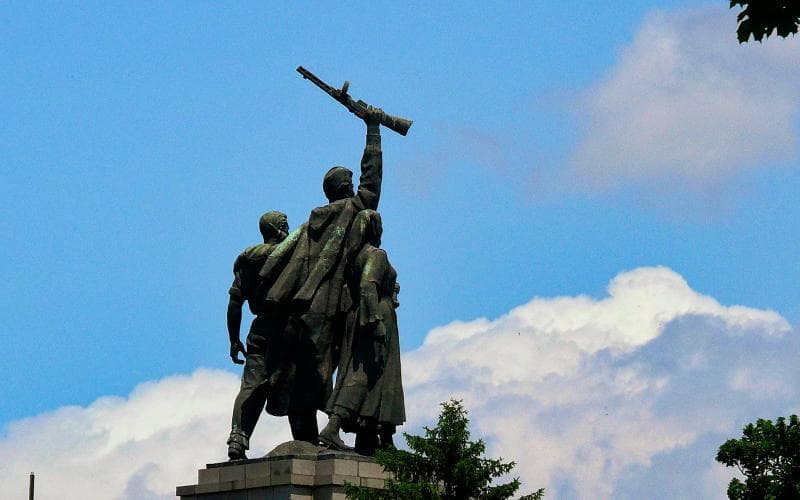
Explore Sofia's Soviet Army Monument in Borisova Gradina, Bulgaria – a monumental site of complex history, art, and ongoing public debate.
Overview
Nestled within the sprawling greenery of Borisova Gradina, one of Sofia's oldest and largest parks, the Soviet Army Monument stands as a monumental and historically charged landmark in the heart of Bulgaria's capital. While the park itself offers a serene escape with leafy paths and vibrant flowerbeds, the monument introduces a complex layer of history and ongoing public discourse. Erected in 1954, this imposing structure was intended to commemorate the Soviet Army's role in the liberation of Bulgaria during World War II, a narrative deeply intertwined with the country's communist past. Today, its meaning remains a subject of intense debate and evolving interpretation among Bulgarians.
The monument features a towering central composition depicting a Soviet soldier, his arm raised, accompanied by a Bulgarian man and woman. Surrounding this main sculpture are several bas-reliefs illustrating various scenes, from soldiers in battle to depictions of Bulgarian peasants. The structure's sheer size and prominent location near Tsar Osvoboditel Boulevard, Orlov Most, and Sofia University, make it an undeniable presence in the city's urban landscape. Beyond its official purpose, the monument has organically evolved into a vibrant social hub, attracting young people, skaters, and various subcultural groups, adding a contemporary layer to its historical significance.
History & Cultural Background
The Soviet Army Monument was inaugurated in 1954, specifically to mark the 10th anniversary of the Soviet Army's entry into Bulgaria in September 1944. This event paved the way for the establishment of the socialist regime in Bulgaria, which lasted until 1989. The monument was conceived as a symbol of gratitude for the Soviet Union's decisive role in what was officially termed the 'liberation' of Bulgaria from fascism.
The larger Borisova Gradina park, where the monument is situated, has its own layered history. Established in the late 19th century, it was originally named after Tsar Boris III. During the communist era (1944-1989), the park was renamed Freedom Park, a change that was reversed following the fall of communism. The monument's presence within this historic park underscores the complex interplay between different historical epochs and their legacies in modern Sofia.
What Makes It Special
What makes the Soviet Army Monument particularly special is not just its impressive scale, standing 37 meters high, but its dual nature as both a historical relic and a dynamic canvas for contemporary expression. While its original intent was to glorify Soviet power and a specific historical narrative, it has become a focal point for public discourse, protest, and artistic intervention. Unlike many static historical monuments, this one actively participates in the city's ongoing cultural and political dialogue.
The monument's main composition prominently features a Soviet soldier with a machine gun, flanked by a Bulgarian man and a woman holding a child. This imagery was designed to convey the idea of the Soviet soldier as a liberator and protector, an enduring symbol of socialist realism. However, the interpretations of this symbolism have dramatically shifted over time, reflecting Bulgaria's post-communist journey and its evolving relationship with Russia.
Stories, Fun Facts & Local Details
Perhaps the most compelling aspect of the Soviet Army Monument in recent decades has been its transformation into an unofficial public canvas. Beginning in 2011, anonymous artists repeatedly 'redecorated' the statues, turning the Soviet soldiers into various American pop culture icons like Superman, Captain America, Ronald McDonald, and Wonder Woman, often with messages like 'In pace with the times'. These acts of artistic vandalism, or 'guerrilla art', garnered international media attention and sparked widespread debate about the monument's future and Bulgaria's past.
Over the years, the monument's figures have also been painted with Guy Fawkes masks during anti-ACTA protests, dressed in Pussy Riot balaclavas, adorned with the colors of the Bulgarian national flag, and, most notably, painted in the blue and yellow of the Ukrainian flag in solidarity with Ukraine. Each instance has highlighted the monument's contested legacy and its role as a visible platform for dissent and political expression. Locals often refer to these transformations as a way to reclaim or reinterpret a controversial piece of history.
In a significant development, discussions regarding the monument's fate culminated in its partial dismantling in December 2023. Citing structural integrity concerns and a need to remove symbols of an oppressive past, authorities began relocating parts of the monument to the Museum of Socialist Art. This move, while controversial and met with protests from some groups, reflects a broader societal shift in how Bulgaria engages with its communist heritage.
Visitor Perspective
For a curious traveler, a visit to the site of the Soviet Army Monument offers more than just a glimpse at a large statue; it's an encounter with a living piece of history and a barometer of contemporary Bulgarian society. While the main figures have been removed, the complex still invites contemplation on the impact of historical events and the evolving memory of a nation. The surrounding park, Borisova Gradina, remains a beloved green space where one can observe daily life in Sofia, from families strolling to young people gathering.
Exploring the monument's former location provides an opportunity to understand the ongoing debates about national identity, historical interpretation, and artistic freedom. It serves as a powerful reminder that historical monuments are not always universally celebrated, and their meanings can be reinterpreted, debated, and even physically transformed by subsequent generations. Even with its main figures gone, the space continues to carry the weight of its past and the echoes of the many voices that have engaged with it.
Coordinates: 23.3344944, 42.6906889
View on Google Maps💬 How Travelers Describe This Place
Based on community votes
Beautiful
799Interesting
424Photogenic
234Must See
181Unique
30
Traveler Stories
Discover memorable experiences shared by travelers who have visited this place.
No traveler stories yet.
Be the first traveler to share what made this place memorable.

Tour
By
Spot
Discover amazing places around the world. Your journey starts here.
Explore
© 2026 TourBySpot. All rights reserved.