Solomiya Krushelnytska Grave
Lviv, Ukraine
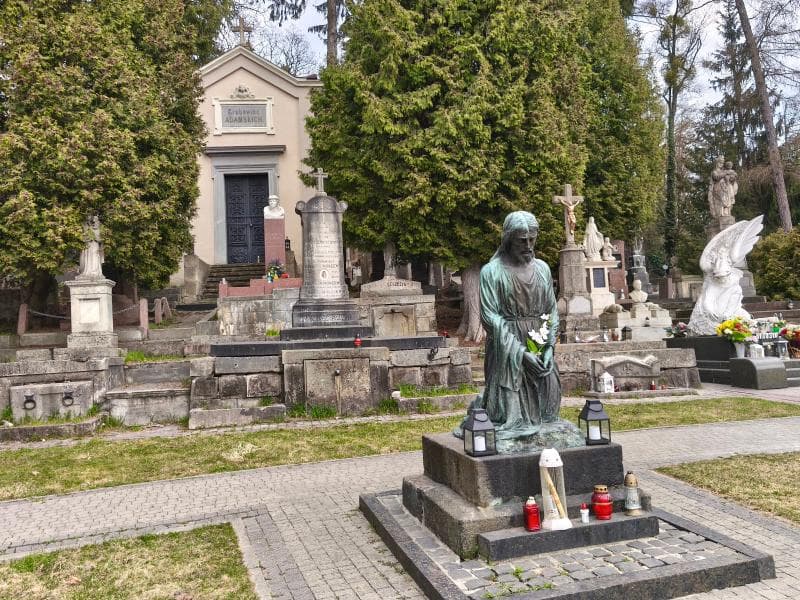
Discover the grave of legendary opera singer Solomiya Krushelnytska in Lychakiv Cemetery, Lviv, Ukraine. Explore her impactful life and enduring legacy.
Overview
Deep within the historic Lychakiv Cemetery in Lviv, Ukraine, lies the revered grave of Solomiya Krushelnytska, a name synonymous with operatic brilliance and Ukrainian pride. This resting place is more than just a tomb; it is a monument to a legendary soprano whose voice once captivated audiences across continents. Visitors to Lychakiv Cemetery often seek out her grave, drawn by the profound legacy of an artist who brought Ukrainian culture to the world stage. Her monument is a testament to her enduring influence, inviting quiet reflection amidst the cemetery's elaborate artistic landscape.
Lychakiv Cemetery itself is one of Europe's oldest and most significant necropolises, established in 1787. It serves as an open-air museum, showcasing a vast collection of elaborate tombstones and sculptures that tell the story of Lviv's diverse past. As you wander through its serene avenues, dotted with centuries-old trees and artistic memorials, Solomiya Krushelnytska's grave stands out as a focal point of cultural pilgrimage, commemorating one of Ukraine's most cherished figures.
History & Cultural Background
Solomiya Krushelnytska, born on September 23, 1872, in Biliavyntsi, then part of Austria-Hungary and now Ukraine, emerged as a lyric-dramatic soprano of unparalleled talent in the late 19th and early 20th centuries. Her musical journey began at the Lviv Conservatory, where her exceptional skills were quickly recognized, paving the way for further studies in Milan, Italy.
Krushelnytska's career soared, leading her to perform in major opera houses across Europe, Egypt, and the Americas. She was acclaimed as 'the most outstanding singer in the world' and earned the title of 'Wagner's diva'. A pivotal moment in her career was her role in salvaging Giacomo Puccini's opera 'Madama Butterfly'. After its disastrous premiere at La Scala, Krushelnytska's performance in a revised version in Brescia in 1904 transformed it into a global success, earning her the lasting gratitude of Puccini himself, who inscribed a portrait to her as 'The most beautiful and charming Butterfly'. Enrico Caruso and Fyodor Chaliapin considered it an honor to share the stage with her.
Despite her international fame, Krushelnytska maintained a deep connection to her Ukrainian heritage, often concluding her concerts with Ukrainian folk songs. After retiring from the operatic stage in 1920, she returned to Lviv in 1939 and dedicated her later years to teaching at the Lviv Conservatory, shaping future generations of Ukrainian musicians until her death on November 16, 1952.
What Makes It Special
Solomiya Krushelnytska's grave is distinctive not only for the person it commemorates but also for its artistic representation. Her monument features a poignant sculpture of a young Orpheus, the mythical musician, with a harp in hand, symbolizing her lifelong devotion to music. This elegant and meaningful design was crafted by the renowned Ukrainian sculptor Teodosiy Bryzh, adding another layer of artistic significance to the site.
The location within Lychakiv Cemetery further enhances its special character. The cemetery itself is a vast outdoor museum, where artistry and history converge. It holds the remains of many prominent figures – writers, artists, politicians, and intellectuals – creating a panorama of Lviv's rich and complex past. Krushelnytska's grave lies in close proximity to that of the celebrated Ukrainian writer Ivan Franko, underscoring her stature among the nation's cultural giants. The juxtaposition of her musical legacy with the literary contributions of Franko creates a powerful cultural nexus within the cemetery.
Stories, Fun Facts & Local Details
One of the most captivating stories associated with Solomiya Krushelnytska is her legendary role in the triumph of 'Madama Butterfly'. Puccini's opera initially failed, but Krushelnytska's powerful voice and dramatic interpretation breathed new life into the work, transforming it into the masterpiece we know today. This act solidified her status as a 'savior' of opera and endeared her to composers and audiences alike.
Despite her global travels and performances in eight languages, Solomiya remained deeply connected to her Ukrainian roots. She often made it a point to include Ukrainian folk songs in her concert repertoire, showcasing her national identity on every international stage. This dedication made her an important cultural ambassador for Ukraine long before such a concept was common.
Lychakiv Cemetery, where she rests, is home to an astonishing array of grave art, with approximately 500 sculptures and over 2,000 vaults across 42 hectares. The inscriptions on its tombstones are carved in a multitude of languages—Ukrainian, Polish, German, Armenian, Latin, Russian, and Hebrew—reflecting Lviv's multicultural history. Exploring the cemetery is like stepping into a historical narrative, with each gravestone telling a unique story of Lviv's diverse inhabitants and their contributions.
Visitor Perspective
Visiting Solomiya Krushelnytska's grave offers a moment of profound connection to Ukrainian cultural heritage. As you approach her memorial, the artistic depiction of Orpheus with his harp immediately conveys the essence of her life's work. It's a place that inspires contemplation on the power of art and the enduring legacy of a dedicated artist.
The serene and park-like atmosphere of Lychakiv Cemetery makes the journey to her grave a reflective experience. Pathways wind through hills dotted with ornate sculptures and ancient trees, creating a peaceful ambiance. While the cemetery is a historical reserve, it feels less like a somber burial ground and more like an open-air gallery, where each monument is a piece of history and art. Allow ample time to explore, as the beauty and stories within Lychakiv are vast, inviting you to discover not only Solomiya Krushelnytska's narrative but also the broader tapestry of Lviv's past residents. The grave is easy to find, often marked on maps provided at the cemetery entrance, and is a significant stop for anyone interested in Ukrainian history and the performing arts.
Coordinates: 24.0560909, 49.8324603
View on Google Maps💬 How Travelers Describe This Place
Based on community votes
Unique
670Beautiful
655Photogenic
594Must See
266Interesting
166
Traveler Stories
Discover memorable experiences shared by travelers who have visited this place.
No traveler stories yet.
Be the first traveler to share what made this place memorable.

Tour
By
Spot
Discover amazing places around the world. Your journey starts here.
Explore
© 2026 TourBySpot. All rights reserved.