Shrines
Yangon, Myanmar
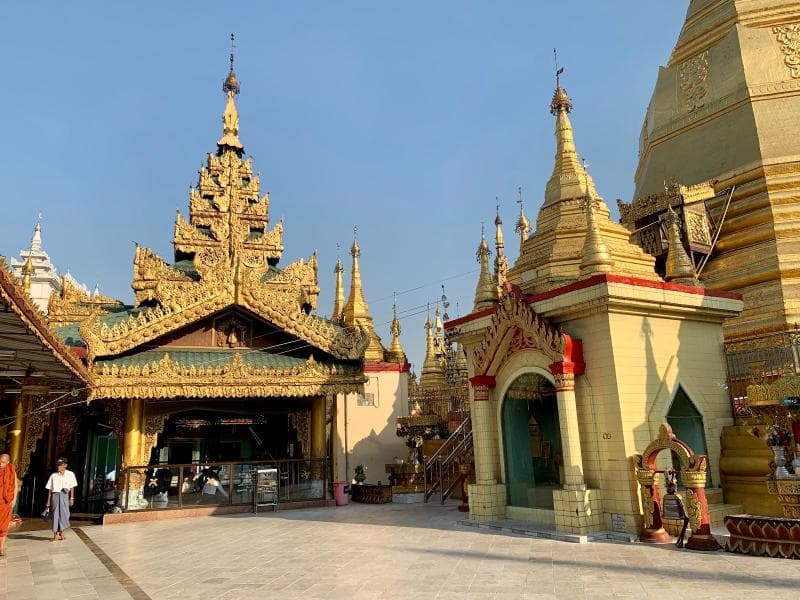
Explore the ancient shrines of Sule Pagoda in Yangon, Myanmar. Discover its rich history, unique astrology-linked deities, and cultural significance.
Overview
At the bustling heart of Yangon, Myanmar, the majestic Sule Pagoda stands as an ancient beacon of spirituality and a pivotal city landmark. More than just a golden stupa, this venerable site, believed to be over 2,000 to 2,600 years old, serves as a vital spiritual and social nexus. Its striking octagonal form, ascending gracefully to a golden spire, marks the very center from which the city's grid-patterned streets radiate. Encircling the central pagoda is a captivating array of smaller shrines, each imbued with deep cultural and religious significance. These shrines are dedicated to various deities and are uniquely linked to specific days of the week and their corresponding astrological signs, offering a profound glimpse into local Buddhist practices. The entire complex is a vibrant testament to Myanmar's enduring Buddhist heritage, inviting visitors into a realm where ancient legends and daily devotion converge.
History & Cultural Background
The origins of Sule Pagoda are steeped in myth and history, predating even the renowned Shwedagon Pagoda, according to Burmese legend. Tradition holds that the site was once home to a powerful spirit, the Sule Nat named Sularata, who played a crucial role in revealing the location for the Shwedagon Pagoda's construction. The pagoda's name itself is thought to derive from 'su-way,' meaning 'gather around' or 'meeting,' referencing this ancient assembly. Its architecture, a distinctive Mon-style chedi, evolved from original Indian stupa designs, incorporating unique Burmese forms over centuries. Significant renovations, including those overseen by Queen Shin Sawbu in the 15th century, have shaped its current appearance. Beyond its spiritual role, Sule Pagoda has etched its presence into Myanmar's political narrative, serving as a powerful rallying point during pivotal moments such as the 1988 uprisings and the 2007 Saffron Revolution. This dual significance as both a sacred relic-holder, believed to enshrine a strand of the Buddha's hair, and a symbol of national resilience, makes it a profound cultural landmark.
What Makes It Special
What truly sets the shrines of Sule Pagoda apart is their intimate connection to daily life and belief. The pagoda's unique octagonal shape, which maintains its form right up to its golden spire, distinguishes it from many other pagodas in Myanmar. Surrounding this central stupa are eight dedicated shrines, each embodying a specific day of the week, with Wednesday uniquely split into two. This arrangement provides a personal spiritual anchor for devotees, who visit the shrine corresponding to their birth day to offer prayers and perform rituals, such as gently pouring water over the Buddha image. This practice is not merely ceremonial; it is a deeply personal act of seeking blessings and good fortune. Furthermore, the presence of a sacred hair relic of Gautama Buddha within the main pagoda elevates its spiritual status, drawing pilgrims seeking profound veneration. The blend of ancient legends, intricate Mon-style design, and its symbolic role as the historical and contemporary heart of Yangon, established even by British colonial urban planning, solidifies its special place in the nation's spiritual and cultural landscape.
Stories, Fun Facts & Local Details
One of the most captivating tales associated with the Sule Pagoda's shrines involves the Sule Nat, Sularata. Legend recounts that this ancient spirit was so old, his eyelids had to be propped open with trees, and he possessed the unique knowledge of the precise location of relics from past Buddhas. He guided King Okkalapa in finding the sacred spot for the construction of the Shwedagon Pagoda, tying Sule Pagoda directly to the foundation of Myanmar's most revered shrine. Another fascinating aspect is the distinct astrological connection of the peripheral shrines. Each shrine around the main stupa is not only associated with a day of the week but also with a specific planetary post and animal from the Burmese zodiac, like the tiger for Monday or the elephant for Wednesday. This allows for highly personalized rituals, as locals make offerings and pour water at their respective birth-day shrines for health, success, and divine guidance. Ten bronze bells of varying sizes, often inscribed with donors' names, punctuate the complex, their soft chimes adding to the meditative atmosphere. The area immediately surrounding the pagoda is a bustling hub, where astrologists and palmists offer insights, and various merchants cater to the spiritual needs of pilgrims, creating a vibrant tapestry of local life.
Visitor Perspective
For those visiting the shrines within Sule Pagoda, the experience is an immersive journey into Myanmar's spiritual heart. Approaching the pagoda, the constant tinkling of small bronze bells harmonizes with the city's pulse, while the air often carries the sweet scent of jasmine and the subtle aroma of burning candles from the sheltered shrines. Visitors are encouraged to dress modestly, ensuring shoulders and knees are covered, and to remove their shoes before entering the sacred precincts as a sign of respect. Walking barefoot on the sun-warmed marble tiles is a grounding sensation, connecting one directly to the ritualistic environment. Inside, the atmosphere is one of serene devotion, with locals engaged in prayers and making offerings of food or flowers (dana) at the many smaller shrines. Observing them pour water over the Buddha images corresponding to their birth day offers a unique insight into a cherished local tradition. The pagoda is a 'human center of worship,' less touristy than some other sites, providing an authentic glimpse into everyday Burmese Buddhist practice. The early morning or late afternoon hours are ideal for a visit, offering cooler temperatures and fewer crowds, allowing for a more reflective experience. From the outer platform, one can gain a panoramic 360-degree view of downtown Yangon, truly appreciating how this ancient pagoda physically and spiritually anchors the sprawling city around it. A nominal entrance fee is typically required for foreign visitors, contributing to the pagoda's upkeep.
Coordinates: 96.158741, 16.774427
View on Google Maps💬 How Travelers Describe This Place
Based on community votes
Interesting
981Photogenic
617Beautiful
565Must See
157Unique
28
Traveler Stories
Discover memorable experiences shared by travelers who have visited this place.
No traveler stories yet.
Be the first traveler to share what made this place memorable.

Tour
By
Spot
Discover amazing places around the world. Your journey starts here.
Explore
© 2026 TourBySpot. All rights reserved.