Seventeen-Arch Bridge
Beijing, China
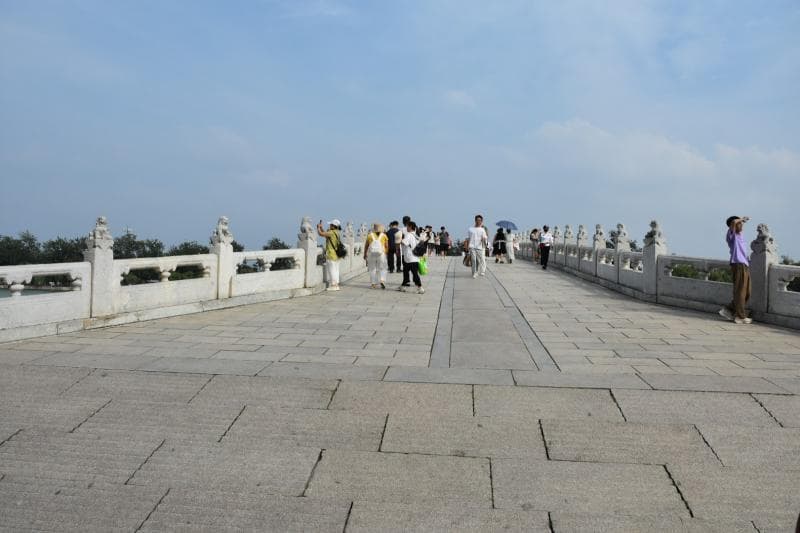
Explore Beijing's iconic Seventeen-Arch Bridge in the Summer Palace, a majestic stone bridge with 17 arches and 544 lions. Discover its history and unique Winter Solstice golden light phenomenon.
Overview
Nestled within the breathtaking landscape of the Summer Palace in Beijing, China, lies the magnificent Seventeen-Arch Bridge. This architectural marvel gracefully spans the Kunming Lake, serving as the sole connection to the enchanting Nanhu Island. As the longest multi-arched stone bridge found in China's imperial gardens, it captivates visitors with its elegant design and rich historical tapestry.
Crafted from grey-green granite and adorned with gleaming white marble balustrades, the bridge measures an impressive 150 meters in length and stands 7 meters high. Its name, the 'Seventeen-Arch Bridge', directly reflects its distinctive structure, featuring seventeen symmetrical arches. The central arch is the largest, with the others diminishing in size towards either end, creating a visually harmonious flow over the water.
More than just a pathway, this bridge is a significant landmark, offering stunning vistas of the surrounding imperial garden, a UNESCO World Heritage site known for its harmonious blend of natural and artificial features.
History & Cultural Background
The Seventeen-Arch Bridge was constructed during the Qing Dynasty, specifically under the reign of Emperor Qianlong between 1749 and 1750. Its creation was a central part of a large-scale renovation of the Summer Palace, undertaken by the emperor to commemorate his mother's sixtieth birthday, a gesture reflecting profound filial piety.
The bridge draws inspiration from the famed Marco Polo Bridge (Lugou Bridge) located in southern Beijing. Emperor Qianlong, known for his grand vision, specifically requested that the Seventeen-Arch Bridge surpass its predecessor in splendor, particularly in the number of decorative stone lions. The entire Summer Palace complex itself, originally known as Qingyi Garden (Garden of Clear Ripples), was first built in 1750. Although it suffered destruction in 1860 and was later rebuilt and renamed the Summer Palace in 1886 by the Qing government, the bridge has largely retained its original grandeur.
What Makes It Special
Beyond its sheer size and structural elegance, several elements contribute to the Seventeen-Arch Bridge's unique allure. Its design with seventeen arches is intentional; counting from the center, there are nine arches on each side. In ancient China, the number nine held immense imperial significance, reserved exclusively for emperors and symbolizing prestige and power.
The bridge's balustrades are a masterpiece of stone carving, featuring 544 intricately sculpted stone lions. Each lion possesses a distinct posture and expression, making a stroll across the bridge a delightful discovery as visitors try to spot the variations among them. At each end of the bridge, two mythical stone creatures, known as 'Watchful Roarers', stand guard, believed to be sons of dragons. They symbolize protection over Kunming Lake and are considered auspicious, warding off evil spirits.
Moreover, the bridge acts as a symbolic 'rainbow' connecting the mainland to Nanhu Island, which itself represents the legendary Isle of the Immortals in traditional Chinese mythology. Viewed from a distance, the island combined with the bridge is said to resemble a tortoise stretching its neck, a powerful symbol of longevity in Chinese culture, which perfectly aligned with Emperor Qianlong's purpose of honoring his mother.
Stories, Fun Facts & Local Details
One fascinating legend surrounds the final keystone of the central arch, known as the 'Dragon Gate Stone'. As construction neared completion, this crucial stone mysteriously wouldn't fit, a development that caused great concern and was seen as an ominous sign. Legend has it that an elderly man appeared, selling a strangely shaped stone that, upon being placed, perfectly locked the arch, ensuring the bridge's stability and appeasing fears of divine displeasure.
A truly spectacular phenomenon occurs annually around the Winter Solstice (mid-December to early January). During this period, as the sun sets, its rays align perfectly to shine directly through all seventeen arches of the bridge, creating a breathtaking 'Golden Light Through the Holes' spectacle. This magical display bathes the arches and Kunming Lake in a warm, golden glow, attracting numerous photographers and visitors who gather between 3:30 PM and 4:30 PM to witness this ephemeral beauty.
Visitor Perspective
For any traveler to the Summer Palace, the Seventeen-Arch Bridge is an unmissable highlight. Walking across its impressive length allows for close examination of the hundreds of unique stone lions, each a small work of art. The gentle curve of the bridge offers panoramic views of Kunming Lake, Longevity Hill, and the surrounding imperial garden. It provides a sense of connection to the imperial past, imagining emperors and empresses crossing this very path.
The bridge serves not only as a functional crossing to Nanhu Island, where structures like the Dragon King Temple and Hanxu Hall reside, but also as a prime location for photography, especially during sunrise or sunset. Experiencing the Summer Solstice 'Golden Light' event is a rare treat, offering a unique glimpse into the sophisticated architectural foresight of its builders. The bridge embodies the rich aesthetic and wisdom of ancient Chinese design, making it a profound and memorable experience for any curious traveler.
Coordinates: 116.26593, 39.99018
View on Google Maps💬 How Travelers Describe This Place
Based on community votes
Interesting
953Beautiful
695Photogenic
658Must See
396Unique
22
Traveler Stories
Discover memorable experiences shared by travelers who have visited this place.
No traveler stories yet.
Be the first traveler to share what made this place memorable.

Tour
By
Spot
Discover amazing places around the world. Your journey starts here.
Explore
© 2026 TourBySpot. All rights reserved.