Secret Annex
Amsterdam, Netherlands
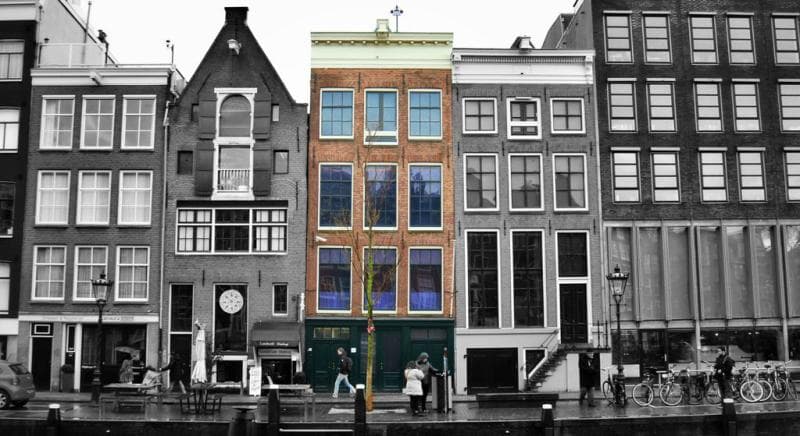
Explore Amsterdam's Secret Annex, the hidden hiding place of Anne Frank during WWII. Delve into history and personal stories at this poignant museum.
Overview
Nestled discreetly behind a canal-side house in Amsterdam, the Secret Annex, known in Dutch as 'Het Achterhuis,' stands as a profoundly moving testament to human resilience and the harrowing realities of the Holocaust. This hidden living space, located within the Anne Frank House museum, served as the sanctuary for Anne Frank, her family, and four other Jewish individuals for over two years during World War II, as they sought to evade Nazi persecution. Today, it is one of the most poignant historical sites in the Netherlands, drawing millions of visitors annually to connect with Anne's story and the broader history of the Holocaust.
The Anne Frank House, encompassing both the front house and the Secret Annex, preserves the austere environment where Anne penned her world-renowned diary. The museum's primary mission is to inform the public and educate future generations about the dangers of antisemitism, racism, and discrimination, inspired by Anne's life and legacy.
History & Cultural Background
The building at Prinsengracht 263, originally constructed in 1635 as a private home adjacent to warehouses, became Otto Frank's business premises for his pectin-trading company, Opekta, in 1940. As the Nazi occupation of the Netherlands intensified and the persecution of Jewish people escalated, the Frank family made the desperate decision to go into hiding.
In July 1942, Anne Frank, her parents Otto and Edith, and older sister Margot, moved into the concealed annex. They were soon joined by Hermann and Auguste van Pels, their son Peter, and later by dentist Fritz Pfeffer, bringing the total to eight people living in the cramped quarters. The entrance to their hiding place was ingeniously disguised behind a movable bookcase, making it imperceptible to those unaware. For 761 days, these eight individuals relied on the bravery and unwavering support of Otto Frank's employees, who risked their own lives to provide food, supplies, and news from the outside world.
Tragically, on August 4, 1944, the Secret Annex was raided following a betrayal, and all eight occupants were arrested and deported to concentration camps. Otto Frank was the sole survivor. After the war, he returned to Amsterdam and, with the help of Miep Gies who had salvaged Anne's diary, dedicated his life to publishing Anne's writings and preserving the hiding place.
What Makes It Special
What makes the Secret Annex profoundly special is its stark authenticity. Unlike many historical reconstructions, the rooms within the Annex remain largely unfurnished, a deliberate choice made by Otto Frank to emphasize the emptiness left by the Holocaust and to allow visitors to reflect on the lives forcibly taken. This absence of personal belongings, combined with the dim lighting and confined spaces, creates an incredibly powerful and immersive experience.
The revolving bookcase, still in place, serves as a tangible portal between the ordinary world of the office workers and the secret world of those in hiding, symbolizing the fragility and desperation of their existence. Visiting the Secret Annex allows one to physically walk through the spaces Anne Frank described in such vivid detail, offering a visceral connection to her words and the immense courage required to live in constant fear.
Stories, Fun Facts & Local Details
- Daily Life in Hiding: Life in the Secret Annex was governed by strict routines to avoid detection. During office hours, the occupants had to remain silent, often walking in socks, and could not flush toilets or run water. Anne shared a small bedroom with dentist Fritz Pfeffer, decorating her walls with pictures of Hollywood stars, a testament to her enduring teenage spirit amidst immense hardship.
- The Helpers' Courage: The four main helpers – Miep Gies, Bep Voskuijl, Victor Kugler, and Johannes Kleiman – demonstrated extraordinary courage, risking their lives daily to bring food, news, and comfort to those in hiding. Miep Gies famously preserved Anne's diary after the arrest, returning it to Otto Frank, who ensured his daughter's voice would be heard globally.
- Preservation Efforts: After the war, the building faced potential demolition. However, public outcry and the growing global recognition of Anne's diary led to the establishment of the Anne Frank Foundation in 1957, specifically to save and preserve the house as a museum, which opened its doors in 1960.
- Anne's Legacy: Anne's diary, originally titled 'Het Achterhuis' (The Secret Annex), became an international bestseller, translated into over 70 languages. Her desire to become a writer and journalist, expressed within its pages, was posthumously fulfilled, making her story a powerful tool for education on human rights and tolerance.
Visitor Perspective
A visit to the Secret Annex is an inherently emotional and reflective experience. The limited space, steep staircases, and quiet atmosphere convey the profound challenges faced by those who lived there. Visitors often speak of the heavy silence and the palpable sense of history that permeates the unfurnished rooms, encouraging deep contemplation.
The museum guides visitors through the main house, offices, and then into the Secret Annex itself, using quotes, photographs, and original artifacts to tell the story. Due to the compact nature of the building and its immense popularity, tickets must be purchased online in advance, often selling out weeks ahead. Photography is not permitted inside the Annex, ensuring a respectful and undisturbed experience for all. While challenging for some due to its historic layout, particularly the steep stairs, the powerful message and historical significance make it an unforgettable and essential visit for anyone seeking to understand this pivotal period in history.
Coordinates: 4.88432, 52.37525
View on Google Maps💬 How Travelers Describe This Place
Based on community votes
Interesting
853Must See
667Unique
190Photogenic
93Beautiful
32
Traveler Stories
Discover memorable experiences shared by travelers who have visited this place.
No traveler stories yet.
Be the first traveler to share what made this place memorable.

Tour
By
Spot
Discover amazing places around the world. Your journey starts here.
Explore
© 2026 TourBySpot. All rights reserved.