Schönbrunn Gardens
Vienna, Austria
Explore the magnificent Schönbrunn Gardens in Vienna, Austria. Discover Baroque landscapes, historical fountains, the Gloriette, Palm House, and the world's oldest zoo.
Overview
Stepping into Schönbrunn Gardens, nestled within the majestic Schönbrunn Palace complex in Vienna, Austria, is like entering a living painting of Baroque artistry and imperial grandeur. As a UNESCO World Heritage site, these expansive gardens span approximately 160 hectares, offering a harmonious blend of meticulously manicured landscapes, impressive fountains, and historic monuments. They serve not only as a stunning backdrop to the palace but also as one of Vienna's most cherished recreational areas, welcoming millions of visitors annually. Visitors can wander through vast open spaces like the Great Parterre, discover hidden corners, and enjoy breathtaking views, particularly from the Gloriette.
History & Cultural Background
The origins of Schönbrunn stretch back to the Middle Ages when the estate was known as 'Katterburg' and primarily served as a hunting ground. The name 'Schönbrunn,' meaning 'beautiful spring,' is rooted in a legend where Emperor Matthias, in 1612, discovered a natural spring on the grounds and exclaimed, 'Ei, welch' schöner Brunn!' This discovery gave the entire estate its enduring name.
The transformation into the magnificent Baroque complex seen today largely began under Emperor Leopold I in the late 17th century, though significant development was spurred by Empress Maria Theresa and her husband, Emperor Franz I Stephan, in the mid-18th century. Maria Theresa, who received Schönbrunn as a gift, held a profound affection for the palace and its gardens, overseeing its evolution into a Rococo masterpiece and the imperial summer residence. Influenced by French Baroque garden design, Jean Trehet, a student of André Le Nôtre (who designed the gardens of Versailles), laid the formal groundwork for Schönbrunn's symmetrical layout. A significant cultural milestone was its opening to the public in 1779, transforming an imperial preserve into a beloved public space.
What Makes It Special
Schönbrunn Gardens are a treasure trove of historical and botanical wonders:
- The Great Parterre: This vast, formal garden is perhaps the most iconic part, featuring intricately patterned flowerbeds and 32 sculptures depicting mythological and allegorical figures. Its strict symmetry exemplifies Baroque garden design.
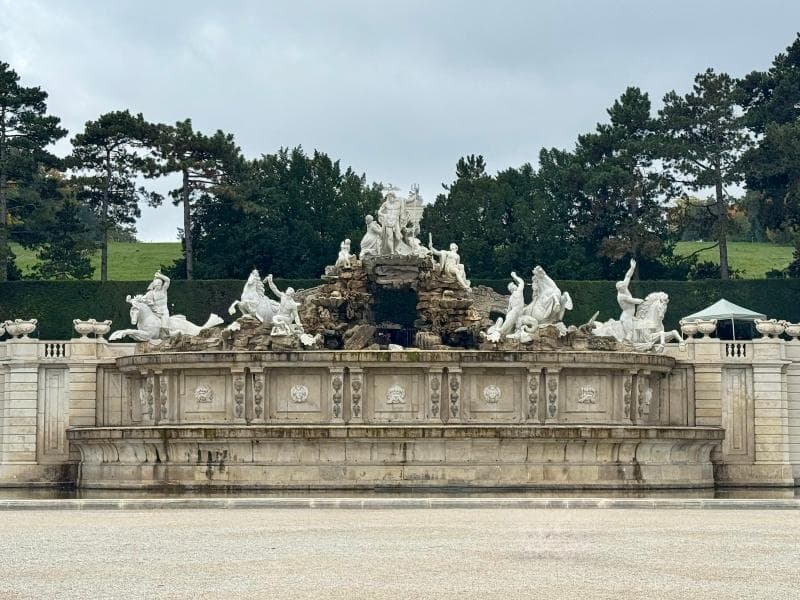
- Neptune Fountain: Completed in the 1770s, this grand fountain is a masterpiece of late-Baroque art, showcasing a mythological allegory of Neptune and his retinue, symbolizing Habsburg power.
- The Gloriette: Perched majestically on a hill overlooking the palace, the Gloriette is a triumphal arch built in 1775 to celebrate Habsburg victories. It offers unparalleled panoramic views of Vienna and the entire palace grounds. Today, it also houses a café.
- The Palm House: One of Europe's largest glasshouses, built in 1882, the Palm House shelters over 4,500 plant species from tropical, subtropical, and Mediterranean climates, blending botanical science with architectural beauty.
- Tiergarten Schönbrunn (Zoo): Founded in 1752 by Emperor Franz I Stephan, it is the oldest continuously operating zoo in the world. Originally an imperial menagerie, it now houses a diverse collection of animals, including giant pandas.
- Roman Ruin: An 18th-century 'folly' constructed in 1778, this artificial ruin reflects the era's fascination with romanticism and antiquity.
- The Maze & Labyrinth: Offering playful pathways and challenges, these hedge mazes provide an interactive and enjoyable experience for visitors of all ages.
Stories, Fun Facts & Local Details
The gardens are steeped in fascinating stories. The very name 'Schönbrunn' hails from Emperor Matthias's joyful cry upon discovering a fresh spring, 'What a beautiful spring!' Empress Maria Theresa's influence is evident throughout, as she dedicated much effort to transforming the palace and gardens into a magnificent imperial summer residence. Even the world-renowned Schönbrunn Zoo began as her husband Franz I Stephan's private menagerie, reflecting his keen interest in natural science. A young Wolfgang Amadeus Mozart once performed in the palace's Hall of Mirrors, adding to the site's rich cultural tapestry. The Gloriette, while offering grand views today, was once used as an imperial dining room, showcasing the lavish lifestyle of the Habsburgs. Remarkably, despite their imperial past, much of the Schönbrunn Gardens remain freely accessible to the public, providing a vast green oasis for Viennese residents and tourists alike to stroll, jog, and relax.
Visitor Perspective
For any curious traveler, Schönbrunn Gardens offers an immersive experience, combining natural beauty with profound historical significance. Given its immense size—stretching 1.2 kilometers from east to west and one kilometer from north to south—a thorough exploration requires ample time. Many visitors opt for an early morning visit to enjoy the tranquility and capture stunning, crowd-free photographs of the palace and its surroundings. While most of the expansive park is free to enter, specific attractions such as the Orangery Garden, Privy Garden, Maze, and the viewing terrace of the Gloriette require a separate ticket. Whether you're seeking a leisurely stroll, a historical journey, or simply a peaceful escape within a UNESCO World Heritage site, Schönbrunn Gardens provides a captivating glimpse into the grandeur of the Habsburg era.
Coordinates: 16.311865, 48.184516
View on Google Maps💬 How Travelers Describe This Place
Based on community votes
Interesting
748Unique
499Photogenic
427Must See
337Beautiful
94
Traveler Stories
Discover memorable experiences shared by travelers who have visited this place.
No traveler stories yet.
Be the first traveler to share what made this place memorable.

Tour
By
Spot
Discover amazing places around the world. Your journey starts here.
Explore
© 2026 TourBySpot. All rights reserved.