Scaenae Frons
Antalya, Turkey
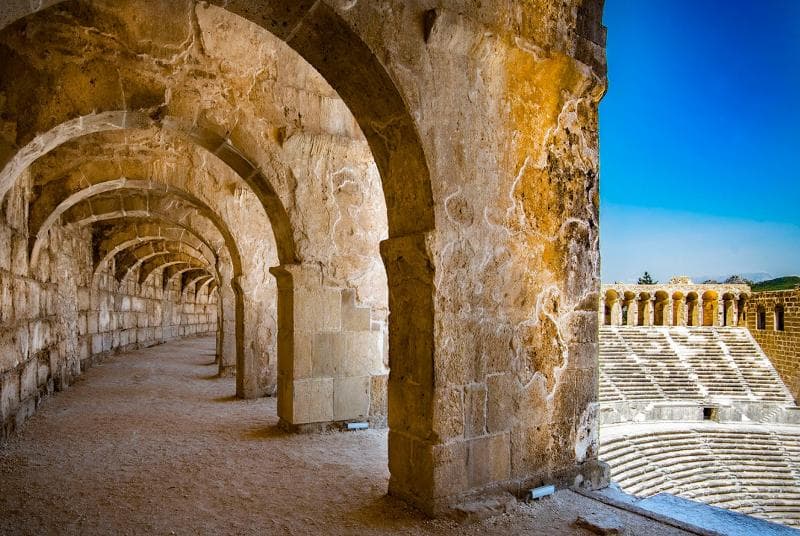

Explore the majestic Scaenae Frons of Aspendos Theatre in Antalya, Turkey. Discover Roman architectural genius, legendary acoustics, and rich history.
Overview
Nestled within the ancient city of Aspendos in Antalya, Turkey, stands one of the world's best-preserved Roman theatres, and at its heart lies the magnificent Scaenae Frons. This elaborately decorated stage building is not merely a backdrop; it is a monumental testament to Roman architectural brilliance and a window into the theatrical grandeur of antiquity. Located approximately 45 kilometers east of Antalya city center, the Aspendos Theatre, with its enduring Scaenae Frons, continues to captivate visitors with its remarkable state of preservation and legendary acoustics.
The theatre, including its impressive Scaenae Frons, was constructed during the reign of the Roman Emperor Marcus Aurelius (161-180 AD) and designed by the local Greek architect Zenon, son of Theodorus. Its survival, particularly of the stage building's full height, is exceptional, distinguishing it from many other Roman theatres where this central feature has largely crumbled. Today, the Aspendos Theatre is not just an archaeological marvel; it remains a vibrant cultural venue, hosting events such as the annual International Aspendos Opera and Ballet Festival, allowing modern audiences to experience its timeless charm.
History & Cultural Background
The ancient city of Aspendos thrived in the historical region of Pamphylia, its prosperity largely attributed to its strategic location on the Eurymedon River, which facilitated trade in goods like salt, oil, and wool. Founded perhaps by Argive colonists after the Trojan War, or even earlier by Hittites, Aspendos developed under successive rules, including Greek, Persian, and ultimately Roman.
During the Roman period, particularly in the 2nd century AD, Aspendos reached its zenith. The theatre's construction reflects the Roman Empire's emphasis on public entertainment and civic pride. The inscriptions on the theatre's walls acknowledge the Greek architect Zenon and the wealthy brothers A. Curtius Crispinus Arruntianus and A. Curtius Crispinus, who funded its construction and dedicated it to the gods and the Imperial house. What is particularly noteworthy is how the theatre, despite being built under Roman rule, incorporates many Greek architectural characteristics, such as the seating area (cavea) partly resting against a natural hillside.
The theatre's remarkable preservation owes much to its continuous use throughout history. During the Seljuk period in the 13th century, the stage building was ingeniously converted into a caravanserai, a roadside inn for travelers, and later served as a palace for Seljuk sultans. This adaptation protected the structure from decay, ensuring its survival almost fully intact for millennia.
What Makes It Special
The Scaenae Frons of Aspendos is often described as the most striking feature of the theatre, largely due to its unparalleled state of preservation. It is the permanent, elaborately decorated architectural backdrop of the stage, forming the front wall of the stage house (scaenae). Rising to an impressive height of approximately 20 meters, this two-story façade is adorned with multiple tiers of columns, intricately carved reliefs, and niches that once housed statues of gods, emperors, and heroic figures.
Traditionally, the Scaenae Frons featured three principal doorways: a grand central opening known as the porta regia (royal door) and two smaller ones, the portae hospitales (guest doors), providing access to the stage (proscenium). The sheer scale and decorative richness of this structure were designed to create a magnificent illusion of an imperial palace facade, enhancing the visual spectacle of performances. Unlike many other ancient theatres where this grand stage wall has been lost, Aspendos's Scaenae Frons stands almost entirely complete, offering an extraordinary glimpse into Roman theatrical design and engineering.
Stories, Fun Facts & Local Details
One of the most enchanting legends associated with the Aspendos Theatre revolves around its construction and the hand of a princess. The story goes that the ruler of Aspendos promised his beautiful daughter in marriage to the man who could build the most valuable structure for the city. Two architects competed: one constructed an intricate system of aqueducts to bring water to Aspendos, while the other, Zenon, built the magnificent theatre.
Initially, the ruler was swayed by the aqueducts' practical benefit. However, during a final inspection of the theatre, while standing in the uppermost rows, he clearly heard a whisper from the architect Zenon on the stage, saying, 'Your daughter must be mine!' So impressed was the ruler by the theatre's perfect acoustics that he declared Zenon the winner, and the wedding supposedly took place within the theatre itself. While likely a charming myth, this tale beautifully illustrates the theatre's legendary acoustic perfection, where even a whisper on stage can be heard distinctly by those in the highest seats, a testament to ancient engineering genius.
Another fascinating detail is the presence of 58 holes in the upper level of the theatre, which once held masts that supported a velarium, a massive awning that could be stretched over the audience to provide shade from the intense Mediterranean sun.
Visitor Perspective
Visiting the Scaenae Frons and the broader Aspendos Theatre is an immersive journey back in time. As you approach, the sheer scale of the theatre, with its towering stage building, immediately commands attention. Standing on the stage where actors once performed, and gazing up at the intricately detailed Scaenae Frons, allows one to truly appreciate the artistry and engineering of the Roman era. Exploring the seating tiers (cavea), which once accommodated an estimated 7,000 to 12,000 spectators, provides a sense of the vibrant public life that once filled this space.
The best time to visit is during spring (April to June) or autumn (September to October) when the weather is milder. Comfortable shoes are recommended, as the stone steps can be steep. Many visitors combine their trip to Aspendos with other nearby ancient sites like Perge and Side. For those lucky enough to attend a performance during the annual festival, experiencing opera or ballet in such a historically rich setting, with the famed acoustics fully at play, is an unforgettable privilege that truly brings this ancient marvel to life.
Coordinates: 31.17222, 36.93889
View on Google Maps💬 How Travelers Describe This Place
Based on community votes
Photogenic
733Interesting
642Beautiful
409Must See
363Unique
12
Traveler Stories
Discover memorable experiences shared by travelers who have visited this place.
No traveler stories yet.
Be the first traveler to share what made this place memorable.

Tour
By
Spot
Discover amazing places around the world. Your journey starts here.
Explore
© 2026 TourBySpot. All rights reserved.