Santiago Bernabéu Stadium
Madrid, Spain
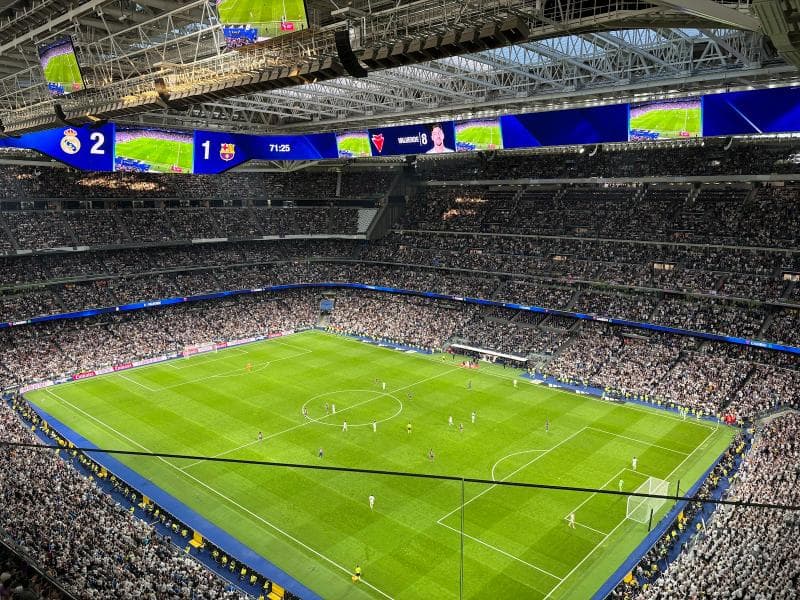
Explore Santiago Bernabéu Stadium in Madrid, Spain, the iconic home of Real Madrid. Discover its rich history, modern architecture, and visitor experience.
Overview
The Santiago Bernabéu Stadium stands as an iconic landmark in Madrid, Spain, serving as the revered home ground of Real Madrid C.F., one of the world's most successful football clubs. Located in the Chamartín district, this colossal arena is more than just a stadium; it is a global symbol of sporting excellence and a testament to architectural innovation. Its recent, ambitious renovation has transformed it into a state-of-the-art multi-purpose venue, blending its rich heritage with futuristic design and technology.
History & Cultural Background
The stadium's journey began with its inauguration on December 14, 1947, under the name 'Nuevo Estadio Chamartín'. Its creation was largely spearheaded by Santiago Bernabéu Yeste, the visionary club president, who embarked on constructing a modern stadium to match the growing ambitions of Real Madrid. Just over seven years later, on January 4, 1955, the club's general assembly voted to rename the stadium in his honor, solidifying his legacy within its very foundations.
Throughout its illustrious history, the Santiago Bernabéu has been the stage for countless unforgettable football moments. It has hosted four European Cup/UEFA Champions League finals, notably in 1957, 1969, 1980, and 2010. Furthermore, it proudly held the final matches for the 1964 European Nations' Cup and the 1982 FIFA World Cup, making it the first stadium in Europe to host both a UEFA Euro final and a FIFA World Cup final. These events have woven the stadium into the very fabric of global football culture, making it a site of pilgrimage for fans worldwide.
What Makes It Special
What truly distinguishes the Santiago Bernabéu today is its remarkable transformation into a 21st-century architectural marvel. A key feature of its new identity is the impressive retractable roof, which can be deployed in just 15 minutes, allowing events to proceed regardless of weather conditions. Complementing this is a groundbreaking retractable pitch system, which can be moved and stored beneath the stadium, enabling the venue to host a diverse array of events beyond football, such as concerts and mega-events, year-round.
The stadium's exterior boasts a sleek, continuous facade of stainless steel louvres, giving it a striking, modern appearance. Inside, the capacity stands at approximately 83,186 spectators, making it Spain's second-largest football stadium. Beyond its aesthetic appeal, the renovation has incorporated advanced technical features, including an extensive pipe system for under-soil heating to prevent the turf from freezing, ensuring optimal playing conditions. This blend of historical significance and cutting-edge technology positions the Bernabéu as a true leader among global sports arenas.
Stories, Fun Facts & Local Details
The Santiago Bernabéu holds a treasure trove of stories and intriguing details. Did you know that in May 1957, artificial floodlights were installed, making it possible for the stadium to host its first-ever nighttime game? This was a significant technological leap at the time. The stadium also played a pivotal role in Spanish football history when it hosted the 1964 European Championship final, where Spain secured its first major international trophy by defeating the Soviet Union.
In a unique turn of events, the Santiago Bernabéu became the first stadium outside South America to host the Copa Libertadores final, welcoming the second leg between River Plate and Boca Juniors in 2018. This highlights its global recognition and capability to host high-stakes international competitions. Beyond football, the stadium has welcomed major musical acts like U2, Bruce Springsteen, and The Rolling Stones, cementing its status as a premier entertainment venue in Madrid.
Visitor Perspective
For any traveler, whether a devoted football enthusiast or a curious explorer, the Santiago Bernabéu offers an unparalleled visitor experience through the 'Tour Bernabéu'. This immersive journey allows guests to delve deep into the club's glorious past and witness the stadium's spectacular transformation.
The tour typically includes panoramic views of the entire stadium, offering a breathtaking perspective of its grandeur. Visitors can explore the Real Madrid Museum, which houses an extensive collection of trophies, including the club's staggering 15 Champions League titles, alongside historical kits, boots, and memorabilia. Interactive and audiovisual displays bring to life the most iconic moments and legendary players, making history tangible. While some areas, like changing rooms and player tunnels, might have temporary restrictions during ongoing works, the core experience provides an intimate look into the heart of Real Madrid, allowing visitors to feel the passion and legacy of this extraordinary club.
Coordinates: -3.6862, 40.4517
View on Google Maps💬 How Travelers Describe This Place
Based on community votes
Interesting
953Beautiful
695Photogenic
658Must See
396Unique
22
Traveler Stories
Discover memorable experiences shared by travelers who have visited this place.
No traveler stories yet.
Be the first traveler to share what made this place memorable.
Things to see at Santiago Bernabéu Stadium



Tour
By
Spot
Discover amazing places around the world. Your journey starts here.
Explore
© 2026 TourBySpot. All rights reserved.