San Agustin Church
Manila, Philippines
Explore San Agustin Church, the oldest stone church in Intramuros, Manila, Philippines. Discover its UNESCO World Heritage Baroque architecture and rich history.
Overview
Nestled within the ancient, fortified walls of Intramuros in Manila, Philippines, stands the magnificent San Agustin Church. As the oldest stone church in the country, completed in 1607, it offers a profound journey into the rich tapestry of Philippine history and Spanish colonial heritage. Recognized as a UNESCO World Heritage Site since 1993, it is one of the distinguished 'Baroque Churches of the Philippines,' celebrated for its enduring architectural grandeur and historical significance. This enduring edifice has silently witnessed centuries of change, surviving wars and numerous earthquakes, making it a powerful symbol of resilience in the heart of the capital.
Beyond its striking facade, the church complex includes a museum housed in the former Augustinian monastery, offering visitors a deeper dive into colonial religious art, artifacts, and the rich narrative of Christianity in the Philippines. A visit to San Agustin Church is not merely a tour of an old building; it is an immersive experience into a living monument that bridges the past and present, offering clear explanations and emotional storytelling for curious travelers.
History & Cultural Background
The story of San Agustin Church is one of remarkable perseverance, beginning in 1571 with the construction of the first religious structure by the Spanish on Luzon island, made of humble bamboo and nipa. This initial church, known as Iglesia y Convento de San Pablo, was tragically destroyed by fire during the Chinese pirate Limahong's attempted invasion of Manila in 1574. A second wooden structure, built on the same site, also met a fiery end in 1583.
Determined to build a more permanent sanctuary, the Augustinian friars commenced construction of the present stone church in 1586, based on the design of Juan Macías. Built from hewn adobe stones sourced from local quarries, the church was formally completed on January 19, 1607. This robust construction proved pivotal in its survival through the centuries. It famously withstood powerful earthquakes that devastated much of Manila, including major tremors in 1863 and 1880, which left other structures in ruins. One of its bell towers was damaged in the 1880 earthquake and subsequently removed, contributing to its unique asymmetrical appearance today.
Throughout its history, San Agustin Church has been a silent witness to pivotal events. British forces looted the church during the Seven Years' War in 1762. In 1898, it was the site where the terms for the surrender of Manila by Spain to the United States were prepared. During World War II, it served as a concentration camp for American and Filipino prisoners under Japanese occupation. Remarkably, during the brutal Battle of Manila in 1945, San Agustin Church was the sole building within Intramuros to remain largely intact, even as the rest of the walled city lay in ruins around it.
What Makes It Special
San Agustin Church stands out not only for its age but also for its distinctive 'Earthquake Baroque' architectural style, a testament to its ingenious design tailored to withstand the Philippines' seismic activity. Its Neoclassical-Baroque aesthetic is evident in the intricate bas-relief carvings on its main wooden doorways, Ionic and Corinthian columns, and a majestic rose window. The church boasts a unique barrel vaulting in its central nave, a rare feature among Philippine churches.
Inside, the visual feast continues with a stunning trompe l'oeil ceiling, painted in 1875 by Italian artists Cesare Alberoni and Giovanni Dibella, creating an illusion of depth and grandeur. The choir loft features sixty-eight meticulously carved molave stalls dating back to 1606, alongside a large sculptural lectern imported from Macao in 1731. The church's durability, combined with its artistic splendor, earned it a place on the UNESCO World Heritage List, solidifying its status as an irreplaceable cultural treasure.
Stories, Fun Facts & Local Details
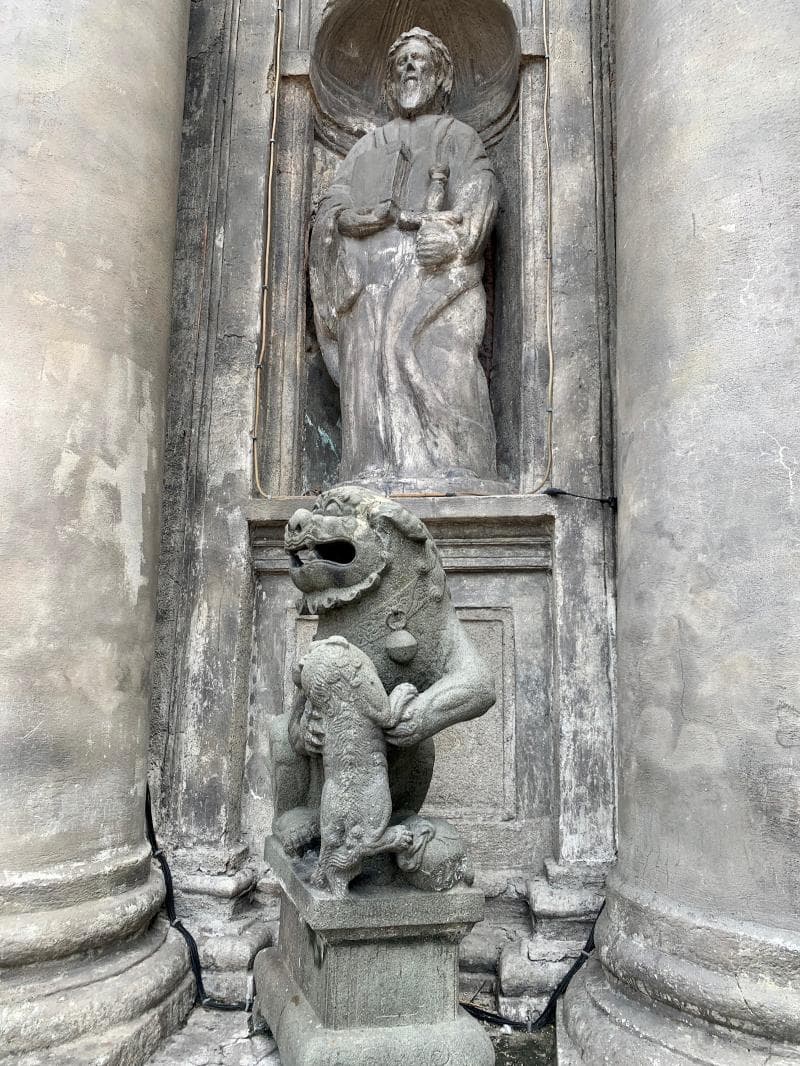
Beyond its grand history, San Agustin Church holds numerous fascinating stories and local details. It is affectionately known as the 'Wedding Capital of the Philippines,' a popular choice for couples seeking to tie the knot within its historic and hallowed walls. Visitors might notice unique Chinese 'fu' dogs guarding the courtyard, a charming detail gifted by early Chinese converts to Catholicism.
The adjoining museum, housed in the former monastery, is a treasure trove of artifacts that reflect centuries of religious and artistic evolution. Among its collections, travelers can find ecclesiastical vestments, ancient documents, colonial furniture, and an array of religious artworks. The 'Escalera Sanctificata,' or 'stairway sanctified by love,' is another notable feature, comprising 44 granite steps brought from Canton, honoring Augustinian martyrs.
The church is also the final resting place of several significant historical figures, including Miguel López de Legazpi, the founder of Manila, and other Spanish conquistadors like Juan de Salcedo and Martín de Goiti, whose remains lie in a communal vault near the main altar. These personal connections weave an even richer narrative into the historical fabric of the church.
Visitor Perspective
A visit to San Agustin Church offers a serene escape from the bustling modern city outside Intramuros' walls. As you step through its massive molave doors, adorned with Rococo carvings, you enter a sanctuary steeped in centuries of prayer and history. Take your time to appreciate the illusionary ceiling paintings, the intricately carved wooden choir stalls, and the fourteen side chapels, each with its own distinct decor. The quiet reverence found within its stone walls invites reflection and an appreciation for the enduring faith and artistry of generations past.
The museum provides a contemplative extension to the church visit, allowing for a deeper understanding of the Augustinian Order's profound impact on the Philippines and showcasing priceless antiques and religious art. Plan to spend a couple of hours exploring both the church and the museum to fully absorb the wealth of history and culture preserved here. San Agustin Church is a testament to unwavering faith and remarkable human resilience, making it a truly unforgettable destination for any traveler seeking to understand the soul of Manila.
Coordinates: 120.97528, 14.58889
View on Google Maps💬 How Travelers Describe This Place
Based on community votes
Interesting
685Unique
446Photogenic
399Must See
152Beautiful
33
Traveler Stories
Discover memorable experiences shared by travelers who have visited this place.
No traveler stories yet.
Be the first traveler to share what made this place memorable.

Tour
By
Spot
Discover amazing places around the world. Your journey starts here.
Explore
© 2026 TourBySpot. All rights reserved.