Salzburg Bull Organ
Salzburg, Austria
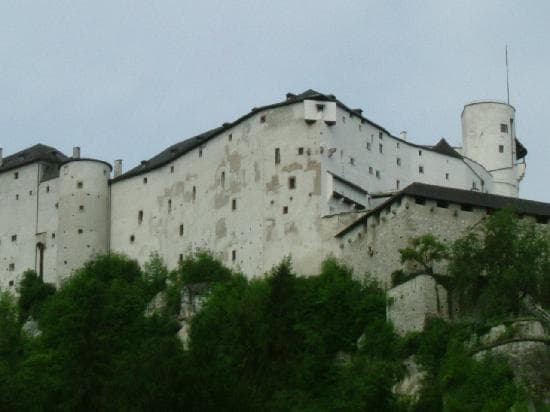
Discover the Salzburg Bull Organ, a unique 16th-century mechanical instrument in Hohensalzburg Fortress, Salzburg, Austria. Learn its history and hear its daily tunes.
Overview
Perched high above the charming city of Salzburg, Austria, within the formidable Hohensalzburg Fortress, lies a remarkable and historic musical instrument known as the Salzburg Bull Organ, or 'Salzburger Stier'. This unique mechanical organ, housed in the Krautturm (Gunpowder Tower) of the fortress, is far more than just an old instrument; it is a living piece of Salzburg's past, whose distinctive sounds have echoed across the city for centuries. Known as one of the world's last surviving late Gothic hornworks and reputedly the oldest mechanical musical instrument still played regularly, the Salzburg Bull offers a fascinating glimpse into medieval engineering and the role of sound in daily life.
Its name, 'Bull', derives from the robust, bellowing sound of its initial F major triad, which historically served as a powerful signal across the valleys and rooftops of Salzburg. Visitors to the Hohensalzburg Fortress can still experience its daily performances, which punctuate the hours and connect the present-day city with its rich, princely past.
History & Cultural Background
The origins of the Salzburg Bull Organ trace back to the early 16th century. It was commissioned in 1502 by Prince-Archbishop Leonhard von Keutschach, a key figure in the expansion and modernization of the Hohensalzburg Fortress. The instrument was originally built by Michael Rytzinger. Unlike the more elaborate pipe organs found in churches, the Salzburg Bull was designed as a 'hornwork' or aerophon, intended for practical signaling rather than purely musical performances.
In medieval times, such instruments were common in city fortifications and monasteries, serving crucial functions for the community. The Salzburg Bull's powerful sounds acted as a daily alarm, signaling to the city's residents the opening and closing of the town gates and marking the beginning and end of the workday. Initially, it played a simple F major triad at 4 AM and 7 PM. Over the centuries, the instrument underwent several restorations and modifications. Around 1640, it was supplemented with a mechanical barrel organ, and its repertoire expanded. Notable renewals include work by Rochus Egedacher in 1735, and later restorations in 1893 by Matthaeus Mauracher and in 2002 by Ferdinand Salomon, ensuring its longevity and continued voice.
What Makes It Special
The Salzburg Bull Organ stands out for several compelling reasons. Firstly, its age and remarkable preservation make it a rarity. It is hailed as one of the world's last surviving late Gothic hornworks and holds the distinction of being the oldest mechanical musical instrument that still plays regularly. This longevity is a testament to the ingenious craftsmanship of its original builders and the dedicated efforts of subsequent restorers.
Secondly, its unique sound is truly distinctive. The original F major triad was so robust and resonant that it was likened to the bellowing of a bull, thus giving the organ its memorable nickname. This raw, powerful sound was an integral part of Salzburg's soundscape for centuries, a sonic beacon from the fortress above. Today, it combines this historic sound with a rotating repertoire of twelve melodies, including pieces by renowned Salzburg court composers like Johann Ernst Eberlin and Leopold Mozart, father of Wolfgang Amadeus Mozart. This blend of historical function and evolving musicality makes every performance a journey through time.
Stories, Fun Facts & Local Details
- The 'Bull's Roar': The very nickname 'Salzburger Stier' comes from the perceived 'roaring' sound of its original F major triad (F-A-C), which loudly resonated throughout the city, embodying a strong, commanding presence.
- Daily Timekeeper: For centuries, before clocks were commonplace, the Bull Organ was Salzburg's primary timekeeper, orchestrating the rhythm of daily life for its citizens by signaling key moments like the start and end of work.
- Musical Legacy: While initially a signaling device, the organ's repertoire expanded to include works from Salzburg's rich musical heritage, connecting it directly to the city's famed composers. Hearing a piece by Leopold Mozart played on an instrument from the fortress he would have known adds a profound layer to the experience.
- Visibility and Audibility: While the instrument itself is housed within the fortress, its sounds are intended to carry far. If there's not too much ambient noise, its daily performances can be heard clearly in the city's main squares, such as Domplatz or Residenzplatz, offering a free auditory treat to those below.
Visitor Perspective
Experiencing the Salzburg Bull Organ is an integral part of any visit to the Hohensalzburg Fortress. Travelers are often captivated not just by the instrument itself, but by the story it tells of a bygone era. Standing in the fortress and listening to its melodies, one can easily imagine the bustling medieval city responding to its signals hundreds of years ago. The organ plays daily at specific times – just after 7 AM, 11 AM, and 6 PM – providing a unique opportunity to witness this ancient tradition firsthand.
The journey to the fortress itself, either via the scenic funicular railway or a walk up the Festungsberg mountain, adds to the anticipation. Once inside, alongside exploring the fortress museums, princely rooms, and enjoying panoramic views of Salzburg and the Alps, the Salzburg Bull offers a sensory connection to the past. It's a moment that transcends mere sightseeing, offering a tangible link to the cultural and historical heartbeat of this magnificent Austrian city.
Coordinates: 13.04722, 47.795
View on Google Maps💬 How Travelers Describe This Place
Based on community votes
Photogenic
950Beautiful
929Interesting
858Must See
730Unique
275
Traveler Stories
Discover memorable experiences shared by travelers who have visited this place.
No traveler stories yet.
Be the first traveler to share what made this place memorable.

Tour
By
Spot
Discover amazing places around the world. Your journey starts here.
Explore
© 2026 TourBySpot. All rights reserved.