Hohensalzburg Fortress
Salzburg, Austria
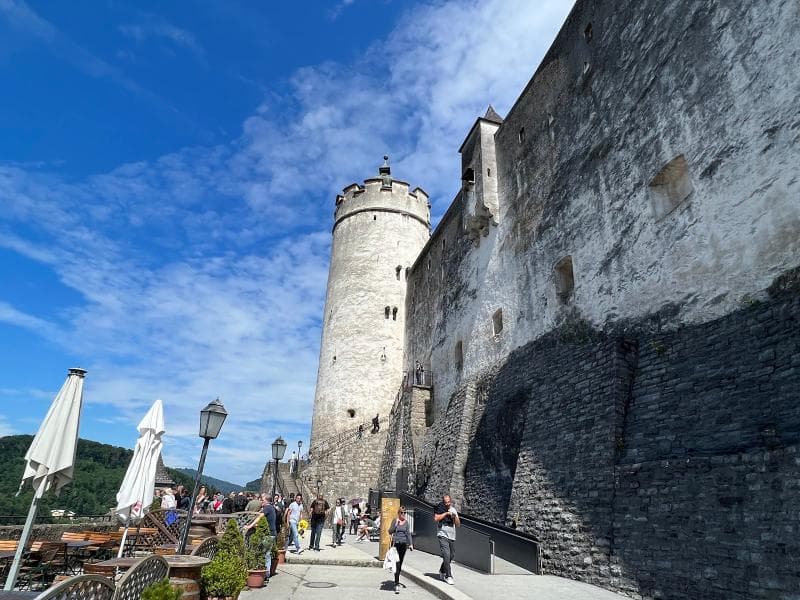
Explore Hohensalzburg Fortress in Salzburg, Austria, one of Central Europe's largest medieval castles. Discover its rich history, unique features, and panoramic views.
Overview
Perched majestically atop the Festungsberg mountain, Hohensalzburg Fortress dominates the skyline of Salzburg, Austria. This monumental medieval castle, whose name translates to 'High Salzburg Fortress', is one of the largest and most fully preserved fortresses in Central Europe. Spanning an impressive area, it measures approximately 250 meters in length and 150 meters in width, covering about 11 hectares of ridge-top complex. For over 900 years, this iconic landmark has stood as a symbol of power and protection, offering visitors a 360-degree panoramic view of the Baroque city and the surrounding Alpine landscape. It remains Salzburg's most prominent structure and a top tourist destination, attracting over a million visitors annually.
History & Cultural Background
The origins of Hohensalzburg Fortress trace back to 1077, when Archbishop Gebhard I of Helfenstein initiated its construction. This initial fortification served as a strategic refuge during the intense Investiture Controversy, a significant dispute between Pope Gregory VII and Holy Roman Emperor Henry IV, in which Gebhard sided with the Pope. The early structure was a more modest keep, designed to provide a defensible retreat. Over the ensuing centuries, successive prince-archbishops continuously expanded and strengthened the fortress. A major period of construction occurred around 1500 under Archbishop Leonhard von Keutschach, who gave the fortress much of its present-day appearance. His extensive building activities included extending the 'Hohe Stock' as a Pallas in 1501, creating cisterns, and raising existing towers. The primary aim of the fortress was to protect the archbishops and the principality from external threats. Remarkably, throughout its long history, Hohensalzburg Fortress was never captured by foreign troops in battle. While it was surrendered to French troops during the Napoleonic Wars in 1800 and later used as a military outpost, barracks, and even a prison during World War I, its walls were never breached by force.
What Makes It Special
Hohensalzburg's enduring appeal lies in its unparalleled preservation and its rich architectural layers. As the largest fully preserved medieval fortress in Central Europe, it offers an authentic glimpse into centuries of history. Within its walls, visitors can explore the magnificent Gothic Prince's Rooms, consisting of the Golden Hall, the Golden Chamber, and a bedroom. These rooms are exceptional examples of Gothic secular architecture, with their furnishings largely unchanged since 1501/1502. The Golden Hall, once a venue for opulent feasts, boasts a star-vaulted gilded ceiling with hundreds of golden spheres on a deep blue background, resembling a night sky. The Golden Chamber features breathtaking Gothic wood carvings. Another distinctive feature is the Festungsbahn, the funicular railway that has been conveniently transporting visitors up to the fortress since 1892, making it the oldest funicular in Austria. The fortress also hosts popular Salzburg Fortress Concerts, often featuring Mozart's works, adding a cultural dimension to its historic ambiance.
Stories, Fun Facts & Local Details
Beyond its grand history, Hohensalzburg Fortress holds several intriguing stories and unique local details. One of the most famous is the 'Salzburg Bull' (Salzburger Stier). This is not an animal, but an approximately 500-year-old mechanical organ commissioned by Archbishop Leonhard von Keutschach in 1502. It served as an 'alarm' for the city's inhabitants, playing an F major triad and the 'old chorale' at specific times. Its powerful 'roar' earned it the name 'Stier,' or 'bull,' from the locals. The organ has been restored and can still be heard playing daily at scheduled times. Visitors might also notice a turnip carved into stonework or decorating gateways throughout the fortress. This unusual symbol is the personal heraldic emblem of Archbishop Leonhard von Keutschach, underscoring his significant role in shaping the fortress's current appearance. The fortress's commanding position also offers spectacular views that inspired countless artists and travelers over the centuries.
Visitor Perspective
Visiting Hohensalzburg Fortress is an immersive journey through time. Travelers can choose to reach the fortress by foot, following a picturesque path from the Old Town, or opt for the convenient Festungsbahn funicular, which offers stunning panoramic views during the ascent. Once inside, there's a wealth of attractions to explore. The fortress houses several museums, including the Fortress Museum, which displays exhibits from the prince-archbishop's court life, ancient weaponry, and Roman coins. Other museums include the Puppet Museum and the Rainer Regiment Museum, offering journeys into different aspects of the past. The historic armory features an interactive exhibition on armor and weapons. A highlight for many is the multimedia Magic Theater on the high floor, which provides an innovative and engaging experience about the fortress's history and its rulers. Guided tours are available, including special and barrier-free options, offering deeper insights into the fortress's history and hidden corners. The panorama tour leads visitors through various areas, culminating in breathtaking views from the observation platform of the keep. Dogs on a leash are welcome in the outdoor areas, though not inside the museums.
Coordinates: 13.047, 47.795
View on Google Maps💬 How Travelers Describe This Place
Based on community votes
Must See
948Beautiful
913Photogenic
499Unique
337Interesting
94
Traveler Stories
Discover memorable experiences shared by travelers who have visited this place.
No traveler stories yet.
Be the first traveler to share what made this place memorable.
Things to see at Hohensalzburg Fortress



Tour
By
Spot
Discover amazing places around the world. Your journey starts here.
Explore
© 2026 TourBySpot. All rights reserved.