Salone Dei Cinquecento
Florence, Italy
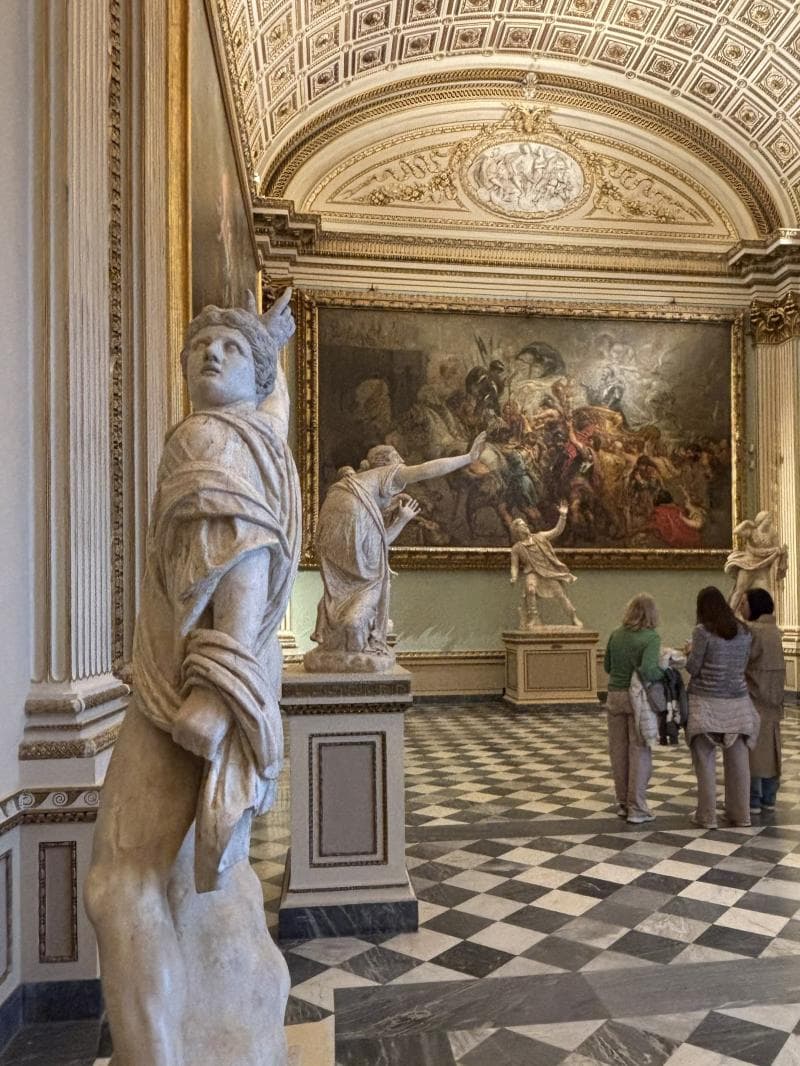
Explore Florence's Salone dei Cinquecento inside Palazzo Vecchio, a monumental hall brimming with Renaissance art and political history in Italy.
Overview
Stepping into the Salone dei Cinquecento, or the Hall of the Five Hundred, is like stepping directly into the heart of Renaissance Florence's political and artistic ambition. Located within the historic Palazzo Vecchio, this monumental chamber is not just a room, but a grand narrative in stone and fresco, reflecting centuries of Florentine power, intrigue, and artistic genius. It measures an impressive 54 meters long, 23 meters wide, and 18 meters high, making it the largest room in Italy designed for a civil power palace.
Originally conceived as a symbol of the Florentine Republic's democratic ideals, it was later transformed into a lavish testament to Medici ducal power. Visitors are immediately enveloped by its sheer scale and the overwhelming richness of its decoration, from the soaring coffered ceiling to the immense frescoes that adorn its walls, each telling a story of triumph and dominion.
History & Cultural Background
The Salone dei Cinquecento was born from a period of fervent republicanism in Florence. In 1494, after the expulsion of the Medici family, the spiritual leader Girolamo Savonarola commissioned its construction. He envisioned a space large enough to house the Grand Council (Consiglio Maggiore), comprising 500 citizens, to foster a more democratic government for the city.
Designed by Simone del Pollaiolo, the hall was initially austere, reflecting Savonarola's desire for frugality. However, the political tides of Florence were ever-changing. After the Medici's return to power, particularly under Grand Duke Cosimo I de' Medici, the hall underwent a dramatic transformation. Starting in 1540, Cosimo I enlisted the celebrated artist and architect Giorgio Vasari to enlarge and redecorate the Salone, converting it into a lavish audience chamber and throne room that would unequivocally glorify Medici rule.
This ambitious renovation saw the ceiling raised by seven meters, creating an even more imposing space. Vasari and his workshop then covered every surface with elaborate frescoes, sculptures, and gilded elements, effectively turning the hall into a magnificent canvas for Medici propaganda.
What Makes It Special
What truly sets the Salone dei Cinquecento apart is its incredible collection of Mannerist art and its historical significance. The walls are dominated by six monumental frescoes by Giorgio Vasari and his assistants, depicting key Florentine military victories over rival cities like Pisa and Siena, including the decisive Battle of Marciano. These paintings are not merely decorative; they serve as a historical chronicle and a celebration of Florentine — and specifically Medici — might.
Looking up, the magnificent coffered ceiling is a spectacle in itself, featuring 39 intricately painted panels. The central panel, 'The Apotheosis of Cosimo I', portrays the Duke being crowned by the city of Florence, surrounded by allegories of Florence's districts and Tuscany, all in submission to his power.
Among the many sculptures, Michelangelo's 'Genius of Victory', originally intended for Pope Julius II's tomb, is a standout, depicting a powerful, twisting figure towering over a defeated enemy. Its presence adds another layer of artistic mastery to an already rich environment. Sculptures of Medici family members and popes further reinforce the dynasty's influence and legacy.
Stories, Fun Facts & Local Details
Perhaps one of the most captivating stories associated with the Salone dei Cinquecento involves two of the greatest Renaissance masters: Leonardo da Vinci and Michelangelo. In the early 16th century, both artists were commissioned to paint monumental battle frescoes on opposite walls of the then-republican hall. Leonardo began work on 'The Battle of Anghiari', while Michelangelo was to paint 'The Battle of Cascina'.
Neither masterpiece was ever completed. Leonardo famously experimented with a new encaustic technique for 'The Battle of Anghiari', mixing wax into his pigments. The experiment proved disastrous, as the paint failed to dry properly and melted under heat, leaving the work unfinished and ruined. Michelangelo, on the other hand, was called to Rome by Pope Julius II to paint the Sistine Chapel, leaving his 'Battle of Cascina' as only preparatory drawings. These lost works are a poignant reminder of 'what might have been' and add an air of enduring mystery to the hall.
A modern intriguing detail, popularized by Dan Brown's novel 'Inferno', is the cryptic message 'Cerca Trova' ('Seek and Find') painted on one of Vasari's frescoes. This small inscription has fueled speculation about hidden secrets within the hall, including the possible survival of parts of Leonardo's 'Battle of Anghiari' hidden behind Vasari's later work. While scientific searches have been conducted, the mystery largely persists.
Visitor Perspective
For the traveler, a visit to the Salone dei Cinquecento is an immersive journey into Florence's glorious past. Standing amidst the colossal artworks, one can almost hear the echoes of impassioned debates of the Grand Council or imagine the solemn pronouncements of Grand Duke Cosimo I. The sheer scale and intricate detail demand time and contemplation. From the dramatic battle scenes to the allegorical figures celebrating the Medici, every corner of the hall offers a deeper understanding of the political landscape and artistic expression of the Renaissance. It's an essential experience for anyone seeking to grasp the soul of Florence.
Coordinates: 11.255968507735693, 43.7692469457203
View on Google Maps💬 How Travelers Describe This Place
Based on community votes
Photogenic
951Unique
748Beautiful
499Interesting
427Must See
94
Traveler Stories
Discover memorable experiences shared by travelers who have visited this place.
No traveler stories yet.
Be the first traveler to share what made this place memorable.

Tour
By
Spot
Discover amazing places around the world. Your journey starts here.
Explore
© 2026 TourBySpot. All rights reserved.