Royal Tombs
Vilnius, Lithuania
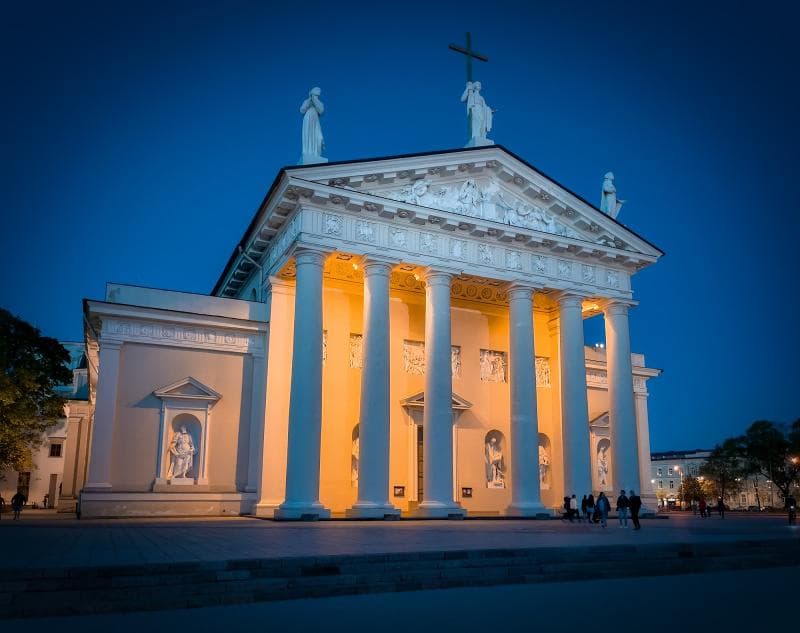
Explore the Royal Tombs beneath Vilnius Cathedral in Vilnius, Lithuania, resting place of Grand Dukes, queens, and historical figures, revealing centuries of history.
Overview
Deep beneath the majestic Vilnius Cathedral, a beacon of faith and history in Lithuania's capital, lie the enigmatic Royal Tombs, often referred to as the Cathedral's Crypts. This subterranean world is a profound historical and cultural treasure, serving as the final resting place for numerous Lithuanian Grand Dukes, Polish monarchs, and other distinguished figures from the Grand Duchy of Lithuania. It is a unique journey into the heart of a nation's past, revealing layers of archaeology, faith, and power. Visitors descend into chambers that have witnessed centuries of change, offering a tangible connection to the rulers who shaped Lithuania's destiny.
These crypts are more than just burial sites; they are a historical record carved in stone, containing not only the remains of royalty but also remnants of earlier structures, including traces of pagan altars, hinting at the site's profound spiritual significance even before Christianization. They stand as a testament to Lithuania's enduring legacy and its complex journey through history.
History & Cultural Background
The history of Vilnius Cathedral and its crypts is deeply intertwined with the very foundation of the Lithuanian state. The current neoclassical cathedral, rebuilt multiple times due to fires and unstable ground, stands on a site believed to have housed a pagan temple dedicated to the Baltic god Perkūnas before the arrival of Christianity. The earliest Christian church on this site is thought to have been built by Grand Duke Mindaugas in 1251, following his conversion to Christianity.
Over centuries, the cathedral became the spiritual and political heart of the Grand Duchy of Lithuania. It was here that Lithuanian Grand Dukes were crowned, solidifying their power and legitimacy. The crypts beneath developed into a royal mausoleum, holding the remains of pivotal figures such as Alexander Jagiellon, who was both King of Poland and Grand Duke of Lithuania. Among the most notable burials are Elisabeth of Austria and Barbara Radziwiłł, both wives of Sigismund II Augustus, King of Poland and Grand Duke of Lithuania. The heart of Władysław IV Vasa, another Polish King and Grand Duke of Lithuania, also found its resting place here, though his body is interred in Kraków.
The crypts themselves have seen periods of obscurity. During the Soviet occupation of Lithuania (1949-1988), the cathedral was used as a warehouse, and the crypts were bricked up, effectively hiding them and their invaluable contents from detection. Their rediscovery in 1984 and 1985 marked a significant moment in Lithuania's efforts to reclaim its suppressed history and identity.
What Makes It Special
What truly sets the Royal Tombs apart is their profound historical density and the sense of continuity they offer. Here, one can witness the evolution of architectural styles, from the medieval Gothic masonry that forms the earliest layers of the crypts to the neoclassical grandeur of the cathedral above.
A remarkable feature is Lithuania's oldest surviving fresco, a 14th-century depiction of the Crucifixion with St. Mary and St. John. This ancient artwork provides a rare glimpse into the early Christian art of the region and symbolizes the merging traditions of Eastern and Western Christianity.
Most recently, the discovery of royal burial regalia in December 2024 (announced in January 2025) has added another layer of intrigue. These treasures, including crowns, scepters, orbs, and rings belonging to Alexander Jagiellon, Elisabeth of Austria, and Barbara Radziwiłł, were originally unearthed in 1931 but hidden for safekeeping during World War II. Their re-emergence offers an unparalleled insight into royal funerary traditions and the opulence of the Polish-Lithuanian Commonwealth.
Stories, Fun Facts & Local Details
The crypts hold many fascinating stories. One of the most poignant is the ongoing quest for the remains of Vytautas the Great, a revered Grand Duke of Lithuania. Despite efforts in 1930 to locate and transfer his remains to a newly crafted sarcophagus, his final resting place remains a mystery, and an empty sarcophagus stands in his honor.
Another captivating tale surrounds Barbara Radziwiłł, whose tragic romance with Sigismund II Augustus is one of Lithuania's most celebrated love stories. Her burial regalia, recently rediscovered, speaks volumes about her enduring legacy and the deep affection she inspired.
The act of visiting the crypts can also be seen as a form of cultural reclamation. For many Lithuanians, exploring these hidden chambers helps to piece together a national narrative that was fragmented during decades of Soviet rule. The preservation and presentation of these historical elements contribute significantly to the country's national identity.
Visitor Perspective
A visit to the Royal Tombs beneath Vilnius Cathedral offers a unique, contemplative experience. Access to the crypts is primarily via guided tours, which are highly recommended for a full appreciation of their historical and cultural significance. These tours, often available in English, provide in-depth narratives about the individuals buried there, the archaeological discoveries, and the broader context of Lithuanian history.
Entering this subterranean world feels like stepping back in time. The cool, quiet atmosphere, combined with the visible layers of history on the walls and the ancient burial sites, evokes a powerful sense of solemnity and wonder. It's an opportunity to connect with the past on a deeply personal level, far removed from the bustling city streets above. The starting point for these tours and the ticket office are typically located in the cathedral's Bell Tower.
Coordinates: 25.286, 54.6848
View on Google Maps💬 How Travelers Describe This Place
Based on community votes
Must See
886Beautiful
564Unique
201Interesting
121Photogenic
87
Traveler Stories
Discover memorable experiences shared by travelers who have visited this place.
No traveler stories yet.
Be the first traveler to share what made this place memorable.

Tour
By
Spot
Discover amazing places around the world. Your journey starts here.
Explore
© 2026 TourBySpot. All rights reserved.