Royal Post Office
Madrid, Spain
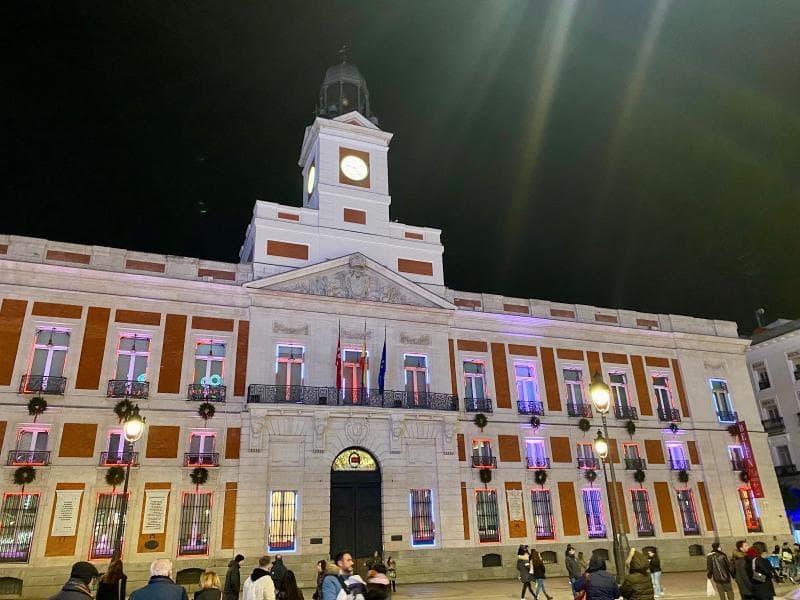
Discover Madrid's Royal Post Office (Casa de Correos) in Puerta del Sol, Spain. Explore its rich history, iconic clock, Kilometre Zero, and New Year's Eve traditions.
Overview
At the bustling heart of Madrid, within the iconic Puerta del Sol, stands the magnificent Real Casa de Correos, or Royal Post Office. This eighteenth-century architectural gem, with its distinctive red brick and white stone facade, is far more than just a historical building; it is a living symbol of Spain's capital. Today, it serves as the official seat of the Presidency of the Community of Madrid, the regional government, yet its legacy as the city's central post office endures. Most famously, its clock tower dictates the rhythm of New Year's Eve for millions across Spain, and right at its foot lies Kilometre Zero, the symbolic starting point for all of Spain's major radial roads.
Visitors to Puerta del Sol are immediately drawn to this grand structure, whose elegant lines and significant clock dominate the southern side of the semi-circular square. While its administrative functions continue behind its historic walls, the Royal Post Office remains a focal point for both daily Madrid life and profound national traditions, inviting curious travelers to delve into its layered past and vibrant present.
History & Cultural Background
The story of the Royal Post Office begins in the mid-18th century, a period of significant urban development in Madrid. King Ferdinand VI initially commissioned Spanish architect Ventura Rodríguez for the project, but political shifts led King Charles III to entrust the design to the French architect Jacques Marquet. Construction commenced around 1766 and concluded in 1768, transforming a collection of smaller houses into this imposing edifice, initially intended as the city's main post office.
Over the centuries, the building has borne witness to pivotal moments in Spanish history. Its strategic location made it a silent observer, and sometimes an active participant, in events that shaped the nation. Notably, its walls saw the dramatic 2nd of May uprising in 1808 against Napoleonic forces, a date etched into Madrid's memory. Later, in the 20th century, its balcony became a platform for political change, including the proclamation of the Second Republic in 1931. During the Franco regime, it housed the Ministry of Interior and State Security, with its basement gaining a dark reputation as a place where political dissidents were reportedly subjected to torture.
What Makes It Special
Beyond its grand facade, several elements make the Royal Post Office truly special. Foremost among these is its celebrated clock, installed in 1866 as a gift from clockmaker Losada and inaugurated by Queen Isabel II. This clock is not merely a timepiece; it is the official timekeeper for Spain's most cherished New Year's Eve tradition. Every December 31st, its chimes are broadcast live across the country, signaling the moment for Spaniards to eat twelve lucky grapes, one with each strike, to ensure prosperity in the coming year.
Equally significant is the small, unassuming plaque embedded in the pavement directly in front of the building's main entrance: Kilometre Zero. This seemingly simple marker is the precise geographical point from which all distances on Spain's national radial road network are measured. It means that whether you are traveling to Barcelona, Valencia, or Seville, your journey officially begins or ends here. It also dictates street numbering in Madrid itself, with lower numbers closer to this central point.
Stories, Fun Facts & Local Details
The Royal Post Office is steeped in anecdotes that bring its history to life. The tradition of eating twelve grapes on New Year's Eve, for instance, is said to have gained widespread popularity after 1909, when vine growers in Alicante, facing a surplus grape harvest, cleverly promoted the custom as a way to bring good fortune. Today, gathering in Puerta del Sol to partake in this tradition, often dressed in silly hats and armed with bottles of Cava, is an unforgettable experience.
Another fascinating detail is the architectural competition that almost saw a different design for the building. Ventura Rodríguez's initial plans were set aside in favor of Marquet's vision, a decision that caused some controversy at the time. Marquet's design, with its elegant Baroque style (though sometimes classified as Neoclassical due to its classical elements), featured a combination of brick and stone, a common Madrid aesthetic. The building's original design included specific considerations for its postal function, such as robust interior courtyards for handling mail.
Visitor Perspective
For visitors to Madrid, the Royal Post Office is an essential stop, not just for its beauty but for its profound connection to Spanish culture. Standing in Puerta del Sol, one can almost feel the echoes of centuries of history. While the building's interior is generally not open for public tours, its exterior offers a wealth of photographic opportunities and serves as a backdrop to the square's vibrant atmosphere. Observing the precise marker of Kilometre Zero is a moment of reflection on Spain's interconnectedness, and imagining the New Year's Eve celebrations adds a layer of festive anticipation to any visit.
The Royal Post Office is a place where history intertwines with everyday life, where national traditions are born and sustained, and where the heart of a nation beats visibly. It invites you to pause, soak in the historical significance, and appreciate its role as a silent guardian of Madrid's identity, making it a truly meaningful destination for any curious traveler.
Coordinates: -3.7022, 40.4168
View on Google Maps💬 How Travelers Describe This Place
Based on community votes
Unique
953Must See
695Interesting
658Photogenic
69Beautiful
22
Traveler Stories
Discover memorable experiences shared by travelers who have visited this place.
No traveler stories yet.
Be the first traveler to share what made this place memorable.

Tour
By
Spot
Discover amazing places around the world. Your journey starts here.
Explore
© 2026 TourBySpot. All rights reserved.