Roundabout Area
Phnom Penh, Cambodia
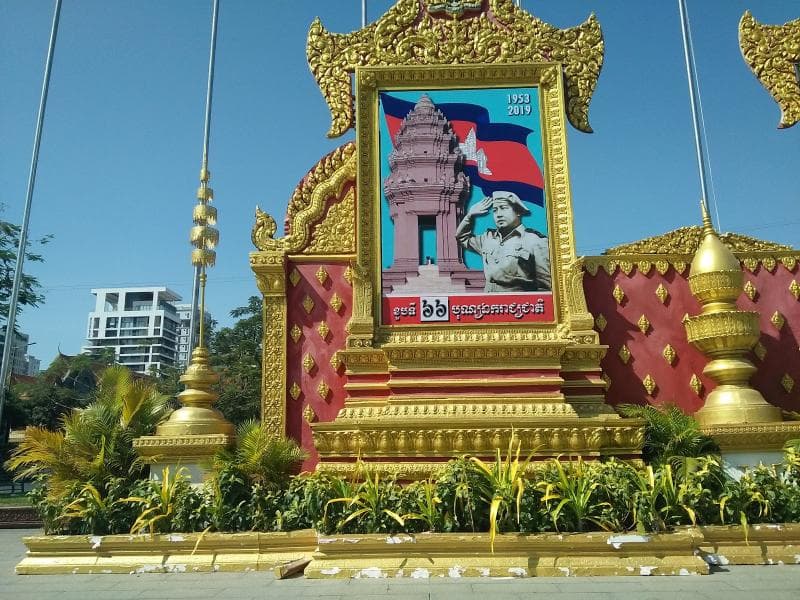
Explore Phnom Penh's iconic Independence Monument, a lotus-shaped stupa symbolizing Cambodia's freedom and resilience. Discover its history, architecture, and cultural significance in the heart of the city.
Overview
The Roundabout Area surrounding the Independence Monument in Phnom Penh, Cambodia, serves as a deeply symbolic and visually striking landmark at the heart of the city. Situated prominently at the intersection of Norodom Boulevard and Sihanouk Boulevard, this imposing structure commemorates Cambodia's hard-won independence from French colonial rule in 1953 and stands as a poignant memorial to the nation's war dead. Its distinctive lotus-shaped stupa design, soaring 37 meters into the sky, is a masterpiece of modern Khmer architecture, blending ancient artistic traditions with a forward-looking vision. The monument acts not only as a historical marker but also as a vibrant hub where national celebrations come alive, especially during significant holidays like Independence Day.
History & Cultural Background
Conceived in the mid-20th century, the Independence Monument was constructed in 1958 and officially inaugurated on November 9, 1962, marking a crucial period in Cambodia's post-colonial era. Its creation was a direct result of Cambodia's liberation from nearly a century of French dominion, a struggle spearheaded by King Norodom Sihanouk. The monument's design was entrusted to the visionary Cambodian architect Vann Molyvann, who was personally selected and guided by Prince Norodom Sihanouk. Molyvann, a proponent of 'New Khmer Architecture,' skillfully integrated traditional Khmer aesthetics, drawing inspiration from iconic Angkorian temples such as Angkor Wat and Banteay Srei. The five levels of the lotus bud in its design are said to represent the five principles of the Sangkum Reastr Niyum – a political philosophy promoting neutrality, independence, peace, prosperity, and democracy – further cementing its cultural and political significance. Beyond commemorating independence, the monument also functions as a cenotaph, honoring the brave soldiers and countless casualties who sacrificed their lives throughout Cambodia's turbulent history.
What Makes It Special
The Independence Monument's unique architectural fusion of ancient Khmer grandeur and modernist sensibilities is truly what sets it apart. Its form, a lotus-shaped stupa, is adorned with intricate five-headed Naga sculptures, mythical serpent beings deeply ingrained in Cambodian iconography, symbolizing protection, freedom, and safety. The monument's red stone finish, echoing the hues of Banteay Srei temple, is complemented by steps crafted from elegant grey Chinese marble, adding to its majestic presence. A spectacular feature is its nightly illumination, where the monument glows with blue, red, and white floodlights, reflecting the vibrant colors of the Cambodian national flag. This transformation makes it a breathtaking sight after dusk, drawing both locals and visitors. More than just a static structure, the monument becomes the focal point for national pride and collective memory during Cambodia's annual Independence Day celebrations on November 9th and Constitution Day on September 24th, serving as a powerful symbol of the nation's enduring spirit and resilience.
Stories, Fun Facts & Local Details
During national holidays, the Roundabout Area around the Independence Monument buzzes with activity. A poignant ceremony involves a member of the royal family or a high-ranking official lighting a ceremonial flame on an interior pedestal, a powerful act symbolizing the continuity of Cambodia's independence. Floral tributes are often placed on the monument's stairs, honoring war heroes and reflecting the deep reverence the Cambodian people hold for their past. While visitors cannot enter the monument itself, the surrounding park-like area provides a serene space for locals to relax, jog, or simply enjoy the cool breezes, making it a popular spot for community gatherings. A fun detail, particularly noticed by some, is the informal tradition of locals and tourists tying colorful ribbons around the monument's base, a gesture often associated with good luck and blessings. The monument's impressive height of 37 meters (or 121 feet) ensures it is a visible landmark from many points across the city, contributing to its iconic status.
Visitor Perspective
For a curious traveler, the Independence Monument offers a profound insight into Cambodia's national identity and resilience. As an open public space, there is no entrance fee, making it an accessible historical site for everyone. While impressive during the day, many agree that the monument is most captivating in the late afternoon or evening when its intricate designs are highlighted by the setting sun and, subsequently, when it is illuminated by the national colors. This provides excellent photo opportunities and a truly memorable experience. Visitors are encouraged to wear comfortable shoes if they wish to explore the surrounding park areas and to dress modestly, reflecting respect for this significant cultural site. The Independence Monument's central location also makes it an ideal starting point for exploring other key landmarks in Phnom Penh, such as the Royal Palace, Wat Phnom, and Sisowath Quay, all within a short distance. Witnessing the blend of ancient architectural influences with modern purpose, and observing the reverence it commands, provides a meaningful connection to the Cambodian spirit.
Coordinates: 104.9281, 11.5564
View on Google Maps💬 How Travelers Describe This Place
Based on community votes
Photogenic
698Must See
476Beautiful
465Unique
276Interesting
126
Traveler Stories
Discover memorable experiences shared by travelers who have visited this place.
No traveler stories yet.
Be the first traveler to share what made this place memorable.

Tour
By
Spot
Discover amazing places around the world. Your journey starts here.
Explore
© 2026 TourBySpot. All rights reserved.