Rotunda
San Francisco, United States
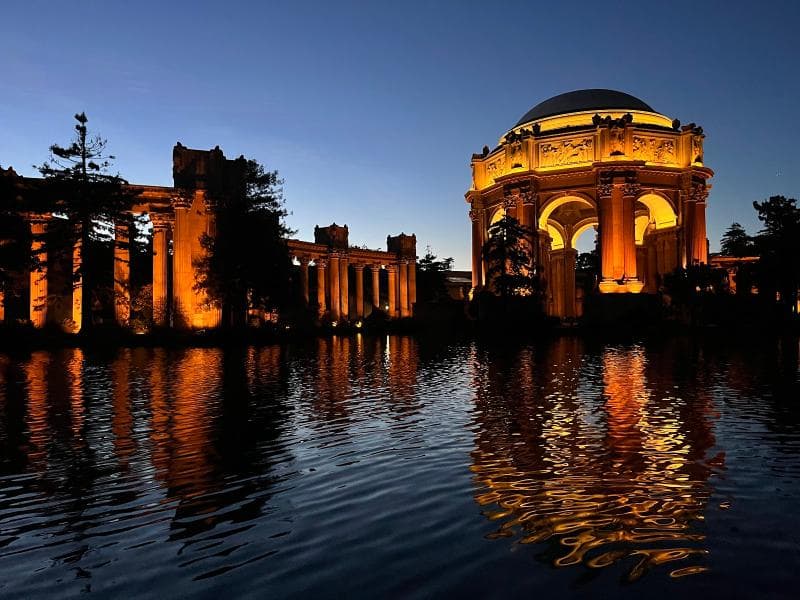
Explore the Rotunda at the Palace of Fine Arts, San Francisco, United States. Discover its rich history, unique Roman-inspired architecture, and serene lagoon, a must-see landmark.
Overview
Nestled within the vibrant Marina District of San Francisco, United States, the Rotunda of the Palace of Fine Arts stands as a breathtaking architectural marvel. This iconic structure, a prominent feature of the larger Palace of Fine Arts complex, immediately transports visitors to a bygone era with its classical Greco-Roman design. Conceived originally as a temporary exhibition hall for the 1915 Panama-Pacific International Exposition, the Rotunda has defied its fleeting intended purpose to become one of the city's most beloved and enduring landmarks.
The Rotunda itself is a majestic, open-air dome, towering approximately 162 feet high, encircled by sweeping colonnades and reflected serenely in a picturesque lagoon. Its design, characterized by intricate detailing and a romanticized 'ruin' aesthetic, invites quiet contemplation and offers a stunning backdrop for photography and leisurely strolls. The entire complex, including the Rotunda, serves as a testament to San Francisco's resilience and its appreciation for art and beauty.
History & Cultural Background
The story of the Rotunda begins with the 1915 Panama-Pacific International Exposition (PPIE), a grand world's fair hosted by San Francisco to celebrate the opening of the Panama Canal and to showcase the city's remarkable recovery from the devastating 1906 earthquake and fire. Architect Bernard Maybeck, a student of the École des Beaux-Arts, was tasked with designing a structure that would serve as a 'quiet zone' for visitors between the bustling fairgrounds and the art exhibits.
Maybeck's vision for the Palace of Fine Arts, and specifically its central Rotunda, drew heavily from classical Roman and Ancient Greek architecture. He found particular inspiration in Piranesi's etchings of the remnants of the Temple of Minerva Medica in Rome and also from Böcklin's Symbolist painting 'Isle of the Dead'. The goal was to evoke a sense of melancholy beauty, creating what was essentially a fictional ruin designed to appear as though it had gracefully decayed over centuries.
Though most structures of the PPIE were intended for demolition after the fair, the Palace of Fine Arts was so beloved that a public outcry, championed by figures like Phoebe Apperson Hearst, led to its preservation. However, its original construction used temporary, less durable materials like wood, plaster, and burlap fiber, which quickly deteriorated. By the 1950s, the simulated ruin had become a crumbling reality. From 1964 to 1974, the entire structure, including the Rotunda, was completely rebuilt using permanent, lightweight concrete and steel, faithfully restoring Maybeck's original design and ensuring its longevity.
What Makes It Special
The Rotunda's profound specialness lies in its deliberate design to mimic a gracefully decaying ancient ruin, a concept both romantic and deeply contemplative. Bernard Maybeck's architectural genius shines through in how he crafted this monumental structure to evoke a sense of timelessness and a reflection on 'the mortality of grandeur and the vanity of human wishes'. The sheer scale of the 162-foot-high domed Rotunda, combined with the elegant colonnades featuring statues of 'weeping women' with their backs turned to the structure, creates a powerful emotional impact.
Its position alongside a tranquil, artificial lagoon is another key element. The still waters provide a perfect mirror, doubling the grandeur of the Rotunda and its colonnades, creating an illusion of depth and serene beauty that is particularly striking at dawn or dusk. This harmonious blend of classical architecture and natural landscape makes the Rotunda a uniquely serene and visually captivating destination, standing as a 'slice of Europe' in the heart of San Francisco.
Stories, Fun Facts & Local Details
One of the most engaging aspects of the Rotunda is its journey from temporary spectacle to permanent icon. Initially, like many World's Fair buildings, it was destined for destruction, but its unexpected popularity earned it a reprieve. Yet, its temporary construction materials meant it genuinely began to crumble decades later, leading to its complete demolition and meticulous reconstruction. The fact that the Rotunda we see today is a meticulously rebuilt version of Maybeck's original vision, preserving its 'fictional ruin' aesthetic, adds a layer of fascinating history.
During the Great Depression, W.P.A. artists were commissioned to replace Robert Reid's decayed murals on the Rotunda's ceiling, showcasing how the structure has continually adapted and been cared for over the decades. The exhibition hall behind the Rotunda served various unexpected purposes over the years, from hosting 18 lighted tennis courts between 1934 and 1942, to being requisitioned by the military during World War II for storing trucks and jeeps. Today, it remains a favorite spot for wedding photography, reflecting the joy of new beginnings against its ancient-inspired backdrop, and has appeared in numerous films and television productions.
Visitor Perspective
Visiting the Rotunda of the Palace of Fine Arts is an experience that blends architectural appreciation with peaceful outdoor enjoyment. As a free and publicly accessible space, it welcomes all to explore its majestic grounds. Travelers often describe the feeling of stepping into a different world, away from the city's hustle and bustle, where the only sounds are often the gentle lapping of the lagoon and the calls of resident waterfowl.
The expansive promenade around the lagoon, lined with trees and offering stunning reflections of the Rotunda, is perfect for leisurely walks. Many visitors find themselves drawn to simply sit by the water, taking in the grand architectural details and the serene atmosphere. It's a popular spot for picnics, informal gatherings, and, of course, capturing memorable photographs. The interplay of light and shadow on the fluted columns and the impressive dome offers ever-changing perspectives, making each visit a unique visual delight. Whether seeking artistic inspiration, historical context, or simply a moment of tranquility, the Rotunda provides an unforgettable San Francisco experience.
Coordinates: -122.44833, 37.80278
View on Google Maps💬 How Travelers Describe This Place
Based on community votes
Photogenic
953Unique
695Beautiful
396Must See
286Interesting
22
Traveler Stories
Discover memorable experiences shared by travelers who have visited this place.
No traveler stories yet.
Be the first traveler to share what made this place memorable.

Tour
By
Spot
Discover amazing places around the world. Your journey starts here.
Explore
© 2026 TourBySpot. All rights reserved.