Rosendal Palace
Stockholm, Sweden
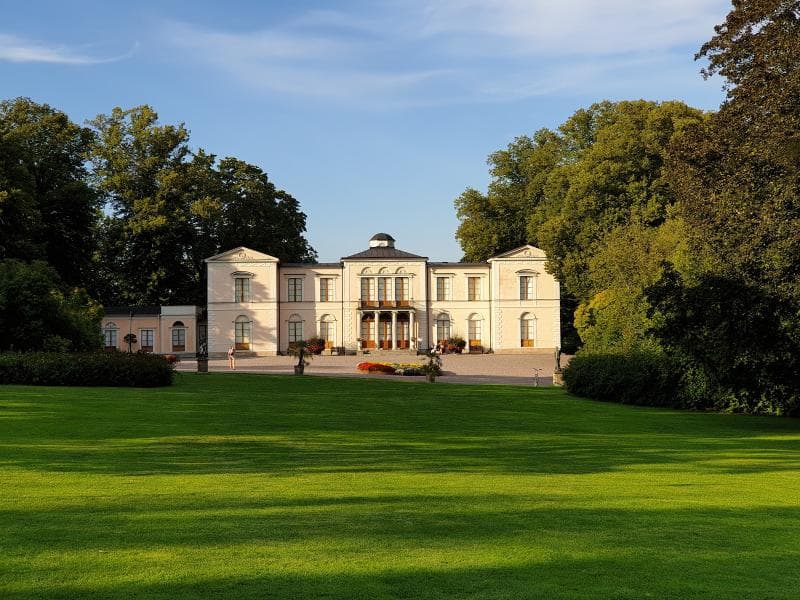
Discover Rosendal Palace, a beautifully preserved 19th-century royal retreat in Djurgården, Stockholm, Sweden. Explore its unique Karl Johan style interiors.
Overview
Nestled within the verdant landscape of Djurgården, a tranquil island in central Stockholm, Sweden, lies the exquisite Rosendal Palace. This charming palace, known in Swedish as Rosendals slott, stands as a testament to the early 19th century and offers a unique glimpse into Swedish royal history. Built as a private summer retreat rather than a formal residence, it provided King Karl XIV Johan, the first Bernadotte monarch, a respite from the strictures of court life at the Royal Palace. Today, Rosendal Palace is preserved as a museum, welcoming visitors to explore its remarkably intact interiors and serene surroundings.
Its significance stems from its role as an exceptional example of the Swedish Empire style, often referred to as the Karl Johan style. The palace's design and furnishings have been largely preserved from the time of its original owner, providing an authentic time capsule of early Bernadotte culture. Visitors can wander through the historic halls, admire period furniture, and enjoy the peaceful park, which remains open to the public year-round.
History & Cultural Background
The story of Rosendal Palace begins in the 1820s, a period marked by significant change for Sweden with the ascent of the House of Bernadotte. King Karl XIV Johan, born Jean-Baptiste Bernadotte in France, commissioned the palace's construction between 1823 and 1827. The site had an earlier structure that tragically burned down in 1819. Following this, the esteemed architect Fredrik Blom was tasked with designing the new palace, adapting initial drawings from Fredrik August Lidströmer, Stockholm's City Architect.
Rosendal was envisioned as a pleasure retreat, a place where the king could relax and escape the formalities that governed life at the Royal Palace in the city center. This informal purpose allowed for a distinct architectural and interior design approach, focusing on comfort and refined elegance over grand ceremonial spaces. The resulting Swedish Empire style, with its neoclassical influences, is beautifully showcased throughout the palace. After King Oskar II's death in 1907, his heirs decided to transform Rosendal Palace into a museum dedicated to the Karl Johan period and the life of its original royal patron. It officially opened to the public in 1913, carefully maintaining its 19th-century character.
What Makes It Special
What truly sets Rosendal Palace apart is its extraordinary preservation. Unlike many royal residences that have undergone extensive renovations over centuries, Rosendal stands largely as it did during King Karl XIV Johan's lifetime. This makes it an unparalleled 'document' of the Swedish Empire style, offering an authentic journey back to the early 1800s.
The palace's interiors feature original mahogany furniture, vibrant textiles, and unique diplomatic gifts, such as the famous Sèvres table from King Louis Philippe of France. One of its most impressive outdoor features is the monumental porphyry vase, installed in the garden in 1825. Carved from a 100-ton boulder in Älvdalen, this colossal vase, weighing over 9 tons, is a grand tribute to classical design and Swedish craftsmanship. The design itself, built largely from prefabricated sections, was considered innovative for its time, allowing for swift construction.
Stories, Fun Facts & Local Details
King Karl XIV Johan had a particular affection for Djurgården. Beyond seeking a break from courtly duties, he enjoyed being closer to the common people, as the palace's park area was accessible to the public. He also appreciated the proximity to military exercise grounds where he could oversee the mounted soldiers, reflecting his past as a French marshal.
In a more modern anecdote, Rosendal Palace continued its royal legacy by briefly serving as a home for Prince Carl Philip and Princess Sofia between 2015 and 2017. They resided there while their permanent home, Villa Solbacken, underwent renovations, linking the palace to contemporary royalty.
Beyond the palace itself, the Rosendal Gardens are a highlight. While blending historical roots with modern organic practices, they continue a tradition of horticulture that dates back to the 19th century when the estate hosted the greenhouses of the Swedish Horticultural Society. Today, these biodynamically managed gardens flourish with roses, herbs, and heirloom fruit trees.
Visitor Perspective
For the curious traveler, a visit to Rosendal Palace offers a tranquil escape and a fascinating historical immersion. Guided tours, available during the summer months (typically June to August), provide in-depth insights into the palace's royal history and architecture. Exploring the preserved rooms feels like stepping directly into the 19th century, with every detail telling a story.
While the palace itself has specific opening hours during the summer, the surrounding park and gardens are generally accessible year-round, inviting leisurely strolls amidst nature and history. Rosendal's location within Djurgården makes it easily reachable, with tram line 7 providing convenient access to the Bellmansro stop, followed by a short walk. The palace is a serene counterpoint to Stockholm's busier attractions, offering a peaceful reflection on Sweden's royal past and cultural heritage.
Coordinates: 18.118047, 59.328633
View on Google Maps💬 How Travelers Describe This Place
Based on community votes
Interesting
852Must See
326Beautiful
270Unique
146Photogenic
80
Traveler Stories
Discover memorable experiences shared by travelers who have visited this place.
No traveler stories yet.
Be the first traveler to share what made this place memorable.

Tour
By
Spot
Discover amazing places around the world. Your journey starts here.
Explore
© 2026 TourBySpot. All rights reserved.