Rooftop terraces
Milan, Italy
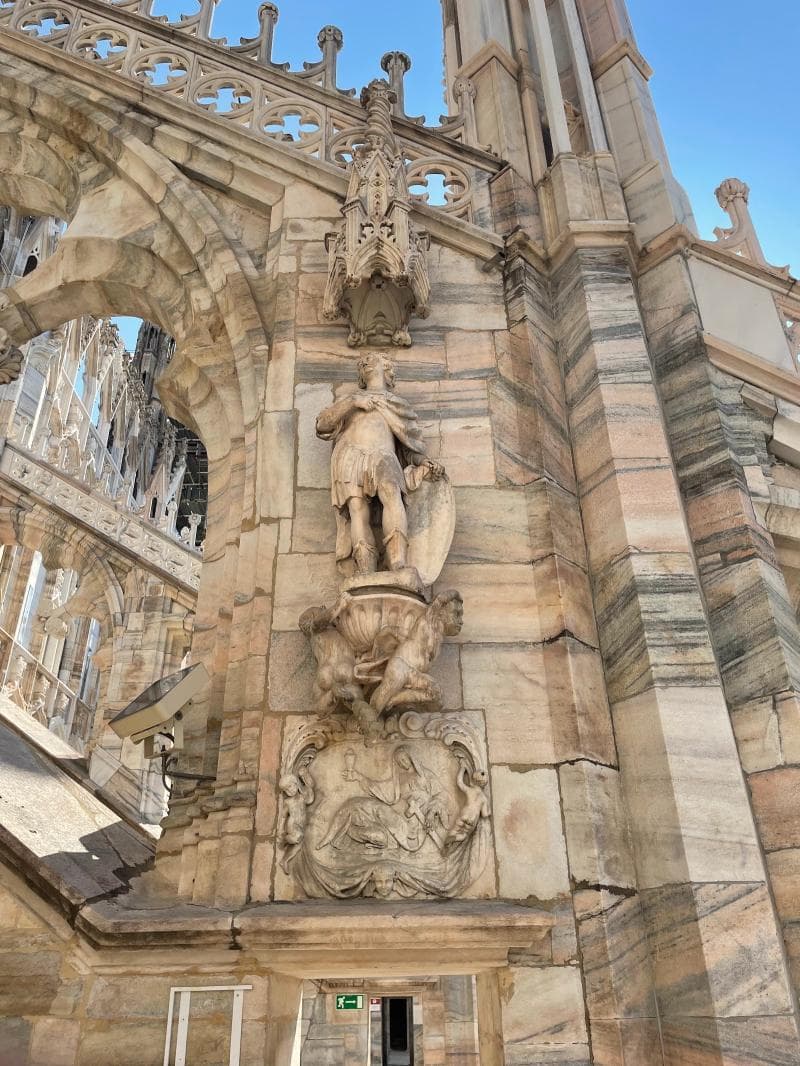
Explore the Duomo di Milano's breathtaking rooftop terraces in Milan, Italy, offering panoramic city views and an up-close look at its intricate Gothic architecture and Madonnina statue.
Overview
Ascending to the rooftop terraces of the Duomo di Milano offers a truly unique perspective on one of Italy's most iconic landmarks. Situated 65 meters above the bustling Piazza del Duomo, these accessible terraces provide breathtaking panoramic views of Milan's cityscape, stretching across its urban tapestry to the distant Alps on clear days. More than just a viewpoint, the terraces allow visitors to intimately experience the cathedral's intricate Gothic architecture, a magnificent 'stone forest' of spires, statues, and decorative elements carved from delicate Candoglia marble. This close-up encounter with centuries of craftsmanship reveals details often unseen from the ground, making it an essential part of any visit to the Duomo.
History & Cultural Background
The construction of the Duomo di Milano began in 1386, an ambitious undertaking that spanned nearly six centuries. The concept of accessible terraces was integral to the original architectural vision, reflecting the International Gothic style's structural schemes and Lombard construction traditions. While the cathedral's building progressed slowly over hundreds of years, significant work on the rooftop, including the placement of many spires and facade details, was initiated under Napoleon's directive between 1807 and 1813. The grandest spire, the Great Spire, began in 1765 and was completed by 1769 under architect Francesco Croce, crowned by the revered Madonnina statue in 1774. This rich history underscores the terraces not merely as an addition, but as a fundamental and evolving part of the Duomo's enduring legacy.
What Makes It Special
The Duomo di Milano's rooftop terraces are exceptional as the only Gothic cathedral in the world with fully accessible rooftops, allowing visitors to walk directly amongst its architectural marvels. Here, one can marvel at an astonishing collection of 135 spires, many reaching approximately 17 meters in height, alongside 150 gargoyles and 96 large statues, often referred to as 'giants'. The entire structure, including these elaborate details, is crafted from the distinctive pink-gray Candoglia marble, which glows with various hues depending on the light. This provides an unparalleled opportunity to appreciate the delicate flying buttresses, ornate pinnacles, and thousands of intricate carvings that adorn the cathedral's upper reaches. At the summit, the gilded Madonnina statue, a powerful symbol of Milan, stands proudly, appearing almost within reach.
Stories, Fun Facts & Local Details
The Madonnina, a four-meter-tall copper statue covered in 3,900 gold sheets, is more than just an architectural feature; it is considered the patroness and spiritual symbol of Milan. For many years, a local tradition dictated that no building in Milan should surpass the height of the Madonnina, a rule that held until 1959. During the bombardments of 1943 in World War II, the precious golden Madonnina was covered with a cloth to prevent it from attracting unwanted attention from aerial bombers, a testament to its cultural significance. Literary giants have also been captivated by the Duomo's rooftops; American writer Mark Twain, in his 1867 visit, described the cathedral as 'What a wonder it is! So grand, so solemn, so vast! And yet so delicate, so airy, so graceful!' after experiencing the roof. Moreover, observant visitors might spot peculiar carvings on the counter-façade staircase, including an icepick, a rope, a racket, and even the face of Dante Alighieri, adding an unexpected charm to the historical ascent.
Visitor Perspective
Visitors to the Duomo terraces have two main options for ascent: by elevator or by stairs. The elevator offers a convenient journey, particularly recommended for those with mobility issues, while the climb of 250 to 256 steps provides a more immersive experience through narrow passageways and historic masonry. Once on the terraces, two parallel paths run along the northern and southern flanks, leading to the central terrace, the highest point accessible to the public. The best times to visit are typically in the early mornings or late afternoons, especially around sunset, when the marble structure glows and the city views are most enchanting. This also helps avoid the midday heat, as the marble floors can become quite warm under direct sunlight. While tickets are required for access, it is highly advisable to purchase them in advance online to avoid long queues, especially during peak seasons. For those entering the cathedral interior, a modest dress code is enforced, requiring shoulders and knees to be covered.
Coordinates: 9.19192, 45.46427
View on Google Maps💬 How Travelers Describe This Place
Based on community votes
Photogenic
980Unique
963Beautiful
663Must See
503Interesting
201
Traveler Stories
Discover memorable experiences shared by travelers who have visited this place.
No traveler stories yet.
Be the first traveler to share what made this place memorable.

Tour
By
Spot
Discover amazing places around the world. Your journey starts here.
Explore
© 2026 TourBySpot. All rights reserved.