Rooftop Dragon Terrace
Barcelona, Spain
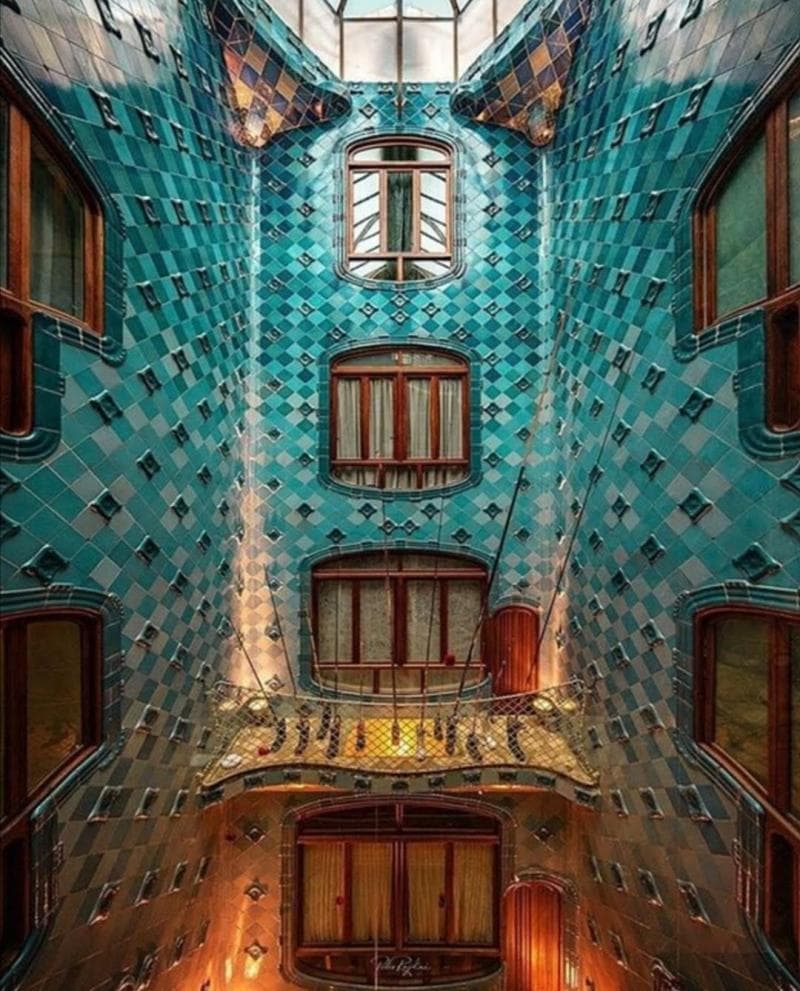
Discover the enchanting Rooftop Dragon Terrace at Casa Batlló in Barcelona, Spain, a masterpiece of Gaudí's organic architecture and rich symbolism.
Overview
Perched atop the architectural marvel of Casa Batlló in Barcelona, Spain, the Rooftop Dragon Terrace is a mesmerizing testament to Antoni Gaudí's boundless imagination. This iconic terrace, often referred to as the Dragon's Back or Dragon Roof, is a visual spectacle of color, form, and symbolism, offering visitors not just panoramic views of the Catalan capital but also a deeply immersive experience into Gaudí's unique Modernisme style.
Far from being a mere functional roof, it is an integral part of the building's narrative, inviting curious travelers to discover the legends and inspirations woven into its very fabric. The terrace is renowned for its undulating form, vibrant mosaic tiles, and distinctive chimney stacks, all contributing to its fantastical, organic appearance.
History & Cultural Background
Casa Batlló, originally a conventional 1877 building, underwent a radical transformation between 1904 and 1906 under Gaudí's masterful hand, commissioned by textile industrialist Josep Batlló. Gaudí was given immense artistic freedom, and he reimagined the entire structure, inside and out. The rooftop, in particular, became a canvas for one of his most powerful architectural statements, deeply rooted in Catalan culture and folklore.
The prevailing interpretation of the Rooftop Dragon Terrace draws inspiration from the legend of Saint George (Sant Jordi), the patron saint of Catalonia. According to this beloved tale, Saint George slew a dragon to save a princess and the people from its wrath. Gaudí ingeniously rendered this narrative in architectural form: the arched, scaly roof represents the dragon's back, covered in glistening, diamond-shaped ceramic tiles. The slender, four-armed cross-crowned turret piercing the roof is widely believed to symbolize Saint George's sword plunged into the dragon.
What Makes It Special
The Rooftop Dragon Terrace stands out for its extraordinary organic design and rich symbolism. Gaudí's aversion to straight lines is evident here, with every curve and contour mimicking natural forms. The roof's surface is covered in iridescent, diamond-shaped 'trencadís' tiles – a mosaic technique using broken ceramic pieces – that give the illusion of reptilian scales. The colors shift from green to blue and violet, and finally to red and pink, creating a dynamic, almost living skin.
Beyond the dragon's back, four groups of polychromatic, sinuous chimney stacks add to the surreal landscape. These sculptural elements are not merely decorative; they were designed to prevent downdrafts, showcasing Gaudí's blend of aesthetic genius and functional innovation. The tower, culminating in a distinctive four-armed cross oriented to the cardinal directions, further reinforces the connection to nature and spirituality often found in Gaudí's works.
Stories, Fun Facts & Local Details
Casa Batlló is affectionately known by locals as the 'Casa dels Ossos' (House of Bones) due to its skeletal-like façade, or 'Casa del Drac' (House of the Dragon), directly referencing its magnificent rooftop. This interplay of nicknames highlights the dual nature of Gaudí's design – both eerie and wondrous.
Another fascinating detail is the varying interpretations of the rooftop's colors. While commonly seen as dragon scales, some art critics, including Salvador Dalí, have suggested an aquatic landscape, evoking Claude Monet's 'Water Lilies' due to the colorful ceramic glaze and shimmering effect. This demonstrates Gaudí's ability to create a work of art open to multiple readings, allowing each visitor to find their own narrative within his design. Gaudí never explicitly explained his work, encouraging individual imagination to complete the story.
Visitor Perspective
Visiting the Rooftop Dragon Terrace is an unforgettable journey. As you ascend through Casa Batlló, perhaps via the lightwell that ingeniously mimics an underwater world or an animal's ribcage, you emerge onto a rooftop that feels like stepping into a fantastical realm. The terrace provides breathtaking 360-degree views of Barcelona, with its unique architectural elements framing the cityscape.
The tactile experience of the textured surfaces, the vibrant play of light on the mosaic scales, and the sculptural chimneys create a truly immersive atmosphere. It's a place where architecture transcends its traditional boundaries, transforming into a piece of art that tells a story, evokes emotion, and connects deeply with the cultural identity of Catalonia. Many visitors find themselves lingering, captivated by the intricate details and the sweeping vistas, experiencing Gaudí's vision come to life.
Coordinates: 2.16492, 41.39158
View on Google Maps💬 How Travelers Describe This Place
Based on community votes
Interesting
980Beautiful
963Must See
663Photogenic
389Unique
201
Traveler Stories
Discover memorable experiences shared by travelers who have visited this place.
No traveler stories yet.
Be the first traveler to share what made this place memorable.

Tour
By
Spot
Discover amazing places around the world. Your journey starts here.
Explore
© 2026 TourBySpot. All rights reserved.