Roman Walls
Barcelona, Spain
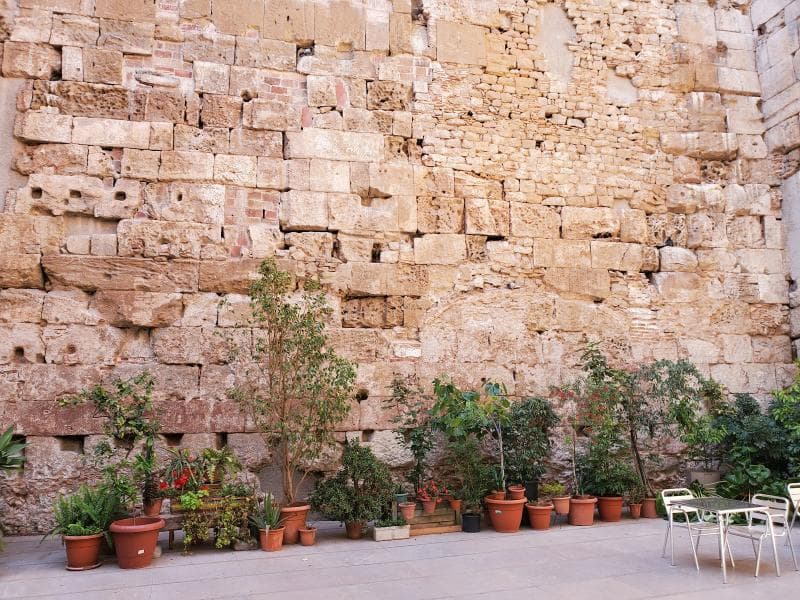
Discover the ancient Roman Walls in Barcelona's Gothic Quarter, Spain. Explore remnants of Barcino's fortifications, towers, and gates.
Overview
Journey back in time within Barcelona's labyrinthine Gothic Quarter, where the enduring remnants of the Roman Walls whisper tales of ancient Barcino. These formidable fortifications, once safeguarding a burgeoning Roman colony, stand today as a powerful testament to the city's two-millennia-old past. Integrated seamlessly into the urban fabric, these venerable stones offer a unique glimpse into Barcelona's origins, inviting curious travelers to trace the footsteps of legionaries and emperors alike.
Far from being isolated ruins, the Roman Walls are an active part of the cityscape, often peeking out from behind medieval structures or forming the very foundations of contemporary buildings. This remarkable preservation, particularly within the historic core, allows for an immersive exploration of Barcelona's Roman heritage. Visitors can discover fragments of this ancient defensive perimeter in various locations throughout the Gothic Quarter, offering a tangible connection to the city's foundation as Colonia Julia Augusta Faventia Paterna Barcino.
History & Cultural Background
The story of Barcelona's Roman Walls begins with the founding of Barcino by Emperor Augustus between 15 and 10 BC. The initial settlement, strategically located on a small promontory, quickly established itself as a significant Roman colony.
Initially, Barcino was enclosed by a simpler wall, built in the 1st century BC. However, as the Roman Empire faced increasing threats, particularly from Frankish and Alemannic incursions around 250 AD, the need for stronger defenses became paramount.
Between the late 3rd and early 4th centuries AD, a second, far more imposing wall was constructed atop the original foundations. This fortified perimeter was a true feat of Roman engineering, reaching up to 18 meters in height and featuring an impressive array of towers. Sources suggest this reinforced wall included between 70 and 81 towers, most with rectangular bases, though the ten at the gates were semicircular. This significant upgrade transformed Barcino into a formidable stronghold, earning it the evocative nickname, 'the crowned city.'
Within these walls, Barcino adopted the classic Roman urban plan, centered around the cardo maximus (today's Llibreteria and Call streets) and decumanus maximus (Bisbe, Ciutat, and Regomir streets), intersecting at the forum near present-day Plaça de Sant Jaume. This grid-like layout, typical of Roman settlements, facilitated trade and administration, leveraging Barcino's strategic position on the Via Augusta.
Over the centuries, especially during the medieval period, the city expanded, and buildings were constructed against and even into the Roman walls. While some sections were later partially demolished in the 19th century to accommodate urban growth, many parts remarkably endured, providing the archaeological treasures we see today.
What Makes It Special
The Roman Walls of Barcelona are distinguished by their extraordinary integration into the city's modern and medieval landscapes. Unlike ruins often cordoned off, these ancient fortifications are an intrinsic part of the Gothic Quarter's character. Walking through its narrow streets, you'll encounter segments of the Roman wall forming the base of a Gothic cathedral or appearing unexpectedly within courtyards, creating a mesmerizing blend of eras.
One of the most impressive visible sections is found in Plaça Nova, adjacent to the Barcelona Cathedral. Here, two cylindrical defense towers and a significant portion of the main access gate to Barcino, the Porta Praetoria, are remarkably preserved. You can also discern remains of the old aqueduct that once supplied water to the Roman city.
Another striking location is Plaça Ramon Berenguer el Gran, where a substantial section of the 4th-century Roman wall stands, with the 14th-century Gothic Chapel of Santa Àgata uniquely built on top of its foundations. This juxtaposition perfectly illustrates Barcelona's layered history.
Even lesser-known fragments contribute to the walls' allure, such as the circular tower on Carrer del Correu Vell or the remains of the Sea Gate within the Pati Llimona Civic Centre. These scattered yet significant pieces allow visitors to actively trace the original perimeter of Roman Barcino, revealing the footprint of an ancient civilization beneath the bustling modern metropolis.
Stories, Fun Facts & Local Details
The full Roman name for Barcelona, Colonia Julia Augusta Faventia Paterna Barcino, rolls off the tongue like a forgotten incantation, hinting at the city's grand beginnings.
During its Roman zenith, Barcino was a strategically vital hub due to the Via Augusta, a major Roman road, meeting the Mediterranean coast here. This location fueled significant commercial and economic development, far beyond what its relatively small initial size might suggest.
Imagine the sight of the 4th-century wall, some sections eight meters thick, studded with its 70 to 81 formidable towers, each about 18 meters tall. This extensive defense network gave Barcino its proud moniker, 'the crowned city,' a reference to the numerous watchtowers that encircled its perimeter.
A fascinating aspect of the walls' survival lies in how they were incorporated into later urban development. By the 13th century, King James I even permitted buildings to be constructed directly against the wall, and windows to be cut through it, slowly embedding the ancient structure within newer constructions. This practice, while obscuring parts of the wall, also inadvertently preserved them, protecting them from complete demolition over time.
Perhaps one of the most surprising 'discoveries' is the Temple of Augustus. While not part of the defensive walls themselves, its four towering, 2,000-year-old columns were found inside a medieval building in the Gothic Quarter, illustrating how ancient Roman structures were repurposed and absorbed into later architectural endeavors.
Visitor Perspective
Exploring the Roman Walls in Barcelona's Gothic Quarter is less about visiting a single monumental site and more about an urban archaeological adventure. It is a journey best undertaken on foot, allowing for serendipitous discoveries around every corner. Start your exploration at Plaça Nova to see the impressive gate and towers, then wander down Carrer del Bisbe, keeping an eye out for wall segments integrated into buildings.
A visit to the Barcelona History Museum (MUHBA) is highly recommended, as it offers a remarkable underground journey through the preserved Roman city, including streets, homes, and significant portions of the walls. This provides an unparalleled understanding of daily life in Barcino.
For those who enjoy a deeper dive, consider joining a guided tour of the Gothic Quarter, as expert guides can illuminate hidden details and share captivating stories that might otherwise be missed. The atmospheric narrow streets, especially in the early morning or evening, provide the perfect backdrop for imagining Barcino as it once was. Don't forget your camera; the unique textures of the ancient stone under the soft afternoon light make for stunning photographs.
Coordinates: 2.159, 41.3888
View on Google Maps💬 How Travelers Describe This Place
Based on community votes
Unique
680Interesting
588Photogenic
566Beautiful
432Must See
316
Traveler Stories
Discover memorable experiences shared by travelers who have visited this place.
No traveler stories yet.
Be the first traveler to share what made this place memorable.

Tour
By
Spot
Discover amazing places around the world. Your journey starts here.
Explore
© 2026 TourBySpot. All rights reserved.