Roman Ruins Site
Zurich, Switzerland
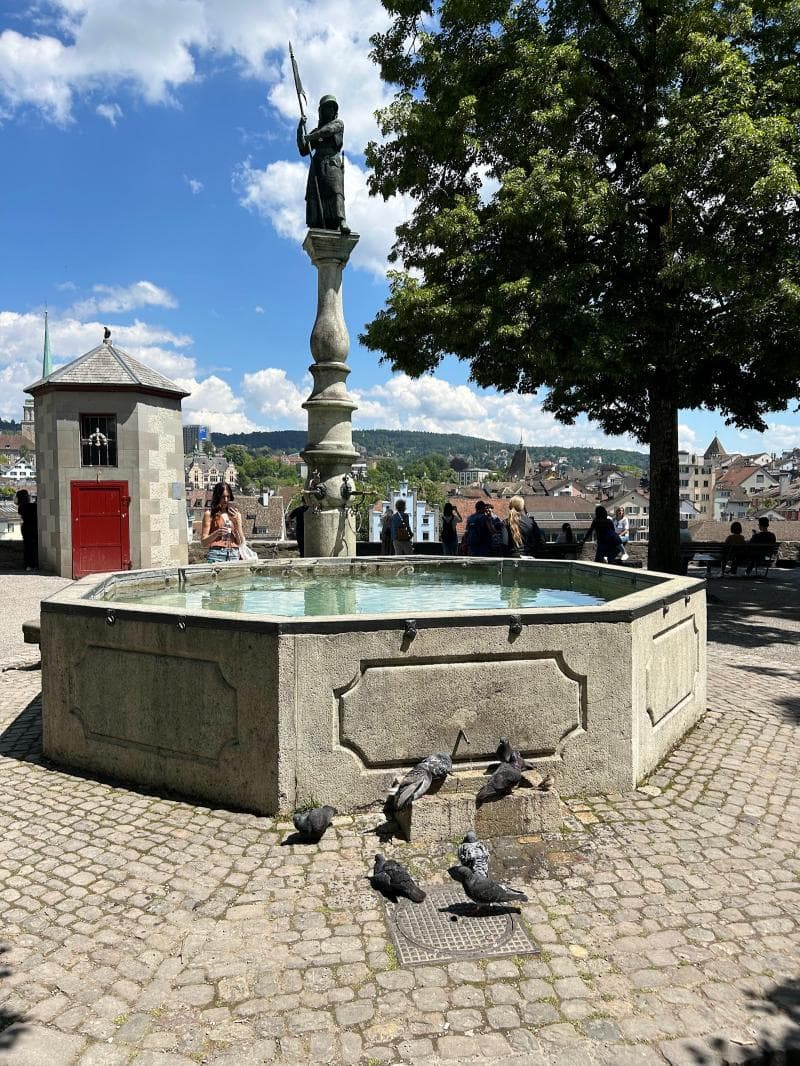
Explore the Roman Ruins Site at Lindenhof in Zurich, Switzerland, once the powerful Roman fort of Turicum, now a historic park with panoramic views.
Overview
Nestled atop a gentle moraine hill in the heart of Zurich, Switzerland, the Lindenhof offers more than just panoramic views of the city's charming Old Town and the Limmat River. It is a site deeply steeped in history, where the ancient Roman past quietly coexists with the vibrant present. What appears today as a tranquil public park, shaded by linden trees and frequented by chess players, was once a crucial Roman fort, a foundational cornerstone in the making of modern Zurich. The Roman Ruins Site within Lindenhof serves as a powerful reminder of Turicum, the Roman settlement that laid the groundwork for this bustling Swiss metropolis.
This historic elevation has been continuously settled for nearly two millennia, making it a priceless archaeological treasure. Visitors can stroll along the same ground where Roman soldiers once stood guard, contemplating the strategic importance of this location which controlled the Limmat valley and served as a vital customs station. It's a place where the layers of time are palpable, from prehistoric settlements to Roman fortifications and medieval palaces, all culminating in the beloved green oasis it is today.
History & Cultural Background
The story of Lindenhof as a Roman site begins much earlier than its visible remnants suggest. Long before the Romans, the area saw Celtic settlements as far back as 400 BC, demonstrating its enduring strategic value. The Roman presence began around 15 BC, establishing a small vicus named Turicum, which functioned as an essential customs station. Goods traveling north from Italy were transferred here from lake vessels to river ships, making it a pivotal hub for trade and a key part of the Roman transport network. The name Turicum itself, possibly of Celtic origin, is famously inscribed on a 2nd-century Roman tombstone discovered in 1747. A replica of this significant artifact is integrated into the Lindenhof wall along Pfalzgasse, offering a tangible link to Zurich's Roman past.
The most prominent Roman structure on Lindenhof was a formidable citadel or fort. Built by the Roman military during the reign of Emperor Valentinian I (364–375 AD), this fort was designed to defend against migrations from the north by the Alamanni. It was a substantial fortification, encompassing 4,500 square meters, featuring ten towers and robust walls that were two meters wide. After the fall of the Roman Empire, the remains of this Roman camp continued to be utilized. In the early medieval age, a Carolingian and later Ottonian Pfalz, or royal palace, was constructed on its foundations, further emphasizing the site's enduring significance as a seat of power and festivity.
What Makes It Special
The Roman Ruins Site at Lindenhof is special precisely because it represents the very genesis of Zurich. It's not just an archaeological curiosity; it's the bedrock upon which the entire city grew. The visible and hidden remnants offer a direct connection to a pivotal era when Zurich, then Turicum, was a bustling Roman outpost, a meeting point for trade and culture at the edge of the empire. The strategic elevation of the hill, chosen by the Romans for their fort, now provides visitors with the same breathtaking vistas that Roman sentinels would have surveyed centuries ago, encompassing the Limmat River and the sprawling cityscape.
The layering of history here is remarkable. While the impressive Roman fort eventually deteriorated, its stones and foundations were often incorporated into later medieval structures, creating a palimpsest of historical periods. This means that walking through Lindenhof, you are literally treading upon the remnants of multiple civilizations. The fact that parts of the lime mortar and ancient castle walls were integrated into surrounding townhouses and the subsequent Kaiserpfalz highlights a continuity of occupation and reuse that is rarely so evident.
Stories, Fun Facts & Local Details
One of the most enduring local legends associated with Lindenhof dates back to 1292. It is said that during a siege by Habsburg forces, the women of Zurich bravely gathered on Lindenhof, fully armed with lances and shields, to defend their city. Their display of strength reportedly misled the enemy into believing Zurich still had a large contingent of fighting men, leading to the Habsburg retreat and preserving the city's independence. This legendary act of defiance is a testament to the hill's historical role as a gathering point for the community in times of crisis.
For those eager to delve deeper into the physical remnants of the past, the Lindenhofkeller (Lindenhof Cellar) beneath the peaceful hill holds fascinating secrets. Here, traces of Zurich's Roman fortifications, alongside Celtic and medieval walls, are preserved. While not always openly accessible, viewing these foundation stones and archaeological layers is possible by contacting the Baugeschichtliches Archiv. This subterranean journey offers a unique perspective on the continuous evolution of the site. Today, the Lindenhof continues its legacy as a beloved public space where locals and visitors alike relax, play chess, and enjoy the serene atmosphere, perhaps unknowingly, just feet above significant historical foundations.
Visitor Perspective
Visiting the Roman Ruins Site at Lindenhof today is an experience that effortlessly blends historical immersion with tranquil recreation. As you ascend to the top of the moraine hill, the hustle and bustle of modern Zurich begin to fade, replaced by a sense of calm and a profound connection to the past. The views are a primary draw, offering picturesque panoramas of the Grossmünster Church, the Limmat River, and the charming rooftops of the Old Town.
While the Roman fort itself is no longer standing in its original form, the subtle cues and interpretive elements throughout the park encourage imaginative reconstruction. Observing the replica of the Roman tombstone integrated into the wall on Pfalzgasse provides a tangible anchor to the Roman settlement of Turicum. It allows visitors to visualize the thriving community that once existed here and understand its strategic importance. The Lindenhof's elevated position, once a defensive advantage, now serves as an ideal vantage point for contemplating Zurich's historical journey from a Roman customs station to a major European city. It's a place where history whispers through the linden leaves, inviting curious travelers to reflect on the enduring legacy of the Romans in Switzerland.
Coordinates: 8.5412, 47.373
View on Google Maps💬 How Travelers Describe This Place
Based on community votes
Interesting
996Must See
658Unique
585Photogenic
143Beautiful
69
Traveler Stories
Discover memorable experiences shared by travelers who have visited this place.
No traveler stories yet.
Be the first traveler to share what made this place memorable.

Tour
By
Spot
Discover amazing places around the world. Your journey starts here.
Explore
© 2026 TourBySpot. All rights reserved.