Roman Ceiling
Split, Croatia
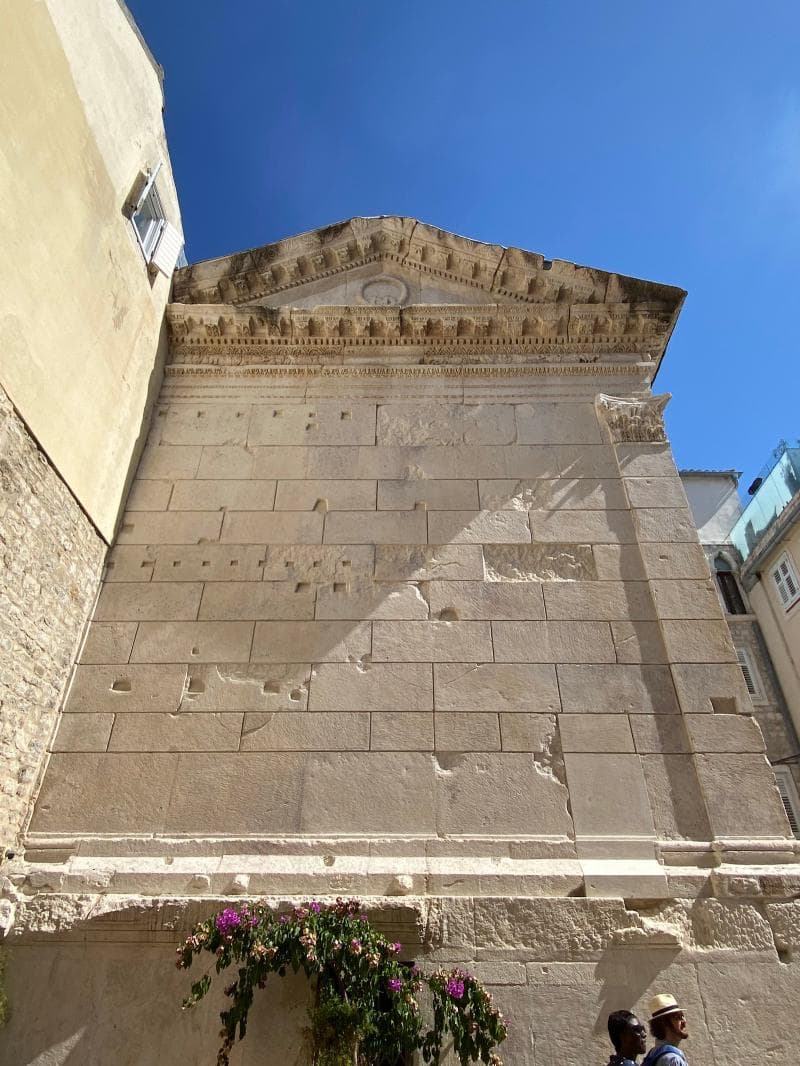
Explore the remarkably preserved Roman Ceiling in Split, Croatia's Temple of Jupiter, a testament to ancient Roman and early Christian artistry within Diocletian's Palace.
Overview
Deep within the ancient walls of Diocletian's Palace in Split, Croatia, lies a historical marvel often simply referred to as the 'Roman Ceiling'. This exquisite architectural feature is found inside the former Temple of Jupiter, a testament to Roman ingenuity and enduring artistry. Constructed between 295 and 305 AD by Emperor Diocletian, the temple was originally dedicated to the supreme Roman deity, Jupiter, whom the emperor regarded as his divine father. Later, in the 6th century, this pagan temple was thoughtfully repurposed and transformed into the Baptistery of St. John the Baptist, embracing the burgeoning Christian era. Today, the Temple of Jupiter stands as one of the best-preserved Roman structures within the palace complex, drawing visitors from across the globe to admire its remarkably intact design, with its ceiling being a particular highlight. Esteemed Scottish architect Robert Adam once declared this temple to be among Europe's most beautiful monuments.
History & Cultural Background
The Temple of Jupiter is an integral part of Diocletian's Palace, itself a UNESCO World Heritage Site, which dates back to the late 3rd and early 4th centuries AD. Emperor Diocletian, a ruler known for his grand architectural ambitions, commissioned the temple's construction as part of his elaborate retirement residence. The temple's dedication to Jupiter was more than a mere religious act; it was a potent symbol of Diocletian's imperial authority, as he positioned himself as Jupiter's earthly son. However, Diocletian's unexpected abdication in 305 AD meant that certain parts of the palace, including the temple, were left unfinished.
Centuries later, as Christianity gained prominence in the region, the temple underwent a significant transformation. In the 6th century, it was converted into a Christian baptistery, now known as the Baptistery of St. John the Baptist. This adaptation beautifully illustrates Split's layered history, where pagan and Christian elements coexist within the same ancient walls. Inside, visitors can observe sarcophagi believed to contain the remains of Archbishops of Split, such as Ivan of Ravenna and Lovre, further cementing its historical and religious significance. A striking bronze statue of St. John the Baptist, created by the renowned Croatian sculptor Ivan Meštrović, also graces the interior, adding a 20th-century artistic layer to this ancient space.
What Makes It Special
The true gem, and what many travelers specifically seek out, is the temple's magnificent Roman Ceiling. It is a barrel-vaulted coffered ceiling, renowned for its exceptional state of preservation. The ceiling is intricately carved with deep panels, or coffers, each adorned with sculpted human faces. These faces are a subject of ongoing fascination; some scholars believe them to represent Roman deities, while others suggest they are idealized portraits, perhaps even of the emperor himself or members of his court. Regardless of their precise identity, the craftsmanship and detail of these carvings offer an extraordinary glimpse into the artistic sophistication of the Roman Empire.
This particular Roman Ceiling is not only a visual spectacle but also holds considerable architectural importance. Its impressive barrel-vaulted form and rich decoration are believed to have significantly influenced early Renaissance art and architecture in Dalmatia, notably seen in works like Andrea Alessi's baptistery and the Chapel of Blessed John in Trogir. Adding to the temple's unique allure is the presence of one of Diocletian's original Egyptian sphinxes, brought from its homeland over 3,000 years ago, which guards the entrance. This blending of Roman and Egyptian influences, alongside its later Christian conversion, makes the Temple of Jupiter, and particularly its ceiling, a truly unique and historically rich site in Europe.
Stories, Fun Facts & Local Details
The story of the Roman Ceiling is inextricably linked to Emperor Diocletian's persona. His deliberate association with Jupiter, positioning himself as the god's 'son', infused the temple with a personal and political dimension that went beyond mere worship. The subtle details within the ceiling's sculpted faces invite contemplation, allowing visitors to ponder the identities of the individuals or deities depicted, bringing a sense of mystery and connection to the ancient world.
It's fascinating to consider that this relatively small temple, compared to other grand Roman structures across the empire, has such a profound impact, primarily due to its impeccably preserved ceiling. The sphinx at the temple's entrance has stood witness to nearly two millennia of history, its ancient gaze having observed emperors, bishops, and countless travelers. The transformation of the temple into a baptistery during the early Christian era wasn't an act of destruction but rather a remarkable evolution, showcasing the adaptability and continuity of sacred spaces throughout history. This site beautifully encapsulates Split's enduring narrative, making it a living museum of cultural and religious shifts.
Visitor Perspective
For many travelers exploring Diocletian's Palace, a visit to the Temple of Jupiter, with its iconic Roman Ceiling, is a highlight. While the interior is often described as compact, the sheer detail and historical weight contained within its walls are immense. Stepping inside, one is immediately drawn to the ceiling, an intricate tapestry of ancient artistry that transports visitors back to the Roman era. The contrast between the bustling Peristyle outside and the often-serene atmosphere within the temple offers a moment for quiet reflection on the passage of time and the blend of civilizations. For those with a keen interest in history, architecture, or simply the beauty of ancient craftsmanship, taking the time to truly appreciate the barrel-vaulted coffered ceiling is an essential part of the experience, revealing the lasting legacy of Roman art and engineering in Split.
Coordinates: 16.439568, 43.508341
View on Google Maps💬 How Travelers Describe This Place
Based on community votes
Interesting
639Photogenic
526Beautiful
421Unique
366Must See
212
Traveler Stories
Discover memorable experiences shared by travelers who have visited this place.
No traveler stories yet.
Be the first traveler to share what made this place memorable.

Tour
By
Spot
Discover amazing places around the world. Your journey starts here.
Explore
© 2026 TourBySpot. All rights reserved.