Riverfront Area
Vientiane, Laos
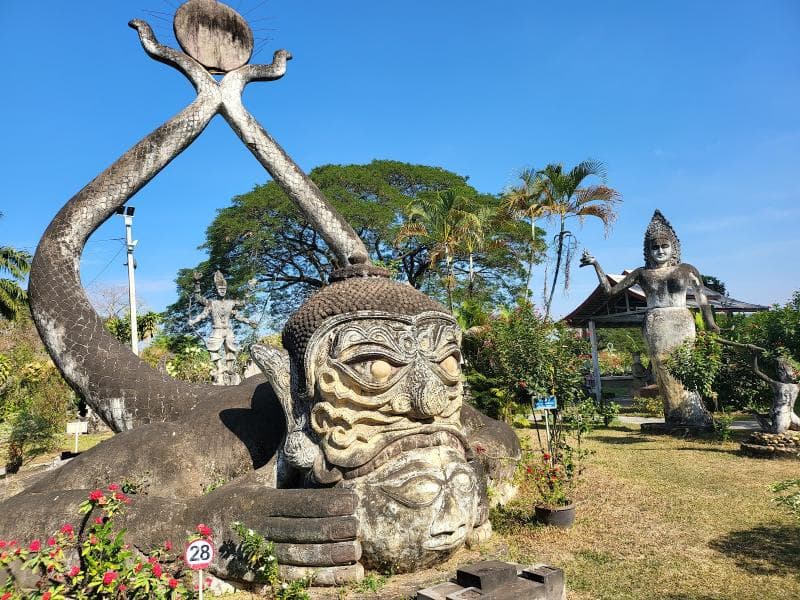
Explore the Riverfront Area of Buddha Park (Xieng Khuan) in Vientiane, Laos, a unique sculpture garden blending Buddhist and Hindu mythologies along the Mekong.
Overview
Nestled in a verdant meadow beside the majestic Mekong River, approximately 25 kilometers southeast of Vientiane, Laos, lies the captivating Buddha Park, locally known as Xieng Khuan or 'Spirit City'. This open-air sculpture park is a truly unique destination, showcasing an extraordinary collection of over 200 Buddhist and Hindu statues. While not a traditional temple, its religious imagery and tranquil setting offer a profound experience for curious travelers seeking cultural immersion and artistic wonder. The park's riverside location provides a serene backdrop to its eclectic mix of concrete sculptures, which, despite their modern construction, often appear ancient and weathered [6, 10, 13].
History & Cultural Background
Buddha Park was conceived and constructed starting in 1958 by Luang Pu Bunleua Sulilat, a priest-shaman whose spiritual journey led him to integrate both Buddhist and Hindu philosophies [6, 13]. His unique perspective, reportedly influenced by a Hindu rishi he studied under in Vietnam, shaped the distinctive syncretic style evident throughout the park [6]. Sulilat, despite lacking formal artistic training, guided unskilled workers in creating these intricate concrete figures, which collectively represent his vision of a unified religious cosmos [10, 11]. Following the 1975 revolution in Laos, Sulilat fled across the Mekong River to Thailand, where he established a similar, larger sculpture park named Sala Keoku in Nong Khai, demonstrating the enduring power of his artistic and spiritual endeavor [6, 13, 14].
What Makes It Special
What truly sets Buddha Park apart is its harmonious yet sometimes bizarre fusion of two major Asian religions, Buddhism and Hinduism, expressed through an astonishing array of sculptures [5, 10]. Visitors encounter deities like Shiva, Vishnu, and Arjuna from Hindu lore alongside various depictions of Buddha in different postures, demons, mythical creatures, and everyday human figures [5, 10, 12, 14]. The sheer volume and scale of the more than 200 statues, all crafted from reinforced concrete, are impressive [6, 13]. A highlight is the enormous, multi-level 'Giant Pumpkin' sculpture, which visitors can enter through a demon's mouth and climb through three distinct levels symbolizing Hell, Earth, and Heaven [4, 5, 12, 14]. Reaching the top offers sweeping panoramic views of the entire park and the tranquil Mekong River beyond [4, 5, 12]. Another prominent feature is the colossal 40-meter (131-foot) reclining Buddha, a powerful symbol of the Buddha's entry into Nirvana [8, 12, 19].
Stories, Fun Facts & Local Details
The name Xieng Khuan, meaning 'Spirit City', perfectly encapsulates the otherworldly atmosphere of the park, a place where spiritual beliefs manifest in tangible, often surreal, forms [6, 10, 18]. Despite the statues appearing centuries old due to their weathered appearance, they are relatively modern creations from the mid-20th century [10, 13]. A fascinating detail is the reported origin of some of Sulilat's more unusual designs, said to have come to him in dreams and through his enlightenment experiences [5]. The park's position directly on the Mekong River, which forms the border with Thailand, means that the tallest structures are even visible from the Thai side [6, 18]. In recent years, the park has undergone significant renovations, including improved walkways, landscaping, and modern facilities, enhancing the visitor experience while preserving its original charm [4, 10].
Visitor Perspective
Exploring Buddha Park is an immersive journey that invites contemplation and wonder. As you wander among the diverse sculptures, each seemingly telling its own story, the serene setting by the Mekong River adds to the overall tranquility [10, 18]. The opportunity to ascend the 'Giant Pumpkin' is a memorable interactive experience, culminating in breathtaking vistas [4, 5, 12]. For a moment of repose, visitors can enjoy the on-site restaurant, often featuring stilted dining huts that offer views of the Mekong, making it an ideal spot to relax and reflect on the artistic and spiritual richness of the site [4, 14]. The park, operated by the socialist government as a tourist attraction, offers a unique window into the syncretic religious traditions of the region and provides a peaceful escape from the bustle of the city [6, 13].
Coordinates: 102.765397, 17.91229
View on Google Maps💬 How Travelers Describe This Place
Based on community votes
Unique
965Interesting
629Must See
443Beautiful
184Photogenic
176
Traveler Stories
Discover memorable experiences shared by travelers who have visited this place.
No traveler stories yet.
Be the first traveler to share what made this place memorable.

Tour
By
Spot
Discover amazing places around the world. Your journey starts here.
Explore
© 2026 TourBySpot. All rights reserved.