River Thames Viewing Experience
London, United Kingdom
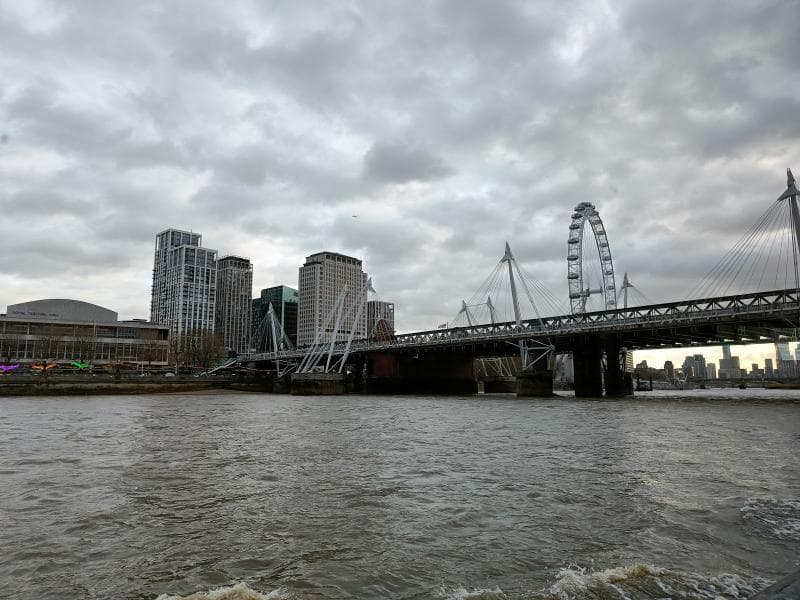
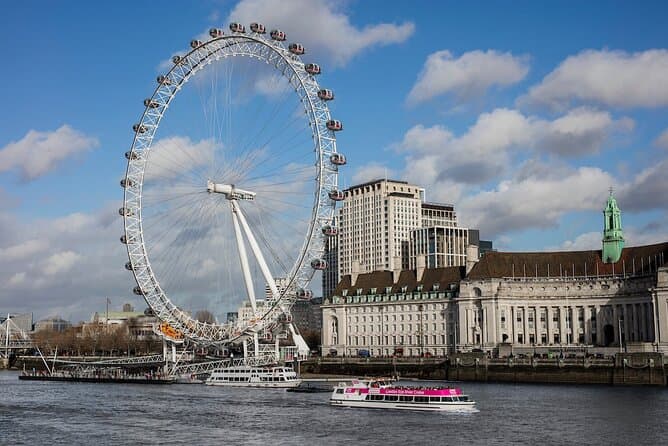
Experience London's River Thames from above with a 360-degree view from the iconic London Eye. Discover history, culture, and panoramic city sights.
Overview
The River Thames Viewing Experience from the London Eye offers a truly unparalleled perspective of London's iconic cityscape. Situated on the South Bank of the River Thames, this remarkable cantilevered observation wheel stands at an impressive 135 meters (443 feet) tall, with a wheel diameter of 120 meters (394 feet). From within one of its 32 fully enclosed glass capsules, visitors embark on a slow, continuous rotation that takes approximately 30 minutes to complete. This gentle ascent provides a breathtaking 360-degree panoramic view of London's most famous landmarks, with visibility extending up to 40 kilometers (25 miles) on a clear day. Each spacious capsule can comfortably accommodate up to 25 people, making it a shared journey of discovery high above the bustling city.
History & Cultural Background
The London Eye, also known as the Millennium Wheel, was originally conceived by architects David Marks and Julia Barfield in 1993 as an entry for a competition to design a new landmark to commemorate the millennium. While it didn't win the initial competition, the project was pursued independently, with construction beginning in 1998. It was ceremonially opened on December 31, 1999, though it welcomed its first public passengers in March 2000. Initially intended as a temporary attraction with a five-year lease, its immense popularity quickly cemented its status as a permanent fixture on the London skyline.
Crucially, the London Eye sits proudly overlooking the River Thames, a waterway steeped in over two millennia of history. The Thames is not merely a river; it is the very reason London exists. Its banks witnessed the establishment of 'Londinium' by the Romans in AD 43, who built the first bridge and used it as a vital route for trade and transport. Throughout history, the Thames has been a backdrop for royal processions, commerce, and countless significant events that shaped the nation. From its dark ages of industrial pollution, where it was once declared 'biologically dead' in the 1950s, the river has undergone a remarkable environmental recovery, now teeming with diverse marine life.
What Makes It Special
The River Thames Viewing Experience from the London Eye is special because it transcends a typical sightseeing opportunity, offering a dynamic and evolving tableau of London. Unlike viewing landmarks from ground level, the Eye's continuous, slow rotation provides ever-changing angles and perspectives, revealing the intricate relationships between historical sites and modern developments. From this vantage point, you can clearly discern the serpentine path of the Thames as it carves through the city, linking disparate neighborhoods and attractions. Iconic structures like the Houses of Parliament and Big Ben, Westminster Abbey, St. Paul's Cathedral, the Shard, and the Tower of London appear in a new light, allowing visitors to grasp the sheer scale and architectural diversity of the capital.
Beyond the visual spectacle, the London Eye itself is a marvel of modern engineering. It is the world's tallest cantilevered observation wheel, ingeniously supported by an A-frame on one side, which contributes to its elegant and distinctive silhouette. At night, the Eye transforms, illuminating the South Bank with its own vibrant lights, adding another layer to the city's captivating nocturnal beauty. This unique combination of historical context, engineering prowess, and an unparalleled viewing platform creates an experience that is both educational and awe-inspiring.
Stories, Fun Facts & Local Details
The River Thames, visible in all its glory from the London Eye, holds a treasure trove of stories. Imagine a time when the river froze solid enough for 'frost fairs' to be held directly on its icy surface, complete with markets and entertainment. Historically, the Thames was so congested with ships that it was said one could almost walk from shore to shore across the vessels awaiting their turn to unload cargo. The river has long inspired artists and writers, featuring prominently in works by Shakespeare, Dickens, and even in Handel's famous 'Water Music', composed for King George I's royal barge procession.
For centuries, the Thames has also been a rich archaeological site. 'Mudlarks', individuals who search the riverbanks at low tide, continue to unearth fascinating artifacts from Roman coins and medieval pilgrim badges to Bronze Age weapons, revealing the river's deep connection to London's past. It even holds spiritual significance for various cultures, with findings indicating offerings dating back millennia, and the Thames being sanctified as a holy river by some Hindu communities in the 1970s.
As for the London Eye itself, its construction was a feat. The massive wheel was assembled horizontally over the Thames on piled platforms and then slowly pulled upright over several days, first at two degrees per hour. This ambitious approach allowed for its unique design to come to life, transforming London's skyline forever.
Visitor Perspective
Stepping into a London Eye capsule is an experience designed for comfort and panoramic discovery. The boarding process is smooth and continuous, rarely requiring the wheel to stop, allowing for an uninterrupted flow of visitors. Inside the air-conditioned, fully glass-enclosed pods, interactive touchscreens provide engaging information about the landmarks you're observing, enhancing your understanding of London's rich tapestry. The slow, 30-minute rotation offers ample time to take photographs, identify famous sites, and simply soak in the breathtaking views.
Visitors often choose to enhance their experience with special options like the Champagne Experience, enjoying a glass of bubbly while surveying the city, or booking a private capsule for an exclusive journey. Many also combine their London Eye ride with a River Thames cruise, offering contrasting perspectives of the city from both high above and directly on the water. Conveniently located on the South Bank, the London Eye is easily accessible by public transport, with Waterloo Tube station just a short walk away, placing it at the heart of London's vibrant cultural district.
Coordinates: -0.1197, 51.5033
View on Google Maps💬 How Travelers Describe This Place
Based on community votes
Interesting
951Beautiful
748Must See
499Photogenic
491Unique
427
Traveler Stories
Discover memorable experiences shared by travelers who have visited this place.
No traveler stories yet.
Be the first traveler to share what made this place memorable.

Tour
By
Spot
Discover amazing places around the world. Your journey starts here.
Explore
© 2026 TourBySpot. All rights reserved.