Remaining Columns
Athens, Greece
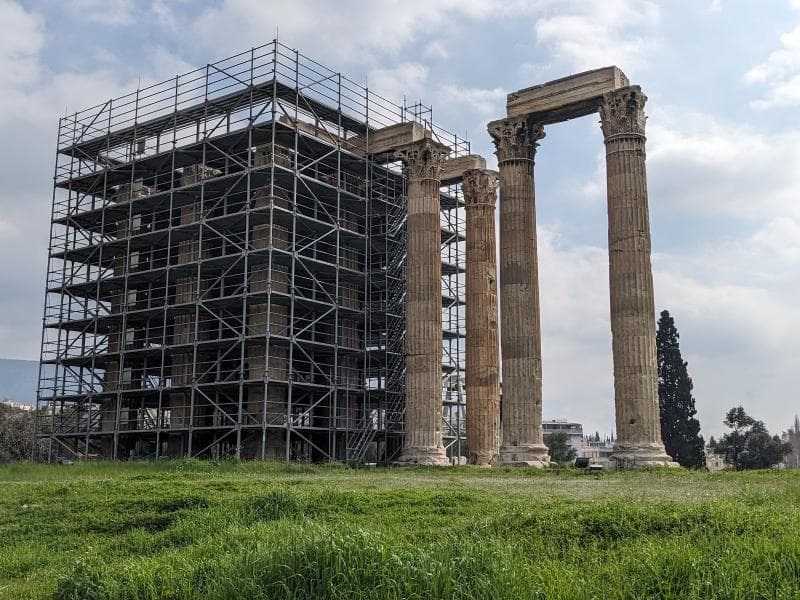
Explore the 'Remaining Columns' of the Temple of Olympian Zeus in Athens, Greece. Discover its colossal Corinthian architecture and 600+ year history.
Overview
As you stand before the 'Remaining Columns' of the Temple of Olympian Zeus in Athens, Greece, you're not just observing ancient ruins; you're witnessing the echoes of an unparalleled architectural ambition that spanned centuries. This colossal temple, dedicated to the king of the Olympian gods, Zeus, was once the largest temple in Greece, a testament to immense human endeavor and unwavering devotion. Today, the site captivates with its towering remnants, a dramatic silhouette against the Athenian sky that hints at its former, glorious scale. Although only a fraction of its original 104 majestic columns still stand, these surviving structures evoke a profound sense of wonder and provide a tangible link to the ancient world. Each column, reaching heights of over 17 meters, crafted from gleaming Pentelic marble, tells a silent story of power, belief, and the passage of time. Located approximately 500 meters southeast of the iconic Acropolis, the Temple of Olympian Zeus forms a crucial part of Athens' rich archaeological landscape, inviting curious travelers to delve into its storied past.
History & Cultural Background
The ambitious undertaking of the Temple of Olympian Zeus began in the 6th century BC under the rule of Athenian tyrants, most notably Peisistratus and his sons, who envisioned creating the grandest temple in the ancient world. However, this monumental project faced numerous halts and resumptions, mirroring the turbulent political landscape of ancient Greece. Following the overthrow of the tyranny, the Athenian democrats deliberately left the temple unfinished, some believing that constructing such an oversized edifice was a display of hubris, an attempt to elevate humans to the level of gods. Centuries later, in 174 BC, the Seleucid king Antiochus IV Epiphanes, who remarkably considered himself an earthly embodiment of Zeus, revived the construction, introducing the Corinthian order and Pentelic marble. Yet, his death brought another pause. It was not until the 2nd century AD, after a staggering 638 years, that the Roman Emperor Hadrian, a known admirer of Greek culture, finally brought the temple to completion in 131 or 132 AD. This completion under Roman rule infused the temple with a blend of Greek heritage and Roman architectural influence, marking it as a significant cultural fusion. The temple served as a central place of worship, housing immense chryselephantine statues, including one of Zeus himself and, controversially, one of Hadrian, signifying his revered status. Its glory, however, was fleeting; after being pillaged during a Germanic invasion in 267 AD, roughly a century after its dedication, the temple fell into ruin and was subsequently quarried for building materials in the centuries that followed.
What Makes It Special
What makes the 'Remaining Columns' truly special is their sheer scale and the testament they offer to ancient Greek and Roman engineering prowess. Originally, the temple boasted 104 colossal columns, each standing at an impressive 17 to 17.25 meters high and approximately 1.7 to 2 meters in diameter. These were not just support structures; they were masterpieces of the Corinthian order, known for their elaborate and decorative capitals adorned with intricate acanthus leaves and scrolls. This choice of the Corinthian order was particularly distinctive for Greek temples of its era, showcasing a blend of traditional Hellenic grandeur with Roman aesthetic preferences. The use of glistening Pentelic marble, sourced from nearby Mount Pentelicus, ensured a structure that would endure the ages and shine under the Athenian sun. Standing amidst these towering remnants, one can truly grasp the monumental ambition of a project that spanned over six centuries, reflecting the shifting tides of political power and architectural innovation. The few remaining columns are a powerful visual representation of the passing of time, endurance against natural forces, and the human desire to build enduring monuments to their deities.
Stories, Fun Facts & Local Details
The Temple of Olympian Zeus is rich with intriguing stories and details that breathe life into its stony remnants. One particularly notable fact is the astonishing duration of its construction—over 600 years—making it one of the longest-running building projects in antiquity. The Greek philosopher Aristotle even cited the temple as an example of how tyrants kept the populace occupied with grand projects to prevent rebellion. During the Roman period, the temple housed a colossal gold and ivory statue of Zeus, alongside an equally large statue of Emperor Hadrian, a bold statement that placed the emperor on par with the chief deity. This detail offers a fascinating glimpse into Hadrian's personal philosophy and the political implications of divine association. Perhaps the most poignant story is that of the 16th column. While 15 columns majestically stand today, one lies on the ground, exactly where it fell during a violent storm in 1852. This fallen giant serves as a dramatic reminder of nature's power and the temple's vulnerability, even after millennia. Another intriguing local detail comes from the Ottoman period, when the temple was known to Greeks as 'Hadrian's Palace' and to Turks as the 'Palace of Belkis,' connected to a Turkish legend about Solomon's wife. Some columns also bear carvings, part of a 'Stone Chronicle,' used during Ottoman rule to record significant events like epidemics and natural disasters.
Visitor Perspective
Visiting the 'Remaining Columns' of the Temple of Olympian Zeus is an experience that transcends mere sightseeing; it's a journey into the heart of ancient grandeur and historical resilience. As you approach the site, the sheer height and girth of the columns immediately command attention, setting a tone of awe and respect. Walking among these majestic structures, you can almost hear the echoes of ancient ceremonies and feel the weight of centuries of history beneath your feet. It offers a unique vantage point to reflect on the immense scale of ancient ambition and the artistry involved in their construction. The juxtaposition of the standing columns with the lone fallen one creates a powerful visual narrative about endurance and the inevitable forces of decay. From this vantage point, you also gain picturesque views of the Acropolis in the distance, framing the historical narrative of Athens beautifully. It's a place that encourages contemplation, allowing a curious traveler to imagine the temple in its full glory and appreciate the enduring legacy of a civilization that sought to honor its gods with such magnificent creations. The site invites you to slow down, absorb the atmosphere, and connect with the profound cultural and historical layers of Athens.
Coordinates: 23.7265, 37.9683
View on Google Maps💬 How Travelers Describe This Place
Based on community votes
Unique
551Beautiful
547Must See
336Interesting
298Photogenic
212
Traveler Stories
Discover memorable experiences shared by travelers who have visited this place.
No traveler stories yet.
Be the first traveler to share what made this place memorable.

Tour
By
Spot
Discover amazing places around the world. Your journey starts here.
Explore
© 2026 TourBySpot. All rights reserved.