Religious Art Displays
Tbilisi, Georgia
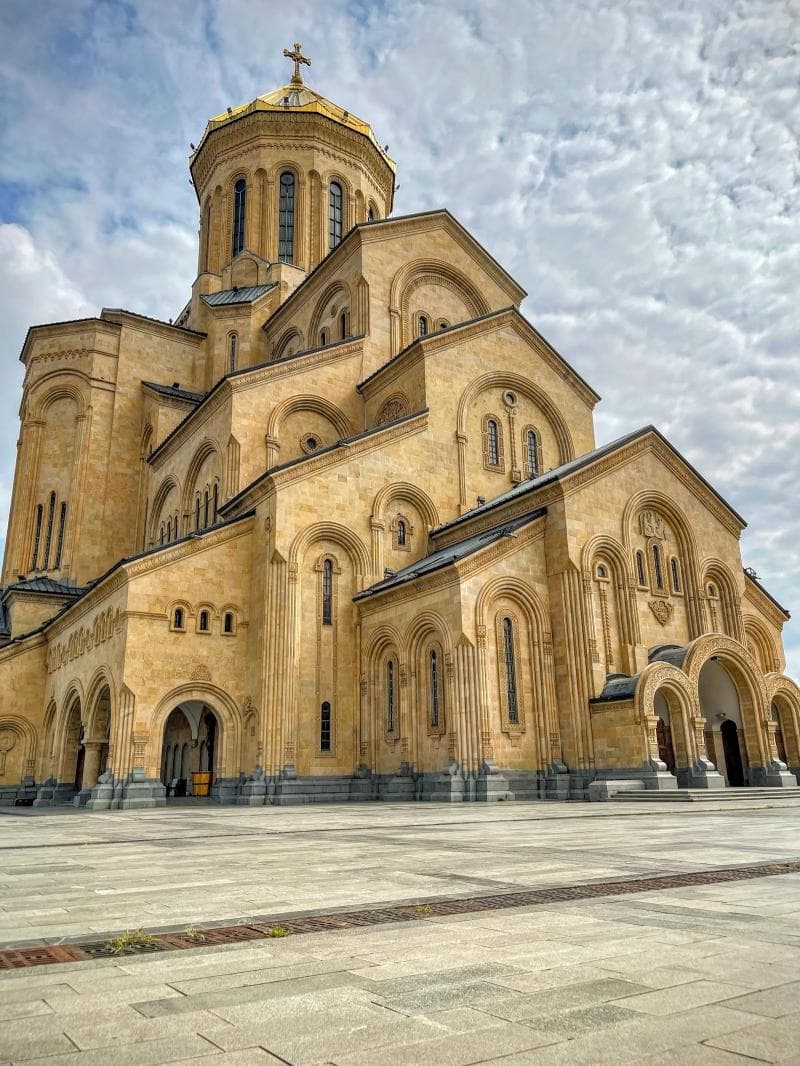
Explore the religious art displays at Holy Trinity Cathedral, Tbilisi, Georgia. Discover stunning icons, frescoes, and cultural significance.
Overview
The Holy Trinity Cathedral of Tbilisi, affectionately known as Sameba, stands as a monumental beacon of Georgian Orthodox Christianity in the heart of Georgia's capital. Consecrated in 2004, this magnificent structure is not only the principal cathedral of the Georgian Orthodox Church but also one of the largest Eastern Orthodox cathedrals in the world. Dominating the Tbilisi skyline from its perch on Elia Hill, Sameba is a powerful symbol of the nation's spiritual and national revival following decades of Soviet rule. Inside its grand walls, visitors are greeted by a treasury of religious art, where traditional Georgian iconography and modern artistic interpretations beautifully converge.
The religious art displays within Sameba are central to its identity, embodying centuries of deep-rooted faith and cultural heritage. From intricate frescoes that adorn soaring ceilings to revered icons lining the walls, each piece tells a story of devotion, history, and the unique artistic traditions of Georgia. The cathedral's design thoughtfully blends ancient Georgian architectural elements with Byzantine influences, providing a majestic setting for these sacred artworks.
History & Cultural Background
The genesis of the Holy Trinity Cathedral dates back to a pivotal moment in Georgian history. The idea to construct this grand edifice emerged in 1989, a significant year marking the dawn of Georgia's national awakening from the Soviet era. Its construction was envisioned as a dual commemoration: celebrating 2,000 years since the birth of Jesus Christ and 1,500 years of the autocephaly—the ecclesiastical independence—of the Georgian Orthodox Church.
Construction commenced in 1995 and was brought to completion nearly a decade later, culminating in its consecration on November 23, 2004, a day coinciding with Saint George's Day, a deeply revered saint in Georgia. The project was largely funded by anonymous donations from numerous businessmen and ordinary citizens, underscoring its role as a collective expression of national pride and spiritual resurgence. Sameba thus represents more than just a religious building; it is a profound testament to the Georgian people's resilience and their enduring connection to Orthodox Christianity.
What Makes It Special
The religious art displays at Sameba are a captivating blend of reverence and artistry. The interior of the cathedral is adorned with a rich collection of traditional icons and frescoes, depicting saints and biblical narratives that are fundamental to Orthodox theology. These vivid murals and icon paintings were meticulously created under the supervision of renowned icon painter Amiran Goglidze, ensuring they honor the distinct Georgian iconographic tradition.
A particularly striking feature is the magnificent iconostasis, a richly decorated screen separating the nave from the sanctuary, which is characteristic of Orthodox churches. It is intricately carved and adorned with gilded icons, creating a visual barrier that also serves as a focal point for prayer and contemplation. Beyond these traditional elements, the cathedral also showcases modern works by Georgian artists, demonstrating a living, evolving thread of religious expression. The Catholicos-Patriarch Ilia II himself contributed to this artistic tapestry, having designed several icons and an image of the Holy Virgin displayed at the entrance.
Stories, Fun Facts & Local Details
Stepping into Sameba, one encounters layers of symbolic meaning and fascinating details. The cathedral complex notably includes nine chapels, five of which are located underground, offering a more intimate and serene worship experience. The architect, Archil Mindiashvili, skillfully incorporated design elements from various periods of Georgian church architecture, creating a harmonious yet monumental structure.
Even the very foundation of Sameba holds a profound symbolic gesture; it is said to contain soil collected from various holy sites across Georgia, symbolically anchoring the entire nation within its sacred walls. Inside, the materials speak of global connections and local craftsmanship: limestone from Georgia, marble from Italy, Egypt, and Greece, and granite from China and India for the floors. One of the most cherished pieces is the 'Hope of Georgia' icon, housed in a glass encasement. This opulent icon, an exquisite example of Georgian minankari (cloisonné enamel) style, is said to feature over 400 saints and contains a significant amount of gold and jewels. A curious fact linking the cathedral's lead artist to wider religious art is that Amiran Goglidze was once commissioned by the Vatican to create an icon for Pope Benedict XVI, with the Vatican specifically requesting it be in the distinctive Georgian style.
Visitor Perspective
A visit to the Holy Trinity Cathedral is a journey into the spiritual heart of Georgia. It is essential to remember that Sameba is an active place of worship, not merely a museum. Visitors may frequently witness religious services, experiencing the profound chants and rituals of the Georgian Orthodox Church firsthand. To ensure respect for this sacred space, visitors are requested to dress modestly; women should cover their heads and knees, and men should avoid wearing shorts.
Photography is generally permitted inside, but it is crucial to do so respectfully, especially avoiding flash during services. The sheer scale of the interior is often a highlight, with its immense central space, high dome, and the bright atmosphere created by natural light. The icons, with their gilded surfaces and intricate details, invite contemplation. Beyond the interior, the cathedral's elevated position offers breathtaking panoramic views of Tbilisi, making it a perfect spot to reflect on the city's beauty and its deep spiritual heritage.
Coordinates: 44.8167, 41.6918
View on Google Maps💬 How Travelers Describe This Place
Based on community votes
Interesting
897Must See
641Unique
481Photogenic
463Beautiful
196
Traveler Stories
Discover memorable experiences shared by travelers who have visited this place.
No traveler stories yet.
Be the first traveler to share what made this place memorable.

Tour
By
Spot
Discover amazing places around the world. Your journey starts here.
Explore
© 2026 TourBySpot. All rights reserved.