Reflection Gardens
Phnom Penh, Cambodia
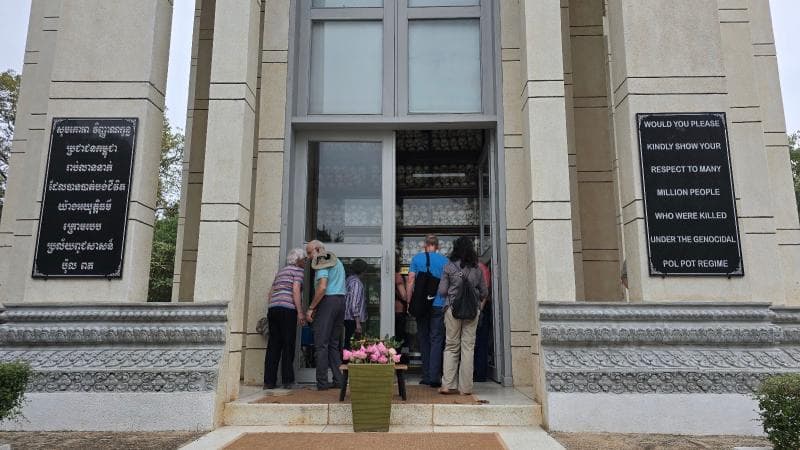
Explore the Reflection Gardens within Choeung Ek Genocidal Center in Phnom Penh, Cambodia, a poignant memorial site for quiet contemplation and remembrance.
Overview
The Choeung Ek Genocidal Center, often recognized as one of the infamous Killing Fields, stands as a profoundly significant and solemn memorial site in Phnom Penh, Cambodia. It is a place of quiet remembrance and reflection, preserving the tragic history of the Khmer Rouge regime's atrocities between 1975 and 1979. This former orchard, approximately 17 kilometers south of the city center, became a mass execution and burial ground for thousands of innocent victims. Today, the center is a powerful testament to the resilience of the Cambodian people and a poignant reminder of humanity's darkest chapters.
Visitors are guided through the grounds, where mass graves and remnants of the past are respectfully preserved. The atmosphere encourages introspection, making the entire site a space for profound reflection. At its heart lies the central Memorial Stupa, a towering structure housing thousands of human skulls and bones, arranged behind clear glass panels as a stark and undeniable record of the genocide. The site offers a solemn educational experience, enabling visitors to honor those who perished and to contemplate the importance of peace and human dignity.
History & Cultural Background
Before its transformation into a site of immense suffering, Choeung Ek was an ordinary orchard and a Chinese cemetery. Between 1975 and 1979, the Khmer Rouge, led by Pol Pot, implemented a brutal campaign to establish an agrarian socialist society, resulting in the Cambodian genocide. An estimated 1.7 to 2 million people died through execution, forced labor, starvation, and disease. Choeung Ek became a primary execution site, particularly for prisoners transferred from the S-21 security center (now the Tuol Sleng Genocide Museum) in Phnom Penh.
Victims were often killed using crude tools like pickaxes, hoes, and even sharp bamboo, to conserve precious bullets. Loud revolutionary music was played through loudspeakers to drown out the sounds of the executions and the cries of the victims. Following the fall of the Khmer Rouge regime in 1979, mass graves were unearthed, revealing the horrific scale of the atrocities. In 1989, a Buddhist stupa was constructed as a memorial, later developed further to include the glass display of skulls.
What Makes It Special
What makes the contemplative areas within Choeung Ek, often serving as 'Reflection Gardens', particularly special is their ability to foster a deep sense of introspection amid a serene yet profoundly tragic landscape. While not explicitly named 'Reflection Gardens' as a distinct section, the entire site is designed to be a meditative space. The quiet pathways winding through the former orchard, past the identified mass graves—some deliberately left unexcavated—and the symbolic 'Killing Tree' where infants were brutally murdered, all contribute to this atmosphere. The silence that permeates the grounds, broken only by the chirping of birds and the somber narration of the audio guide, compels visitors to confront the past and contemplate its lessons.
The centerpiece, the Memorial Stupa, acts as a powerful focal point for this reflection. It houses thousands of skulls, meticulously arranged and categorized, serving as a chilling, tangible record of the lives lost. This monument, though drawing on traditional Buddhist architectural forms, uniquely combines remembrance with an undeniable presentation of evidence, transforming grief into a collective act of bearing witness.
Stories, Fun Facts & Local Details
The audio guide, included with admission, is an integral part of the visitor's experience, often narrated in part by survivors and featuring testimonies from former guards. This personal approach helps visitors connect with the human stories behind the statistics, offering insights into the sheer brutality and the profound impact on individuals and families. The guide encourages visitors to pace themselves and stand still, allowing for moments of quiet reflection at various points of significance across the site.
One poignant detail is the presence of fragments of bone and cloth that still surface in the paths after heavy rain, a stark reminder of the countless victims buried beneath. Visitors are respectfully asked not to touch or move these sacred remnants. Another striking element is the 'Killing Tree', adorned with hundreds of colorful bracelets, a testament to the ongoing remembrance and a symbol of the innocent lives taken, particularly children. This tree evokes a visceral emotional response and underscores the depths of the tragedy endured by the Cambodian people.
Visitor Perspective
A visit to Choeung Ek is universally described as a deeply moving and often harrowing experience, yet one considered essential for understanding Cambodia's recent history. It is not a typical tourist attraction but rather a working memorial and a place of grief for many Cambodian families. Visitors are encouraged to dress modestly and maintain a respectful silence throughout their visit. The intention is not to sensationalize the past but to provide a space for education, remembrance, and the honoring of those who suffered. Many find the experience life-changing, leaving with a profound respect for Cambodia's journey toward healing and a reinforced commitment to peace.
Coordinates: 104.90194, 11.48444
View on Google Maps💬 How Travelers Describe This Place
Based on community votes
Interesting
896Must See
102Beautiful
102Unique
95Photogenic
28
Traveler Stories
Discover memorable experiences shared by travelers who have visited this place.
No traveler stories yet.
Be the first traveler to share what made this place memorable.

Tour
By
Spot
Discover amazing places around the world. Your journey starts here.
Explore
© 2026 TourBySpot. All rights reserved.