Record Tower
Dublin, Ireland
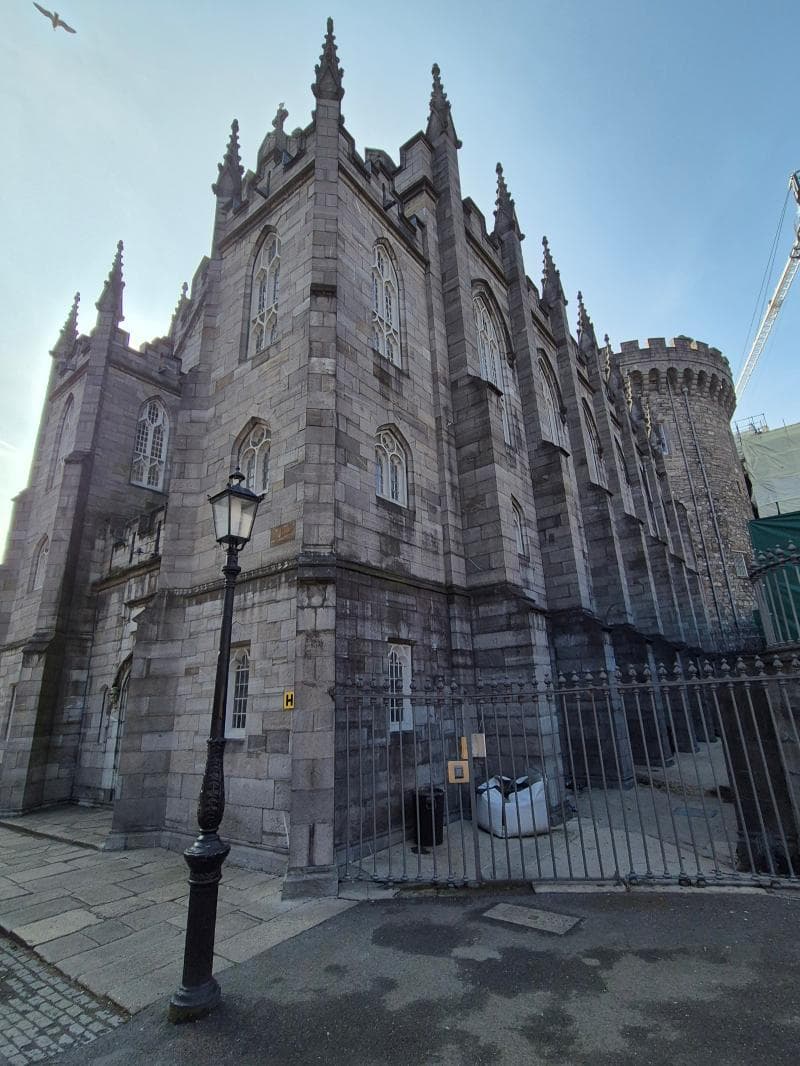
Explore the historic Record Tower, the oldest surviving medieval structure within Dublin Castle in Dublin, Ireland. Discover its past as a fortress, prison, and archive.
Overview
Nestled within the historic grounds of Dublin Castle in Dublin, Ireland, stands the venerable Record Tower, a silent sentinel that has witnessed centuries of Irish history. Also known as the Medieval Tower, Wardrobe Tower, or Gunner's Tower, it is the sole surviving intact medieval tower and one of the oldest structures remaining from the original 13th-century Dublin Castle complex. Its circular form and formidable stone walls offer a tangible link to Dublin's Norman past, contrasting sharply with the more ornate Georgian architecture that now largely defines the castle grounds. This enduring monument, dating back to the early 13th century, represents a remarkable feat of medieval engineering and has played a multifaceted role in the city's narrative, evolving from a defensive stronghold to a prison and ultimately to a repository of state records.
History & Cultural Background
The Record Tower's story begins between 1204 and 1228, largely constructed during the reign of King Henry III, following King John of England's directive for a formidable castle to be built in Dublin. Its initial purpose was primarily defensive, strategically positioned at the southeastern corner of the Norman fortress, guarding against the River Poddle which served as a natural moat. With walls up to 4.8 meters thick, it was designed to withstand sieges, housing archers and guards who patrolled its battlements.
Beyond its military function, the tower also served as the king's Wardrobe Tower, a significant role where armour, royal attire, and the monarch's treasures were securely stored. The 'Wardrobe' itself was a royal household department, underscoring the tower's early administrative importance. As centuries unfolded, its utility transformed dramatically. During the tumultuous Tudor and Stuart periods, the Record Tower became a high-security state prison, incarcerating prominent Irish rebels and political figures. By the 17th century, it was known as the Gunner's Tower, likely serving as the headquarters for the Master Gunner of Ireland.
A pivotal shift occurred in the early 19th century when the tower underwent significant restoration between 1810 and 1813 by architect Francis Johnston. This renovation was undertaken to complement the newly constructed Chapel Royal adjacent to it. Its height was raised, and new masonry battlements were added, giving it a somewhat altered yet still imposing appearance. It was around this time, specifically in 1811, that it gained its enduring name, the Record Tower, as it was converted into a secure archive for state papers, legal documents, and ancient manuscripts.
What Makes It Special
What truly sets the Record Tower apart is its remarkable resilience and longevity. While much of Dublin Castle was rebuilt from the late 17th century onward, transforming it into a Georgian palace, the Record Tower stands as the most complete medieval building at Dublin Castle, the sole surviving tower of the original 13th-century fortification above ground. Its ability to withstand numerous fires, including a severe one in 1684 that damaged other parts of the castle, is a testament to the strength of its medieval masonry.
The tower embodies a powerful visual dialogue between Ireland's ancient past and its more recent history. Its rugged, circular stone structure contrasts dramatically with the elegant symmetry of the Georgian State Apartments nearby, offering visitors a unique perspective on the layers of history embedded within Dublin Castle. It represents the very 'first stone of English rule in Ireland' and now, symbolically, 'a cornerstone of Irish memory,' having adapted and endured through profound political and social changes.
Stories, Fun Facts & Local Details
The thick walls of the Record Tower hold many tales. One of the most famous stories associated with its time as a prison involves the legendary escape of Red Hugh O'Donnell, along with Art and Henry O'Neill, sons of Ulster chieftains, on January 6th, 1592. They reportedly made their audacious escape through a toilet chute, a daring feat that has been etched into Irish folklore.
Interestingly, the tower has held various 'treasures' throughout its existence. Initially, it safeguarded the king's material possessions as the Wardrobe Tower. Later, it protected invaluable state papers and manuscripts. In the 1860s, Sir John Bernard Burke, Keeper of the State Papers, famously had its wooden presses replaced with open pine shelving, describing it as 'the only protection in the world against our invincible enemy – DUST.' The tower even briefly housed the Garda Museum until its relocation in 2017, further demonstrating its continuous utility and historical significance.
Visitor Perspective
For the curious traveler, the Record Tower offers a profound journey back in time. While the tower has recently been closed for restoration, with a view to opening as an exciting new museum space from 2019 onwards, its presence remains central to the Dublin Castle experience. Historically, access has been included with guided tours of Dublin Castle, allowing visitors to explore its winding spiral staircases, narrow corridors, and upper chambers. These tours often reveal remnants of the original Norman curtain wall and medieval foundations beneath its floors, providing a deeper understanding of the castle's origins.
When you approach the Record Tower, take a moment to appreciate its singular nature—it is the surviving heart of the medieval fortress. Imagine the archers who once peered through its narrow arrow slits, the prisoners confined within its robust walls, and the countless documents that charted the course of a nation. It stands as a testament to durability and transformation, connecting the modern visitor to the foundational epochs of Dublin and Ireland itself. Even if currently viewed from the exterior, its imposing structure and rich history provide an evocative glimpse into a bygone era.
Coordinates: -6.2674, 53.3431
View on Google Maps💬 How Travelers Describe This Place
Based on community votes
Interesting
896Must See
102Beautiful
102Unique
95Photogenic
28
Traveler Stories
Discover memorable experiences shared by travelers who have visited this place.
No traveler stories yet.
Be the first traveler to share what made this place memorable.

Tour
By
Spot
Discover amazing places around the world. Your journey starts here.
Explore
© 2026 TourBySpot. All rights reserved.