Reclining Buddha Hall
Shanghai, China
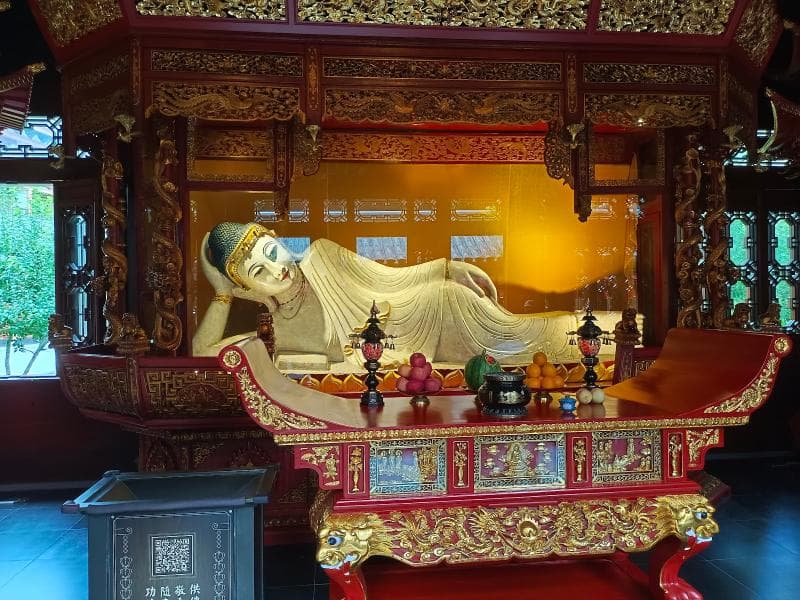
Discover the tranquil Reclining Buddha Hall inside Shanghai's historic Jade Buddha Temple, home to exquisite jade statues symbolizing Nirvana in China.
Overview
Nestled within the bustling metropolis of Shanghai, China, the Jade Buddha Temple offers a tranquil sanctuary, famously housing two exquisite jade Buddha statues brought from Myanmar. Among its many revered spaces, the Reclining Buddha Hall stands out as a focal point for spiritual contemplation and historical intrigue. This sacred hall is home to one of the original precious jade statues, depicting the Buddha at a profoundly significant moment in his spiritual journey. Visitors stepping into this serene space find themselves transported away from the city's din, encountering a piece of Buddhist heritage that has journeyed across continents and survived tumultuous times.
The Jade Buddha Temple, an active place of worship and meditation, was established specifically to enshrine these remarkable jade figures. The Reclining Buddha Hall provides a unique opportunity to witness the delicate craftsmanship and spiritual resonance of the original smaller jade statue, alongside a much larger marble rendition that offers an interesting contrast. This duality underscores the temple's enduring legacy and its continuous evolution as a center for Buddhist faith and cultural preservation in Shanghai.
History & Cultural Background
The story of the Reclining Buddha Hall begins in the late 19th century with a revered Buddhist monk named Huigen. During his pilgrimage from Mount Putuo, Huigen traveled to Myanmar (then Burma) and was gifted five jade Buddha statues. Upon his return, he brought two of these precious statues to Shanghai: a seated Buddha and a reclining Buddha. Lacking the means to transport all five to Mount Putuo, he left these two in Shanghai, laying the foundation for what would become the Jade Buddha Temple.
The temple was initially constructed in 1882 to house these sacred objects. However, history intervened, and the original structure was destroyed in 1918 during revolutionary upheavals (or the 1911 revolution). Fortunately, the invaluable jade statues were saved. A new temple, reflecting traditional Chinese architectural styles, often reminiscent of the Song Dynasty, was meticulously rebuilt on the present site between 1918 and 1928, solidifying its place as a spiritual landmark.
The reclining posture of the Buddha, as depicted in the hall's central statue, holds deep cultural and spiritual significance. It symbolizes Sakyamuni Buddha's entry into Nirvana, the ultimate state of liberation from suffering and rebirth, often referred to as his peaceful passing or death. This representation offers a profound message of tranquility and release, resonating with both devoted practitioners and curious visitors alike.
What Makes It Special
The Reclining Buddha Hall is truly special due to its exceptional artifacts and the profound spiritual atmosphere it cultivates. At its heart lies the original reclining Buddha, meticulously carved from pure white jade. This smaller statue, approximately 96 centimeters (or about one meter/three feet) in length, portrays Sakyamuni Buddha in the moments before entering Nirvana. Its serene and peaceful facial expression is said to comfort many visitors, radiating a sense of calm even amidst the bustling city of Shanghai.
Adding another layer to the hall's distinctiveness is a much larger marble reclining Buddha, roughly four meters long, which was later donated from Singapore. This juxtaposition of the original, delicate jade figure with the grander, more recent marble sculpture creates an intriguing visual and conceptual contrast, highlighting both the historical roots and the ongoing vibrancy of the temple. Unlike many tourist sites, photography is generally not permitted near these sacred jade Buddhas, fostering a more intimate and contemplative experience for visitors, encouraging them to simply absorb the moment rather than through a lens.
Stories, Fun Facts & Local Details
The journey of the jade Buddhas from Myanmar to Shanghai, championed by Monk Huigen, forms a cornerstone of the temple's captivating narrative. A remarkable fun fact illustrates the temple's resilience: during the turbulent Cultural Revolution, the monks cleverly protected the temple and its precious contents by affixing posters of Chairman Mao Zedong to its exterior, deterring destruction by revolutionaries. This strategic act preserved the temple, making it one of the few in Shanghai to survive the period largely intact.
In Chinese culture, jade holds a revered status, not just as a beautiful stone, but as a symbol of good fortune, purity, and positive influence. It is believed to bring luck and even have a beneficial effect on one's heart, a belief that adds a deeper layer of meaning to the statues within the Reclining Buddha Hall. Beyond the spiritual, the temple is also known for its popular vegetarian cafeteria, offering delicious and traditional dishes. Many locals consider enjoying a bowl of vegetarian noodles here a 'must-do' when visiting, making it a beloved local detail that blends cultural practice with daily life.
Visitor Perspective
For those planning a visit to the Reclining Buddha Hall, understanding the temple's rhythm enhances the experience. The Jade Buddha Temple is typically open from 8:00 AM to 4:30 PM daily, though on special 'incense days' (the 1st and 15th of each lunar month), it may open as early as 5:30 AM to accommodate early worshipers. An early morning visit is highly recommended to experience the temple in its most peaceful state, before the arrival of larger crowds.
While entry to the temple grounds is often free, there may be a modest additional fee (e.g., CNY 10) specifically to enter the halls housing the jade Buddhas, including the Reclining Buddha Hall. Visitors are encouraged to dress modestly, ensuring shoulders and knees are covered, as a sign of respect for this active place of worship. When inside the halls, a quiet demeanor is appreciated, and visitors are generally expected to move clockwise, avoiding pointing at the sacred figures.
Accessing the temple is straightforward: take Metro Line 13 to Jiangning Road Station, and from there, it is a convenient short walk. The Reclining Buddha Hall itself is often described as a place where many come to pray for peace and safety, making it a profoundly moving stop for those seeking a moment of introspection and spiritual connection.
Coordinates: 121.43985, 31.24359
View on Google Maps💬 How Travelers Describe This Place
Based on community votes
Unique
995Photogenic
839Beautiful
603Must See
581Interesting
388
Traveler Stories
Discover memorable experiences shared by travelers who have visited this place.
No traveler stories yet.
Be the first traveler to share what made this place memorable.

Tour
By
Spot
Discover amazing places around the world. Your journey starts here.
Explore
© 2026 TourBySpot. All rights reserved.