Reading Halls
Pristina, Kosovo
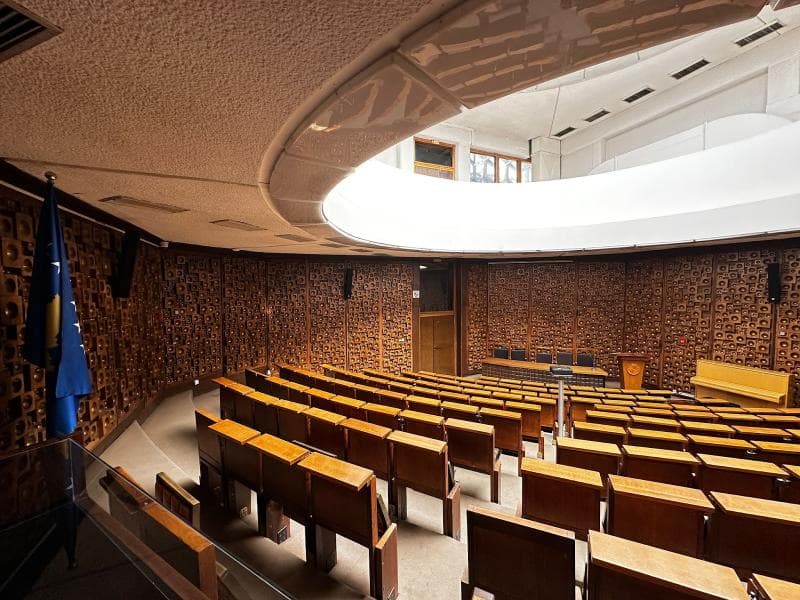
Explore the Reading Halls of the National Library of Kosovo in Pristina. Discover its unique Brutalist architecture, rich history, and vast collections.
Overview
Deep within the distinctive and often-debated architecture of the National Library of Kosovo in Pristina lies a world of quiet contemplation: its Reading Halls. More than just spaces for study, these halls are the intellectual heart of the institution, providing a sanctuary for students, researchers, and curious visitors alike. Designed by Croatian architect Andrija Mutnjaković and inaugurated in 1982, the entire library building is a striking landmark, instantly recognizable by its complex interplay of concrete cubes, 99 domes, and an enveloping metal mesh. The Reading Halls themselves embody the library's mission to collect, preserve, promote, and make accessible the rich documentary and intellectual heritage of Kosovo.
These dedicated areas offer a focused environment where the past and present of Kosovar knowledge converge. Housing an extensive collection of nearly two million volumes, including rare books, historical manuscripts, and an archive of national newspapers, the Reading Halls are where this vast repository comes to life. Visitors are invited to immerse themselves in a setting where natural light filters softly through the unique dome structures, creating an atmosphere conducive to deep thought and discovery.
History & Cultural Background
The journey of the National Library of Kosovo, and by extension its Reading Halls, is deeply intertwined with the nation's own tumultuous history. Established officially in Prizren in 1944, the library's role as a guardian of cultural memory began long before its current iconic structure came into being. The move to the purpose-built facility in Pristina in 1982 marked a significant milestone, providing a modern home for its burgeoning collections.
However, the library's path was not always smooth. During the 1990s, it came under Serbian control, and its spaces were even used to house refugees from the Yugoslav Wars. More tragically, during the 1998-1999 Kosovo War, the building served as a command center for the Yugoslav army, resulting in the theft of materials, destruction of reading room furniture, and scattering of valuable card catalogues. Following the war, a concerted effort, supported by international bodies like UNESCO, the Council of Europe, and IFLA, led to the rebuilding and re-establishment of its services, emphasizing its resilience and enduring importance to the Kosovar people. Today, the library stands as an active monument of the written word, a testament to the stability of intellect and spirit, and a central hub for cultural and educational events.
What Makes It Special
The Reading Halls of the National Library of Kosovo are special not only for their function but also for their profound connection to the building's unparalleled architectural vision. Croatian architect Andrija Mutnjaković designed a structure that sparks debate and fascination, often described as Brutalist yet deeply infused with local cultural references. The most striking features are the 99 white domes of varying sizes that cap the building, said by some to evoke the traditional Albanian 'qeleshe' headgear, and by others to blend Byzantine and Ottoman architectural forms.
This innovative design extends to the interior, where the domes are not merely decorative but serve a crucial purpose: they flood the reading spaces with ample, even natural light, creating a bright and inviting environment for study. The metal mesh that wraps the exterior, sometimes likened to a fishing net or filigree, also plays a role in creating a pleasant indoor atmosphere by acting as a sunlight protector. Inside, visitors discover sweeping staircases and colorful marble mosaic floors in the lobby, leading to the various reading and research areas.
Stories, Fun Facts & Local Details
The National Library's architecture itself is a story. It has been described as a building that refuses to blend in, a meeting point between tradition and modernity, and a blend of Byzantine and Islamic elements. While some consider it an architectural masterpiece, others have controversially ranked it among the 'ugliest buildings in the world,' making it a continuous point of discussion and a fascinating cultural landmark.
One intriguing detail lies in the inspiration for the domes. While one interpretation links them to the 'qeleshe,' another suggests Mutnjaković drew inspiration from pre-Romanesque architecture of the Balkans, and even proposed the design for the Sarajevo National Library. The library's metal 'veil' is said to evoke Kosovo's traditional filigree craftsmanship, subtly connecting a modern, robust structure to delicate local artistry.
Beyond its exterior, the library holds the oldest item in its collection: a 16th-century copy of Marin Barleti's 'Historia de vita et gestis Scanderbegi Epirotarum principis' (The History of the Life and Deeds of Scanderbeg, Prince of the Epirotes), highlighting the depth of its historical holdings. The lobby of the library is not just a passageway but a vibrant venue for various cultural events, further cementing its role as a dynamic cultural institution within Pristina.
Visitor Perspective
Stepping into the Reading Halls of the National Library of Kosovo offers a unique cultural experience. Whether you're a serious scholar or simply a curious traveler, the atmosphere is designed to inspire and facilitate learning. The main reading rooms can accommodate a significant number of people, with capacities noted for 300 and 100 seats, and other specialized rooms for periodicals and researchers, totaling space for about 600 people to study simultaneously.
While items cannot be borrowed for home use, the ability to access and read materials within these historically significant walls is a privilege for anyone over 18 years old. Visitors are encouraged to bring identification, such as a passport, for entry. The peaceful environment, especially on weekdays, allows for a deep dive into Kosovo's literary treasures, with the unique architectural elements providing an enriching backdrop. The way sunlight filters through the domes in the morning is particularly captivating, transforming the functional spaces into an architectural spectacle. A visit here is not just about books; it's about experiencing a cornerstone of Kosovo's identity and intellectual life.
Coordinates: 21.16222, 42.65722
View on Google Maps💬 How Travelers Describe This Place
Based on community votes
Interesting
910Unique
755Photogenic
374Must See
183Beautiful
28
Traveler Stories
Discover memorable experiences shared by travelers who have visited this place.
No traveler stories yet.
Be the first traveler to share what made this place memorable.

Tour
By
Spot
Discover amazing places around the world. Your journey starts here.
Explore
© 2026 TourBySpot. All rights reserved.