Raphael works
Milan, Italy
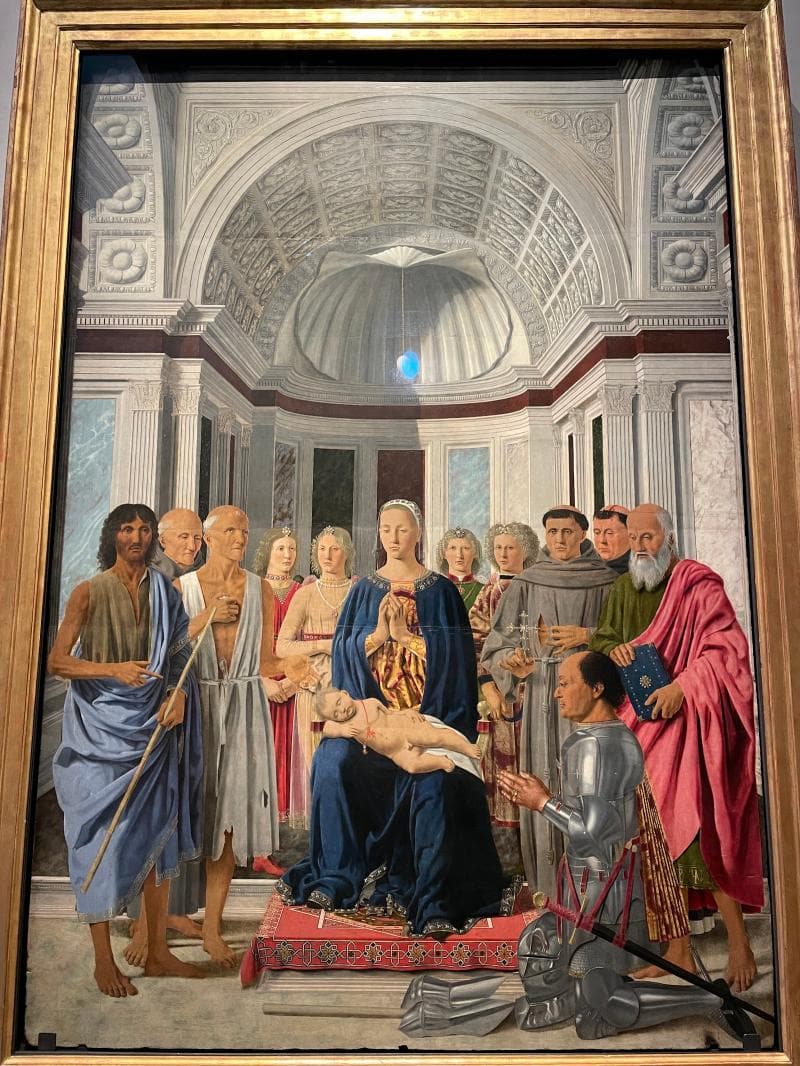
Discover Raphael's 'The Marriage of the Virgin' at Pinacoteca di Brera in Milan, Italy. Explore this High Renaissance masterpiece's history and artistic brilliance.
Overview
Deep within the revered halls of the Pinacoteca di Brera in Milan, Italy, lies a singular masterpiece that draws art enthusiasts from across the globe: Raphael's 'The Marriage of the Virgin' (Lo Sposalizio). This iconic oil painting, completed in 1504, represents a pivotal moment in the young Raphael Sanzio's career, showcasing his burgeoning genius and distinctive style during the High Renaissance. It's not merely a depiction of a biblical event; it's a profound study in perspective, composition, and human emotion, offering a window into the artistic innovations of its time.
The Pinacoteca di Brera itself is Milan's foremost public gallery, housing an impressive collection of Italian paintings spanning from the 13th to the 20th century. Established officially in 1809, the museum's origins trace back to an 18th-century initiative by Maria Theresa of Austria, intended to create a collection of exemplary works for the students of the Brera Academy of Fine Arts, which shares the same historic palace. Raphael's work, therefore, is nestled within a rich tapestry of art history, serving as a beacon of Renaissance achievement.
History & Cultural Background
'The Marriage of the Virgin' was commissioned by Filippo degli Albezzini for his family's chapel in the Franciscan church of San Francesco in Città di Castello. Raphael, then around 21 years old, completed the altarpiece in 1504. The theme, drawn from the apocryphal text 'The Golden Legend,' portrays the marriage ceremony of Mary and Joseph. This narrative was popular in Renaissance art, often depicting numerous suitors for Mary's hand, with Joseph being chosen after his staff miraculously blossomed.
Notably, Raphael's work was inspired by an earlier painting of the same subject by his master, Pietro Perugino, though Raphael's version quickly surpassed his teacher's in dynamism and sophistication. The painting remained in Città di Castello until the late 18th century. Its journey to Milan involved several changes of ownership during the Napoleonic era, eventually being sold to the Italian state in 1806 and subsequently displayed at the newly established Pinacoteca di Brera.
What Makes It Special
Raphael's 'The Marriage of the Virgin' is celebrated for its masterful use of linear perspective, which was groundbreaking for its time. Infrared reflectography reveals a dense network of lines converging on the temple door in the background, creating an incredible sense of depth and three-dimensionality. This mathematical precision in rendering space was a direct application of principles advocated in Piero della Francesca's 'De prospectiva pingendi'.
The composition is a harmonious blend of figures and architecture, carefully arranged in a semicircle that balances the convex line of the temple. Every element is connected by mathematical proportions, showcasing Raphael's belief that beauty resided in an abstract, geometric order. The painting also marks a crucial evolutionary point in Raphael's style, demonstrating his departure from Perugino's influence and the emergence of his signature grace, emotional clarity, and idealized beauty, which would define the High Renaissance.
Stories, Fun Facts & Local Details
One fascinating detail often pointed out by guides is Joseph's blossoming rod. According to the legend, all of Mary's suitors carried rods, but only Joseph's miraculously flowered, signifying his divine selection as her husband. In the painting, a discarded suitor in the foreground is shown breaking his own rod in frustration, adding a touch of human drama to the sacred scene.
Raphael's attention to architectural detail is also remarkable; he even signed and dated the painting—'RAPHAEL URBINAS MDIIII' (1504)—on the frieze of the temple in the background. This demonstrates his profound respect for architecture, a passion that would later see him involved in the construction of St. Peter's Basilica. Viewing this painting provides a unique opportunity to compare it with Perugino's version (now in Caen, France), allowing a direct appreciation of how Raphael refined and innovated upon his master's approach.
Visitor Perspective
A visit to the Pinacoteca di Brera to see 'The Marriage of the Virgin' is an immersive journey into Renaissance artistry. The painting is displayed in Room XXIV, allowing visitors to appreciate its scale and intricate details up close. Beyond Raphael's masterpiece, the museum offers a vast collection, making it a cornerstone of Milan's cultural landscape. The Pinacoteca is conveniently located in the Brera district, a charming area known for its artistic atmosphere, bustling cafes, and unique boutiques, making it a perfect complement to a day of cultural exploration.
The museum strives to make art accessible, sometimes offering special programs like viewing restoration processes through glass walls or experiencing live music alongside the artworks, creating a dynamic and interactive environment. Engaging with 'The Marriage of the Virgin' allows one to witness the genius of a young artist at the peak of his early powers, setting the stage for a career that would profoundly shape the course of Western art.
Coordinates: 9.187408192393892, 45.47100158669917
View on Google Maps💬 How Travelers Describe This Place
Based on community votes
Must See
795Unique
536Beautiful
489Interesting
251Photogenic
88
Traveler Stories
Discover memorable experiences shared by travelers who have visited this place.
No traveler stories yet.
Be the first traveler to share what made this place memorable.

Tour
By
Spot
Discover amazing places around the world. Your journey starts here.
Explore
© 2026 TourBySpot. All rights reserved.