Pyrohoshcha Church
Kiev, Ukraine
Explore Pyrohoshcha Church in Kyiv, Ukraine's Podil district – a historic Orthodox landmark, rebuilt from 12th-century origins, rich in cultural heritage.
Overview
Nestled in the historic Podil district of Kyiv, Ukraine, the Pyrohoshcha Church, also known as the Dormition of the Mother of God Church, stands as a profound testament to resilience and faith. This Orthodox church is not merely a place of worship; it is a living chronicle of Kyiv's intricate past, having been built, destroyed, and meticulously resurrected across nearly nine centuries. Its story is deeply intertwined with the merchant life of old Podil, making it a pivotal cultural and spiritual landmark in the Ukrainian capital. Today, it invites visitors to step back in time and appreciate its rich heritage and architectural beauty.
History & Cultural Background
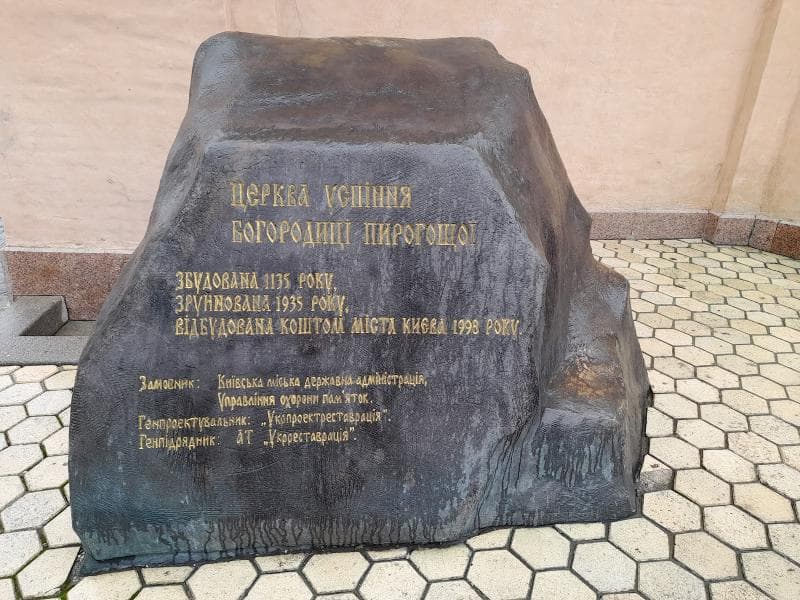
The original Pyrohoshcha Church was a monumental undertaking, constructed between 1132 and 1136 under the patronage of Prince Mstyslav I Volodymyrovych. It marked a significant architectural milestone as the first building erected entirely of brick in Kyivan Rus', diverging from the prevalent stone constructions of the era. Built in the Byzantine style, it featured three naves, apses, and a single dome, with walls adorned with frescoes and floors laid with glazed and mosaic tiles.
Beyond its religious function, the church quickly became the heart of Podil's vibrant merchant community. It served as a central hub, housing an orphanage, a hospital for the poor, and even the municipal archives, highlighting its integral role in the social and administrative life of the district. Throughout the centuries, the church underwent numerous transformations, reflecting the changing architectural trends of its time. It was reconstructed in the Renaissance style in the early 17th century by architect S. Bracci, followed by Baroque renovations in the 1770s by Ivan Hryhorovych-Barsky, and later in the Neoclassical style in 1811 by Andrei Melensky. During the early 17th century, it even temporarily served as the cathedral of the Orthodox metropolitans when the Saint Sophia Cathedral was under Uniate control.
Tragically, the Pyrohoshcha Church met its demise in 1935 when Soviet authorities demolished it as part of an anti-religious campaign, ostensibly to expand a public square. For decades, only its foundations remained, until archaeological excavations in the late 1970s unearthed its ancient past. The vision for its revival took shape, culminating in a careful reconstruction between 1997 and 1998. The aim was to restore the church to a hypothetical medieval Rus' style, once again allowing its domes to grace the Kyiv skyline.
What Makes It Special
The Pyrohoshcha Church holds a distinctive place in Ukrainian history for several compelling reasons. Its multiple cycles of destruction and rebirth symbolize the enduring spirit of Kyiv and its people. Architecturally, it is remarkable for its evolution through various styles – from its original Byzantine form to Renaissance, Baroque, and Neoclassical influences, before its modern reconstruction sought to evoke its early medieval appearance.
Furthermore, its social and civic functions in the medieval period set it apart. It was more than a church; it was a cornerstone of the community, providing essential services and administrative functions to the merchants and tradesmen of Podil. Its name itself, 'Pyrohoshcha', is steeped in cultural lore, believed to be derived either from the Greek word 'pirgotis', meaning 'tower' (referring to icons depicting towers or those placed in them), or from its association with merchants who traded in 'pyrih' (pies or bread). This dual origin story adds a layer of fascinating mystery to its identity.
Stories, Fun Facts & Local Details
One of the most captivating tales associated with the Pyrohoshcha Church revolves around the revered Virgin Mary icon from which it derives its name. This icon, supposedly brought from Byzantium, was said to have been painted by none other than the Evangelist Luke on a board taken from the Cenacle, the Hall of the Last Supper. Such a powerful relic would have imbued the church with immense spiritual significance for centuries.
A fun historical detail is the church's mention in 'The Song of Igor's Campaign', a classic of Old East Slavic literature. Prince Igor, after escaping Polovtsian captivity, is said to have visited this very church upon his return, linking the sacred site to one of the most heroic epics of early Rus'. In a brief but significant period in 1934, the church served as the cathedral for the Ukrainian Autocephalous Church, shortly before its tragic destruction by Soviet authorities. Its reconstruction in the late 1990s was a monumental effort, based on careful archaeological findings from the 1970s, ensuring that its revival was as historically informed as possible.
Visitor Perspective
Today, the Pyrohoshcha Church offers a tranquil and historically rich experience for curious travelers. Located prominently on Kontraktova Square in Podil, it is easily accessible within this vibrant historic district. As an active Orthodox church, it welcomes visitors to explore its grounds and interior, offering a quiet space for reflection and appreciation of its profound history. While there are no strict rules beyond general respectful conduct, visitors are often encouraged to dress modestly, covering shoulders and knees, especially if attending services.
Stepping inside, one can feel the echoes of centuries past, from the prayers of medieval merchants to the artistic visions of various reconstructors. The church stands not just as a building, but as a symbol of Kyiv's enduring faith, cultural resilience, and continuous rebirth, offering a poignant reminder of the city's deep historical layers.
Coordinates: 30.51639, 50.46306
View on Google Maps💬 How Travelers Describe This Place
Based on community votes
Beautiful
540Must See
410Interesting
147Unique
114Photogenic
19
Traveler Stories
Discover memorable experiences shared by travelers who have visited this place.
No traveler stories yet.
Be the first traveler to share what made this place memorable.

Tour
By
Spot
Discover amazing places around the world. Your journey starts here.
Explore
© 2026 TourBySpot. All rights reserved.