Public Square
Sofia, Bulgaria
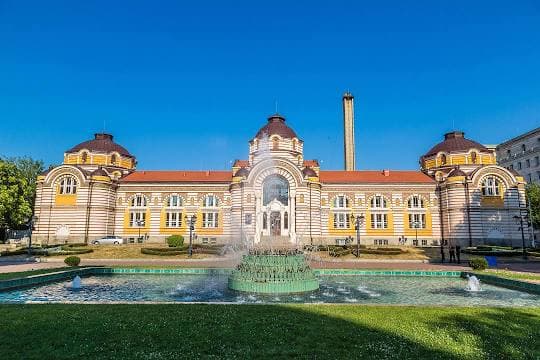
Discover the 'Public Square' at Sofia Central Mineral Baths in Sofia, Bulgaria – a historical hub with thermal springs, stunning architecture, and diverse cultural landmarks.
Overview
The area widely recognized as the 'Public Square' around the Sofia Central Mineral Baths, formally known as Banski Square, serves as a vibrant focal point in Bulgaria's capital. It is an open, inviting space situated in front of the magnificent former bathhouse, which now proudly houses the Sofia Regional History Museum. This square is not merely a transit point but a destination in itself, embodying centuries of Sofia's rich history and its deep connection to natural mineral waters. With its prominent thermal spring taps, where locals and visitors gather to collect warm, healing water, the square pulsates with daily life, offering a unique glimpse into Sofia's enduring traditions.
Surrounded by architectural marvels, including the historic Banya Bashi Mosque and the grand Sofia Central Synagogue, Banski Square forms a remarkable 'Square of Religious Tolerance', showcasing the city's diverse cultural tapestry. The stately building of the Central Mineral Baths, with its distinctive yellow-and-green facade, intricate ceramic mosaics, and elegant domes, stands as a testament to early 20th-century architectural grandeur, blending Vienna Secession, Neo-Byzantine, and Bulgarian National Revival styles.
History & Cultural Background
The historical roots of this public space and the mineral baths run deep, predating the current building by centuries. Sofia, known in Roman times as Serdica, flourished partly due to its abundant mineral springs, which the Romans extensively utilized for bathing and healing purposes. Public baths have existed on or near this site since at least the 16th century, with an Ottoman hammam preceding the current structure. The decision to construct a modern, grand municipal bathhouse at the turn of the 20th century marked Sofia's ambition to embrace European urbanism while honoring its balneological heritage.
Designed by architects Petko Momchilov and Friedrich Grünanger and completed between 1906 and 1913, the Central Mineral Baths quickly became a social epicenter. For decades, it was a place where Sofians met, socialized, relaxed, and shared stories, each wing dedicated separately for men and women. The building's ornate exterior, adorned with ceramic majolica by artists Haralampi Tachev and St. Dimitrov, integrated national romanticism with European Secessionist influences, making it an architectural masterpiece. Although it ceased functioning as a bathhouse in 1986 due to its deteriorating condition, its legacy as a site of healing and community gathering continues through the free-flowing mineral springs outside and its new role as a custodian of Sofia's past.
What Makes It Special
What truly sets this 'Public Square' apart is the seamless blend of history, architecture, and living tradition. It's one of the few places in a European capital where you can witness people openly collecting hot, naturally carbonated mineral water directly from public taps. This daily ritual connects contemporary Sofians with a practice that dates back millennia, offering a tangible link to their city's ancient past. The warm, sulfur-scented steam rising from the ground near the taps serves as a constant reminder of the geothermal activity beneath the city.
The architectural grandeur of the former Central Mineral Baths building, now the Regional History Museum, provides a stunning backdrop to this lively square. Its vibrant facade, featuring yellow and green hues and intricate decorative elements, is exceptionally photogenic, especially when contrasted with the azure Bulgarian sky. Furthermore, the square's unique position amidst a mosque, a synagogue, and various churches underscores Sofia's historical role as a crossroads of cultures and religions, promoting a powerful message of coexistence.
Stories, Fun Facts & Local Details
The mineral waters flowing here are not just for drinking; historically, they were believed to possess significant healing properties, attracting people from far and wide. The Romans, in fact, attributed the longevity and health of their soldiers to these very waters. Locals often bring large bottles, some passed down through generations, to fill with the warm water, using it for both drinking and home remedies. It's not uncommon to see elders patiently waiting their turn, sometimes exchanging pleasantries or even sharing local gossip, making it a truly authentic social experience.
A fun detail is how the architects of the baths, Petko Momchilov and Friedrich Grünanger, initially faced challenges, with earlier designs by foreign architects being rejected before their Bulgarian-influenced vision was approved. The building itself was a social hub, where 'telyatsi' (bath attendants) provided massages and exfoliation, and women would famously gather to gossip over sweets and coffee while enjoying the therapeutic waters. The area is also close to ancient Roman ruins, visible nearby, constantly reminding visitors of Sofia's deep historical layers.
Visitor Perspective
For the curious traveler, the 'Public Square' around the Sofia Central Mineral Baths offers a multi-sensory and deeply enriching experience. You can stroll through the well-maintained garden, find a bench to relax, and watch the world go by, observing the unique local custom of collecting mineral water. Stepping closer to the springs, you can feel the warmth and subtle scent of the thermal water, and even taste it, bringing you closer to a centuries-old tradition.
The square serves as an excellent starting point for exploring the immediate vicinity, which is packed with historical and cultural landmarks. Beyond admiring the exterior of the former bathhouse, a visit inside the Sofia Regional History Museum provides a comprehensive journey through Sofia's past, from ancient Thracian settlements to the 20th century, all within the beautifully restored interiors of the baths. Whether you're interested in architecture, history, cultural traditions, or simply a unique urban experience, this public square offers a genuine slice of Sofia's soul, leaving a lasting impression of a city deeply connected to its past and its natural resources.
Coordinates: 23.322791, 42.698375
View on Google Maps💬 How Travelers Describe This Place
Based on community votes
Unique
540Must See
470Beautiful
410Photogenic
147Interesting
114
Traveler Stories
Discover memorable experiences shared by travelers who have visited this place.
No traveler stories yet.
Be the first traveler to share what made this place memorable.

Tour
By
Spot
Discover amazing places around the world. Your journey starts here.
Explore
© 2026 TourBySpot. All rights reserved.