Prince Mihailo Monument
Belgrade, Serbia
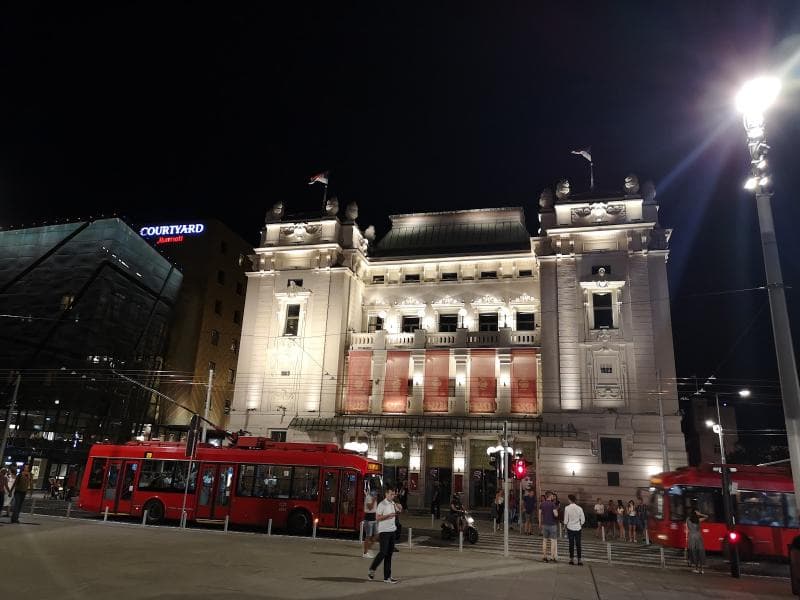
Explore the Prince Mihailo Monument in Belgrade, Serbia. Discover its history, artistic details, and role as a national symbol in Republic Square.
Overview
At the heart of Belgrade, within the bustling Republic Square, stands the majestic Prince Mihailo Monument, an iconic symbol of Serbian national pride and historical triumph. This impressive bronze equestrian statue, unveiled in 1882, commemorates Prince Mihailo Obrenović III, a pivotal figure in Serbia's journey towards independence. It holds the distinction of being the first public monument in Serbia to feature a ruler on horseback. The monument serves not only as a historical marker but also as a vibrant meeting point, deeply integrated into the daily life of Belgrade.
Surrounded by significant cultural institutions like the National Museum and the National Theatre, the monument anchors Republic Square as a central hub for culture, history, and social gatherings. Its presence transforms the square into an open-air museum, where every glance reveals layers of the city's rich past.
History & Cultural Background
The story of the Prince Mihailo Monument is intrinsically linked to Serbia's fight for liberation from Ottoman rule. Prince Mihailo Obrenović III, who reigned twice (1839-1842 and 1860-1868), was instrumental in securing the withdrawal of Turkish garrisons from several key Serbian cities in 1867.
Following his assassination in 1868, a decision was made to erect a monument in his honor. An international competition led to the selection of Italian sculptor Enrico Pazzi from Florence, known for his realistic depictions. Pazzi's work on the monument began in 1874, with the final bronze equestrian statue and pedestal cast in Munich in 1879. The monument was officially unveiled on December 19, 1882, on what was then known as Theater Square.
The location itself carries historical weight. Before the monument and the National Theatre, this area was home to the infamous Stambol Gate, a symbol of Ottoman occupation. Its demolition in 1866, ordered by Prince Mihailo, paved the way for the development of modern Republic Square and the erection of this significant memorial. The monument was declared a Monument of Culture of Great Importance in 1979, solidifying its role in preserving national memory and identity.
What Makes It Special
Beyond its historical significance, the Prince Mihailo Monument is a masterpiece of public art. It is distinguished as Serbia's first public equestrian statue, setting a precedent for such monumental representations. The bronze figure of Prince Mihailo, seated confidently on his horse, features his outstretched arm pointing symbolically towards the territories that were yet to be liberated from Ottoman rule, embodying his vision for a fully independent Serbia.
The monument's pedestal is adorned with intricate bronze reliefs, designed by architect Konstantin Jovanović. These reliefs depict crucial scenes from Serbian history during Prince Mihailo's reign, including allegories representing the cities liberated under his leadership: Belgrade, Smederevo, Kladovo, Užice, Šabac, and Soko. These names are inscribed in gilt letters on three large bronze garlands, transforming the monument into a narrative of national achievement.
The monument has undergone careful preservation efforts, including a significant restoration in 2020, ensuring its detailed artwork and historical integrity remain vibrant for future generations.
Stories, Fun Facts & Local Details
Ask any local in Belgrade where to meet, and chances are they'll tell you 'kod Konja', meaning 'by the horse'. This popular nickname for the Prince Mihailo Monument highlights its role as an unofficial, beloved landmark and a central gathering spot for generations of Belgraders and visitors alike.
Interestingly, when the monument was first unveiled, it reportedly sparked some public debate, with a notable objection being that Prince Mihailo was depicted without a hat. This small detail provides a glimpse into the public's engagement with monumental art and the specific expectations of their historical figures.
For its design, sculptor Enrico Pazzi drew inspiration from renowned equestrian statues in his native Florence, particularly those of the Medici family. This artistic lineage connects Belgrade's monument to classical European sculptural traditions, blending Serbian national aspirations with universal artistic excellence.
Visitor Perspective
Visiting the Prince Mihailo Monument offers a profound connection to Serbian history and culture. Located in the easily accessible Republic Square, it serves as an ideal starting point for exploring Belgrade's urban landscape. You can readily reach it on foot from many central Belgrade locations, and Republic Square is a major public transport hub.
Take your time to walk around the monument, admiring the intricate details of the bronze reliefs and the symbolic gesture of the Prince's outstretched arm. The square itself is a lively area, often filled with street performers, cafes, and a bustling atmosphere, especially in the evenings when the monument is beautifully illuminated, offering stunning photo opportunities. Nearby, you can easily visit the National Museum and the National Theatre, further enriching your historical and cultural immersion in Belgrade.
Coordinates: 20.46012, 44.81645
View on Google Maps💬 How Travelers Describe This Place
Based on community votes
Interesting
551Unique
547Beautiful
336Photogenic
298Must See
219
Traveler Stories
Discover memorable experiences shared by travelers who have visited this place.
No traveler stories yet.
Be the first traveler to share what made this place memorable.

Tour
By
Spot
Discover amazing places around the world. Your journey starts here.
Explore
© 2026 TourBySpot. All rights reserved.