Prayer Wheels
Ulaanbaatar, Mongolia
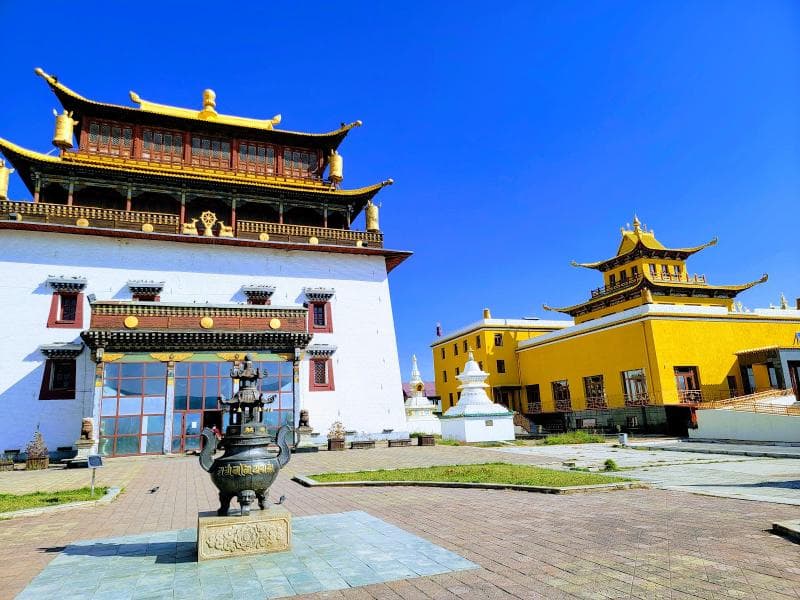
Discover the spiritual significance of prayer wheels at Gandan Monastery in Ulaanbaatar, Mongolia. Learn about their history, cultural role, and the meditative practice of turning them clockwise for blessings.
Overview
At the heart of Ulaanbaatar, Mongolia, lies the Gandan Monastery, a vibrant center of Mongolian Buddhism. Within its serene courtyards and along its pilgrimage paths, visitors encounter numerous prayer wheels, integral to the spiritual life of the monastery and its devotees. These cylindrical devices, known as Mani wheels in Tibetan Buddhism, are more than mere objects; they are powerful tools for spiritual practice, inviting all who visit to participate in a centuries-old tradition of devotion and mindfulness.
These prayer wheels, often crafted from metal or wood and sometimes adorned with intricate designs, vary in size from small handheld devices to towering, fixed installations that line the monastery's pathways. Each turn of a prayer wheel is believed to have a profound spiritual effect, equivalent to orally reciting the countless mantras contained within.
History & Cultural Background
The tradition of prayer wheels originated in ancient India, around the 4th to 5th century, before spreading across the Himalayas and becoming a prominent feature of Tibetan Buddhism. This practice was later introduced to Tibet in the 8th century by master Padmasambhava. The Gandan Monastery itself, whose full name Gandantegchinlen Khiid translates to 'The Great Place of Complete Joy,' was founded in 1809 and later moved to its current location in 1838. It served as a vital educational and spiritual hub, evolving into a complex of colleges for Buddhist teachings.
Despite suffering partial destruction during the political purges of the 1930s, Gandan Monastery remarkably survived, becoming the only active monastery in Mongolia for several decades and a symbol of the nation's spiritual resilience. Today, it continues to thrive, with its prayer wheels standing as enduring testaments to the deep-rooted Buddhist faith that has shaped Mongolian culture for centuries.
What Makes It Special
What truly makes the prayer wheels at Gandan special is their profound spiritual significance. Each wheel contains countless copies of sacred mantras, most commonly the six-syllable Sanskrit mantra 'Om Mani Padme Hum,' which is believed to embody compassion. By turning the wheel, practitioners are believed to accumulate wisdom and merit, purify negative karma, and release blessings into the world for the benefit of all sentient beings.
The act of spinning a prayer wheel is a meditative practice, a tangible way to express devotion and connect with the spiritual teachings of Buddhism. The rotation must always be clockwise, a direction that aligns with the cyclical nature of life and the Buddhist philosophy of circulating positive energy. Many of these large, fixed prayer wheels are encountered along the kora, or pilgrimage path, around the monastery's temples, integrating them seamlessly into the daily devotional routines of monks and lay practitioners alike.
Stories, Fun Facts & Local Details
Walking through Gandan's courtyards, you'll often see locals, from elderly devotees to young children, participating in this sacred ritual. It's a common sight to witness pilgrims gently turning the golden or crimson wheels, sometimes rubbing their palms over them for good luck, their faces reflecting a deep sense of peace and concentration. The rhythmic hum of the spinning wheels, often accompanied by the soft chanting of mantras and the occasional ring of bells, creates a deeply spiritual and tranquil atmosphere.
Some of these prayer wheels at Gandan are notably large, such as the 'massive, crimson Mani wheel' towering over visitors, requiring a collective effort to turn. This communal aspect highlights the shared spiritual journey and the collective desire for blessings and well-being. The act of turning a prayer wheel is not just an individual endeavor but a part of the vibrant, living tradition of Mongolian Buddhism, passed down through generations.
Visitor Perspective
For visitors to Gandan Monastery, interacting with the prayer wheels offers a unique opportunity to immerse oneself in the spiritual fabric of Mongolia. While there is no obligation to participate, observing the devotees and respectfully engaging with the practice can be a deeply moving experience. Visitors are encouraged to approach the prayer wheels with a mindset of reverence, following the local custom of turning them clockwise.
This simple act connects you to a profound spiritual heritage and the countless individuals who have sought solace and merit through these ancient devices. It is a moment to pause, reflect, and appreciate the rich cultural and religious traditions that thrive within the 'Great Place of Complete Joy' in Ulaanbaatar. Remember to be mindful and respectful of those engaged in prayer, allowing for a truly authentic and enriching visit.
Coordinates: 106.895, 47.921
View on Google Maps💬 How Travelers Describe This Place
Based on community votes
Photogenic
551Interesting
547Unique
336Beautiful
219Must See
186
Traveler Stories
Discover memorable experiences shared by travelers who have visited this place.
No traveler stories yet.
Be the first traveler to share what made this place memorable.

Tour
By
Spot
Discover amazing places around the world. Your journey starts here.
Explore
© 2026 TourBySpot. All rights reserved.