Prayer Hall
Kuala Lumpur, Malaysia
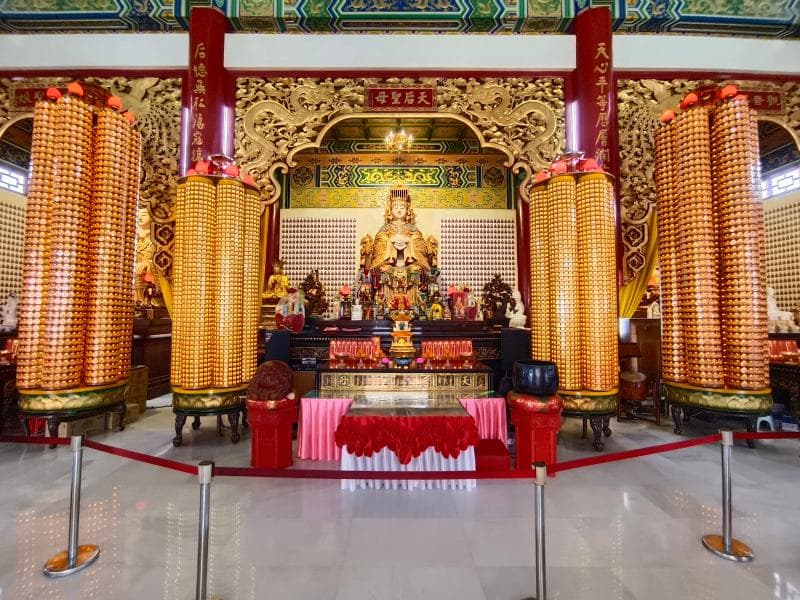
Explore the majestic Prayer Hall of Thean Hou Temple in Kuala Lumpur, Malaysia, honoring Mazu, Guanyin, and Shui Wei Sheng Niang. Discover rich culture.
Overview
Stepping into the Prayer Hall of Thean Hou Temple is to enter the very spiritual heart of one of Southeast Asia's largest and most magnificent Chinese temples, nestled in Kuala Lumpur, Malaysia. This six-tiered religious marvel is dedicated primarily to the revered Chinese Sea Goddess Mazu, but within its sacred walls, devotion is also offered to Guanyin, the Goddess of Mercy, and Shui Wei Sheng Niang, the Goddess of the Waterfront. Located on the fourth level of the temple's grand structure, the Prayer Hall stands as a vibrant testament to faith, culture, and architectural splendor, offering both devotees and curious travelers a profound sense of peace and wonder.
The hall is a focal point of activity, where the air often carries the scent of incense and the soft murmur of prayers. It is here that the temple's three principal deities are enshrined, each presiding over their own ornate altar, drawing countless visitors seeking blessings, guidance, and spiritual connection. The intricate details of its design, from the towering pillars to the spectacular roofs, immediately convey the rich tapestry of Chinese tradition.
History & Cultural Background
Thean Hou Temple itself, and by extension its central Prayer Hall, was a colossal undertaking by the Hainanese community in Kuala Lumpur. Construction began in 1981, with the temple finally completed in 1987 and officially opened to the public in 1989. This dedication project aimed to create a spiritual home and cultural anchor for Hainanese immigrants, a place where their traditions could thrive and be passed through generations.
The temple's design beautifully encapsulates a syncretic blend of Buddhism, Taoism, and Confucianism, reflecting the diverse spiritual practices prevalent among the Chinese community in Malaysia. More than just a place of worship, Thean Hou Temple, with its impressive Prayer Hall, quickly became a significant cultural institution, fostering community ties and serving as a central venue for important discussions and celebrations.
What Makes It Special
The Prayer Hall's distinction lies in its breathtaking grandeur and the palpable spiritual energy it emanates. As visitors enter, they are greeted by three main altars. In the center, Tian Hou Niang Niang (Mazu) takes pride of place, flanked by Guan Yin, the Goddess of Mercy, on the right, and Shui Wei Sheng Niang, the Goddess of the Waterfront, on the left. Each statue is a masterpiece, adorned with intricate details that invite contemplation and reverence.
The architectural elements within the hall are equally captivating. Imposing pillars, often decorated with vibrant colors and mythical creatures like dragons, support elaborately carved ceilings and spectacular, multi-tiered roofs. The visual richness is further enhanced by hundreds of traditional red lanterns, which become a mesmerizing spectacle, especially when illuminated during festivals. This blend of traditional artistry and the sheer scale of the hall makes it a truly immersive experience.
Stories, Fun Facts & Local Details
Mazu, the central deity, carries a profound story as the Goddess of the Sea, traditionally worshipped by sailors and fishermen for protection during their voyages. This resonates deeply with the Hainanese community, many of whom were seafarers. Guanyin, known as the Bodhisattva of Compassion, is often invoked by those seeking mercy and happy, prosperous marriages. In fact, couples often pray to Guanyin within this very temple.
A unique detail found in the Prayer Hall are the Kau Cim oracles, two pairs of which are located between the altars. These traditional fortune-telling devices allow devotees to seek answers and guidance regarding their future. Thean Hou Temple is also famous as a popular venue for marriage registrations and wedding ceremonies, a modern function blending with its ancient spiritual role.
Visitor Perspective
For any traveler, a visit to the Prayer Hall is an enriching cultural journey. While it is a major tourist attraction, it remains an active place of worship. Visitors will often witness devotees engaging in rituals, lighting incense, and offering prayers. Respectful attire is encouraged, and it is customary to remove shoes before entering the Prayer Hall, reflecting reverence for the sacred space.
The atmosphere inside is typically serene, offering a quiet escape from the city's bustle. Beyond the spiritual experience, the temple's hilltop location provides stunning panoramic views of the Kuala Lumpur skyline, making it a perfect spot for reflection and photography. Observing the sincere devotion and the vibrant traditions within this magnificent hall offers a unique window into Chinese-Malaysian culture and spirituality.
Coordinates: 101.68778, 3.12167
View on Google Maps💬 How Travelers Describe This Place
Based on community votes
Must See
673Photogenic
336Interesting
219Unique
186Beautiful
80
Traveler Stories
Discover memorable experiences shared by travelers who have visited this place.
No traveler stories yet.
Be the first traveler to share what made this place memorable.

Tour
By
Spot
Discover amazing places around the world. Your journey starts here.
Explore
© 2026 TourBySpot. All rights reserved.