Ploče Gate Section
Dubrovnik, Croatia
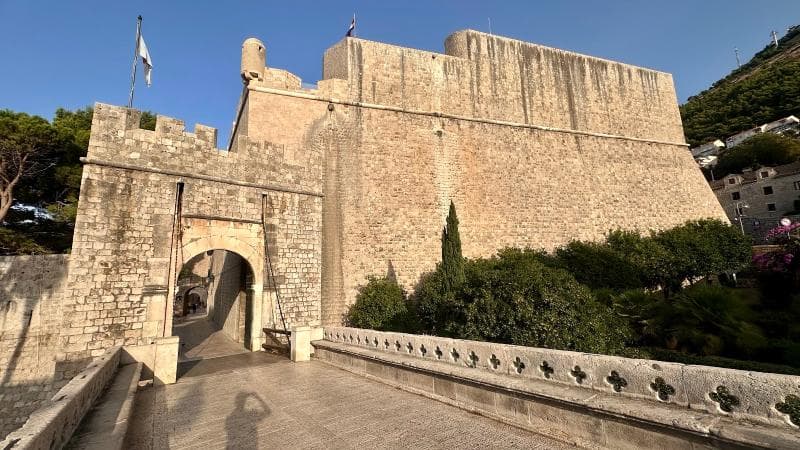
Explore Ploče Gate Section, the historic eastern entrance to Dubrovnik's Old Town, Croatia. Discover its defensive past, architectural beauty, and vital role in the City Walls.
Overview
The Ploče Gate Section, known locally as Vrata od Ploča, serves as the majestic eastern entrance to Dubrovnik's historic Old Town, nestled within the formidable Dubrovnik City Walls in Croatia. Far more than just an entryway, this complex of gates, bridges, and fortifications represents a crucial defensive stronghold and a vibrant portal connecting the ancient city with the modern world. It is an integral part of the UNESCO World Heritage site, offering a dramatic introduction to the city's rich past and its enduring charm. As visitors pass through its arches, they step back in time, directly onto the historic Stradun, Dubrovnik's main thoroughfare. The gate also provides one of the key access points for those wishing to embark on the breathtaking walk along the City Walls, offering panoramic views of the Adriatic Sea, Lokrum Island, and the red-tiled rooftops of the Old Town.
History & Cultural Background
The origins of the Ploče Gate date back to the late 14th century, evolving significantly through the 15th, 16th, and 17th centuries to meet the ever-changing demands of defensive strategies. Originally built in a Romanesque style, the complex gradually incorporated Renaissance elements, reflecting Dubrovnik's continuous efforts to fortify itself against external threats, particularly from the east. The gate's sophisticated design, much like its western counterpart, Pile Gate, featured an inner and outer section connected by a stone bridge and a wooden drawbridge. This drawbridge was famously raised each night, symbolizing the closure and security of the independent Republic of Ragusa.
Key figures in its development include Paskoje Miličević, a local architect and builder, who designed the two bridges linking the gate to the formidable Revelin Fortress in the 15th century. Revelin Fortress itself was strategically placed to protect this vulnerable eastern flank of the city. Later, in 1628, Mihajlo Hranjac oversaw further renovations to the outer gate, enhancing its fortifications. The inner Ploče Gate, sometimes referred to as the Gate of Saint Luka, was built in 1450 based on designs by Simeon della Cava. A notable cultural detail is the statue of Saint Blaise, Dubrovnik's revered patron saint, positioned above the inner gate, holding a model of the city in his hands, symbolizing his protective role over Dubrovnik.
What Makes It Special
What sets the Ploče Gate Section apart is its ingenious multi-layered defensive system and its architectural narrative. It was designed not merely as a simple entrance but as an 'obstacle course' for any potential invader, guiding them through a sequence of bridges, a moat, and double gates, all guarded by the imposing Revelin Fortress. This complex arrangement ensured a controlled flow of people and goods while providing robust protection. The blending of Romanesque and Renaissance architectural styles throughout the different sections of the gate offers a visual journey through the city's historical evolution.
Beyond its defensive prowess, the gate offers stunning aesthetic details. The older Romanesque section, for instance, features a carved figurehead, or 'pulena,' of a mermaid on its inner side, a motif often found on the bows of medieval ships. While less ornate than Pile Gate, Ploče Gate holds its own with its strategic importance and the serene presence of Saint Blaise above its arch, a constant reminder of the city's deep faith and history. The views from the gate itself, overlooking the old port and the azure Adriatic, are truly captivating.
Stories, Fun Facts & Local Details
The Ploče Gate was historically considered the more important entrance to Dubrovnik from the east, as it faced towards the direction from which caravans from the East would arrive, facilitating trade and communication with the wider world. The wooden drawbridge, which was diligently raised and lowered each day, was a daily spectacle, signaling the city's vigilance. Legend has it that the inner gate once bore a defiant inscription, 'Keep far away, ye savages! For centuries, this fortress fears no war, warmed by the breath of the holy old man,' celebrating the city's safety under Saint Blaise. This inscription was later removed during 19th-century renovations by Austrian authorities who widened the passage for vehicular traffic.
In modern times, the Ploče Gate has also found its way into popular culture, serving as a filming location for the acclaimed series 'Game of Thrones,' where it doubled as a gateway into King's Landing. Walking through this gate, you're not only tracing the footsteps of Dubrovnik's historical figures but also stepping onto a set where fictional royalty once strode. The area nearby was also home to Dubrovnik's 'Lazareti,' the quarantine complex, highlighting the Republic's advanced public health measures from as early as the 14th century, where people and goods were held before entering the city to prevent the spread of disease.
Visitor Perspective
Today, the Ploče Gate Section remains a vital and bustling entry point into Dubrovnik's Old Town. Many visitors arriving from the eastern part of the city or nearby hotels will find this their primary access. The experience of entering through Ploče Gate is arguably one of the most dramatic introductions to the city, immediately immersing you in its historical atmosphere. It leads directly to Luža Square and Stradun, making it a convenient starting point for exploring the city's main attractions, including the Dominican Monastery and the Church of Saint Blaise.
For those eager to walk the iconic Dubrovnik City Walls, the Ploče Gate offers a less crowded entrance compared to Pile Gate, especially during peak season, making for a potentially more serene beginning to your exploration. From the ramparts above, you're treated to postcard-perfect vistas of the harbor, the terracotta rooftops, and the surrounding Adriatic Sea. While the climb to the walls still involves steps, the reward is an unparalleled perspective on Dubrovnik's architectural grandeur and strategic layout.
Coordinates: 18.112739, 42.642
View on Google Maps💬 How Travelers Describe This Place
Based on community votes
Photogenic
692Beautiful
674Must See
503Interesting
261Unique
49
Traveler Stories
Discover memorable experiences shared by travelers who have visited this place.
No traveler stories yet.
Be the first traveler to share what made this place memorable.

Tour
By
Spot
Discover amazing places around the world. Your journey starts here.
Explore
© 2026 TourBySpot. All rights reserved.