Planetarium
Munich, Germany
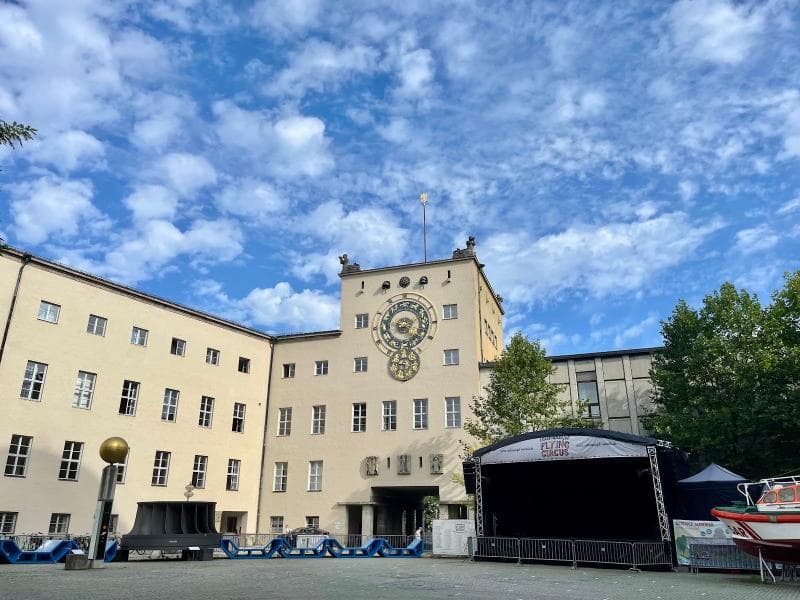
Discover the historic Planetarium at the Deutsches Museum in Munich, Germany, the site of the world's first projection planetarium. Currently closed for renovation until 2028.
Overview
Nestled within the vast and impressive Deutsches Museum in Munich, Germany, lies the Planetarium – a sub-spot of profound historical and scientific significance. It's not merely an attraction, but a landmark in the history of astronomy education, renowned as the site of the world's first projection planetarium. This pioneering institution, envisioned by the museum's founder Oskar von Miller, brought the cosmos closer to the public in an unprecedented way, revolutionizing how we understand the night sky.
Although currently undergoing renovations until 2028, the Planetarium, when operational, offers visitors an unparalleled journey through the universe. Through cutting-edge technology, it recreates the starry firmament with breathtaking accuracy, allowing for immersive experiences that transcend time and space. From viewing ancient constellations to exploring distant galaxies, the Deutsches Museum Planetarium is a testament to human curiosity and ingenuity, making the wonders of the cosmos accessible to everyone.
History & Cultural Background
The story of the Deutsches Museum Planetarium begins in 1913 with Oskar von Miller, the visionary founder of the Deutsches Museum. He approached the renowned optical company Zeiss with a groundbreaking idea: to create a 'rotating star sphere' for his new museum, an apparatus that could accurately depict the movements of celestial bodies. After the interruptions of World War I, under the leadership of Dr. Walther Bauersfeld, Zeiss successfully developed the world's first projection planetarium between 1919 and 1923.
This marvel of engineering officially opened its doors at the Deutsches Museum on May 7, 1925. The initial Zeiss Model I projector could illuminate a dome with 4,500 stars, along with the Milky Way, the Sun, Moon, and five planets. This innovation fundamentally changed astronomy education, moving beyond static models to dynamic, projected representations that could replicate the changing skies across seasons and Earth's rotation. Its success spurred the construction of thousands of planetariums worldwide, solidifying the Deutsches Museum's place as the birthplace of modern planetarium technology.
What Makes It Special
What truly sets the Deutsches Museum Planetarium apart is its pioneering legacy combined with its commitment to technological advancement. As the world's first projection planetarium, it established the blueprint for all others, turning a groundbreaking concept into a global phenomenon.
In its operational state, the Planetarium houses an ultra-modern Zeiss-Skymaster ZKP4 optical fiber star projector, equipped with LED light sources and approximately 7,300 optical fibers. This sophisticated system allows for the demonstration of a perfect starry sky, planetary movements, and celestial phenomena, free from light pollution. Visitors can experience not only the night sky above Munich but also the heavens as seen from any point on Earth, or even how they appeared millennia ago, and how they will look in the distant future.
Beyond star gazing, the Planetarium offers immersive virtual journeys. Guests can virtually travel 13.7 billion light years to the edge of the observable universe, approaching planets and viewing our solar system or the Milky Way from an external perspective within its 15-meter projection dome. A significant renovation between 2013 and 2015 replaced older slide projectors with six advanced digital projectors, further enhancing the immersive experience and bringing the entire observable universe to life.
Stories, Fun Facts & Local Details
The journey to create the planetarium involved a decade of collaborative effort by mechanics, engineers, astronomers, and physicists. The initial breakthrough, often referred to as the 'Miracle of Jena,' occurred in the summer of 1923 when the first artificial starry sky shone there, proving the projection concept was viable.
Imagine the awe of early visitors in 1925, witnessing 4,500 stars projected with intricate detail onto the dome – a sight previously unimaginable to the general public. This innovative device quickly gained international acclaim, with images circulated on postcards, inspiring institutions globally to build their own. The Planetarium's ability to compress a 13.7-billion-light-year journey to the edge of the cosmos into just ten minutes of presentation is a captivating feat, demonstrating the incredible power of modern projection technology.
Historically, the Planetarium in the Deutsches Museum has welcomed millions of visitors, averaging around 80,000 per year prior to its current closure, highlighting its enduring popularity and educational impact.
Visitor Perspective
For travelers planning a visit to the Deutsches Museum in Munich, it is crucial to note that the Planetarium is currently closed. It has been undergoing extensive renovations since July 2022 as part of a larger modernization project for the second half of the museum building. The Planetarium is expected to reopen in 2028, coinciding with the museum's 125th anniversary.
While the Planetarium itself is temporarily inaccessible, the Deutsches Museum remains a world-leading science and technology museum with an astounding collection of approximately 125,000 objects across 50 fields. Visitors can still explore numerous other captivating exhibitions, including the broader Astronomy exhibition which the Planetarium complements. Even with the Planetarium closed, the museum offers a wealth of knowledge and interactive displays to satisfy any curious mind, making it a worthwhile destination for families and science enthusiasts alike.
Coordinates: 11.5830498, 48.1295845
View on Google Maps💬 How Travelers Describe This Place
Based on community votes
Interesting
998Photogenic
481Beautiful
472Must See
399Unique
92
Traveler Stories
Discover memorable experiences shared by travelers who have visited this place.
No traveler stories yet.
Be the first traveler to share what made this place memorable.

Tour
By
Spot
Discover amazing places around the world. Your journey starts here.
Explore
© 2026 TourBySpot. All rights reserved.