Piazza del Duomo
Milan, Italy
Explore Piazza del Duomo, Milan, Italy's vibrant heart. Discover its rich history, stunning Gothic architecture, and cultural landmarks.
Overview
Piazza del Duomo, or Cathedral Square, stands as the vibrant, beating heart of Milan, Italy. More than just a square, it is the city's central point, both geographically and culturally, a grand stage dominated by the magnificent Duomo di Milano. This expansive rectangular plaza, covering approximately 17,000 square meters, serves as a bustling hub where Milanese life unfolds daily, attracting both locals and curious travelers. It acts as a primary gateway to many of Milan's historical and cultural treasures, making it an essential first stop for anyone exploring this dynamic city.
The square's grandeur is accentuated by the architectural marvels that flank its perimeter, including the majestic Milan Cathedral, the elegant Galleria Vittorio Emanuele II, and significant cultural institutions like the Royal Palace and Museo del Novecento. It’s a place where centuries of history seamlessly blend with Milan's modern, cosmopolitan identity, offering a visual feast and a profound sense of place.
History & Cultural Background
The origins of Piazza del Duomo can be traced back to the 14th century. In 1330, Milan's lord, Azzone Visconti, initiated the clearing of taverns and existing churches, Santa Maria Maggiore and Santa Tecla, to create a market square called 'Piazza dell'Arengo'. This early incarnation marked the beginning of the square's evolution.
However, the piazza's current monumental form is largely the result of a significant redesign in the second half of the 19th century by architect Giuseppe Mengoni. Following the Second Italian War of Independence, a competition was launched to radically redesign the square. Mengoni's winning plan, executed between 1865 and 1873, involved enlarging the square through demolitions and introducing the iconic surrounding buildings, including the Galleria Vittorio Emanuele II and the two 'Palazzi dei Portici'. Mengoni tragically died during the works, falling from a scaffolding in the square in 1877.
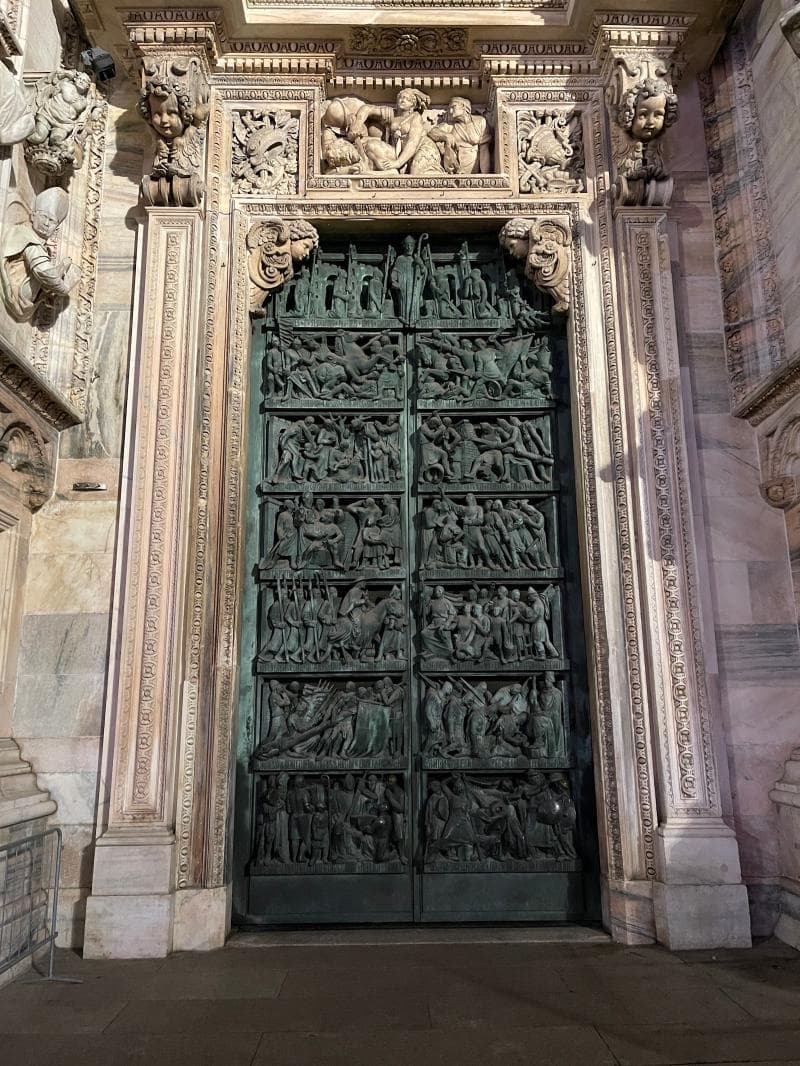
While the square developed, the Duomo itself underwent a colossal construction period spanning nearly six centuries, beginning in 1386 and officially concluding in 1965 with the installation of the last bronze door. This extended timeline explains the cathedral's unique blend of architectural styles and the ongoing nature of its preservation.
What Makes It Special
Piazza del Duomo is distinguished by its stunning concentration of architectural masterpieces. The undeniable centerpiece is the Duomo di Milano, a breathtaking Gothic cathedral renowned for its intricate façade, 135 spires, and over 3,400 statues. It is one of the largest cathedrals in the world and Italy's largest.
The cathedral is built predominantly from Candoglia marble, a unique pink-white marble transported via canals, which gives it a distinctive luminous quality. Visitors can ascend to the Duomo's rooftop terraces, offering a rare opportunity to walk among the spires and gargoyles while enjoying panoramic views of Milan and, on clear days, even the Alps.
Adjacent to the Duomo is the magnificent Galleria Vittorio Emanuele II, a 19th-century shopping arcade often called 'Milan's drawing room'. This elegant structure boasts a stunning glass and iron dome, mosaic floors, and houses prestigious shops and cafes. The Royal Palace (Palazzo Reale), once a seat of government, now serves as a significant cultural center hosting art exhibitions. Next to it, the Palazzo dell'Arengario houses the Museo del Novecento, dedicated to 20th-century Italian art, offering another cultural gem right on the square.
Stories, Fun Facts & Local Details
- The Madonnina's Reign: Perched atop the Duomo's main spire since 1774, the gilded bronze statue of the Virgin Mary, known as the Madonnina, traditionally marked the highest point in Milan. For centuries, an unwritten rule decreed that no building in the city could surpass her height, a tradition still honored by placing a replica on top of any newer, taller structures.
- The Bull's Superstition: Inside the Galleria Vittorio Emanuele II, on the mosaic floor of the central octagon, there is a depiction of a bull. Local tradition holds that spinning three times on its reproductive organs with your right heel brings good luck.
- A Nail from the True Cross: The Duomo houses a revered relic – a nail believed to be from the True Cross of Christ. This relic is historically brought down and displayed to the faithful once a year.
- Beneath the Surface: Extensive archaeological remains lie beneath the Duomo, revealing the foundations of earlier Roman and medieval churches, including the Basilica of Santa Tecla and the Baptistery of San Giovanni alle Fonti, accessible to visitors.
- The Cathedral of Statues: The Duomo boasts a world record number of statues, with over 3,400 adorning its exterior and interior, depicting saints, biblical figures, and even mythical creatures, telling stories across centuries.
Visitor Perspective
Visiting Piazza del Duomo is an immersive experience that caters to all types of travelers. The square itself is pedestrian-friendly, providing ample space to admire the cathedral's intricate facade, people-watch, or simply soak in the vibrant atmosphere. It's easily accessible via Milan's metro system, with a dedicated 'Duomo' station on both the M1 (red) and M3 (yellow) lines.
For those planning to enter the Duomo, appropriate attire is essential: shoulders and knees must be covered. Buying tickets in advance, especially for rooftop access, is highly recommended to avoid long queues. Early mornings offer a calmer experience inside the cathedral, while late afternoon provides spectacular views from the rooftops as the sun sets. A combined ticket often includes access to the cathedral, its terraces, the Duomo Museum, and the archaeological area, offering a comprehensive historical and artistic journey.
Allow sufficient time – a balanced visit exploring the interior and rooftops typically takes 1.5 to 2 hours, while a full experience including the museum and archaeological area can extend to 2.5 to 3 hours. After exploring the Duomo complex, the square offers an excellent starting point for further exploration of Milan's nearby attractions like the Galleria Vittorio Emanuele II, the Royal Palace, and Teatro alla Scala.
Coordinates: 9.1874, 45.4585
View on Google Maps💬 How Travelers Describe This Place
Based on community votes
Interesting
923Beautiful
587Must See
334Unique
309Photogenic
232
Traveler Stories
Discover memorable experiences shared by travelers who have visited this place.
No traveler stories yet.
Be the first traveler to share what made this place memorable.

Tour
By
Spot
Discover amazing places around the world. Your journey starts here.
Explore
© 2026 TourBySpot. All rights reserved.