Photography Spots
Chisinau, Moldova
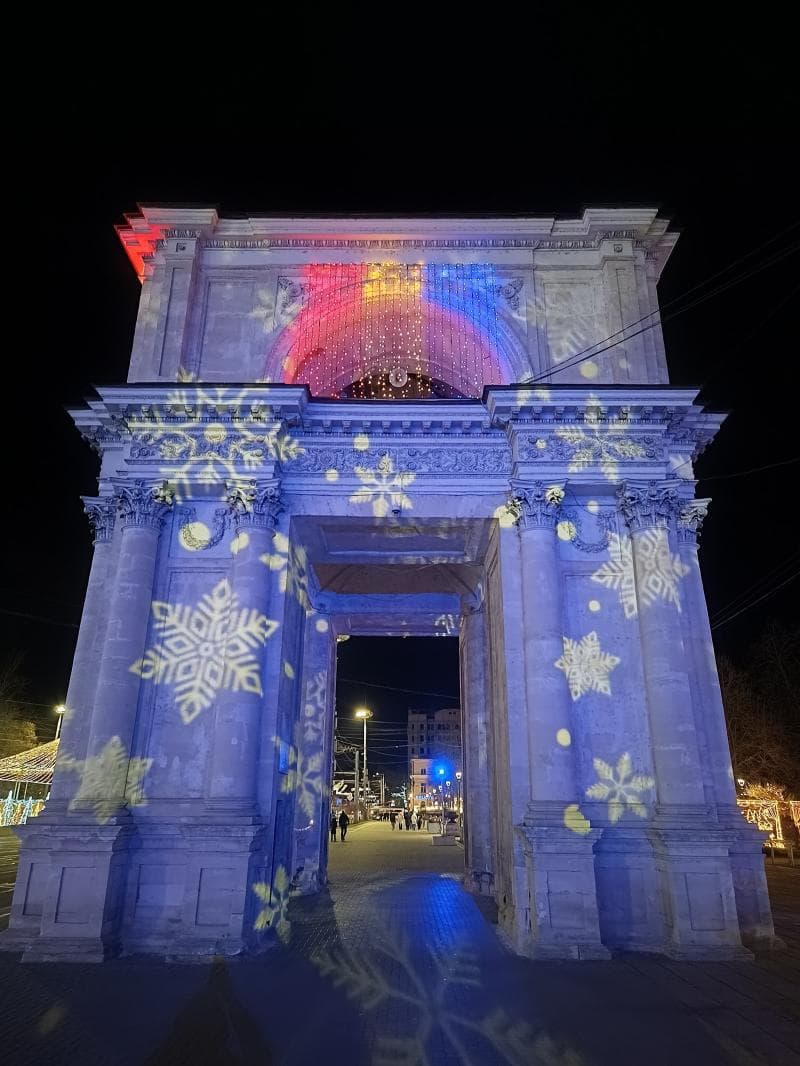
Explore Chisinau's Triumphal Arch, a neoclassical landmark in Moldova's capital. Discover its rich history, unique stories, and best photography spots.
Overview
Standing proudly in the vibrant heart of Chisinau, Moldova, the Triumphal Arch, known locally as Arcul de Triumf or the 'Holy Gates,' is more than just a monument; it is a gateway to the city's rich past and a beloved symbol of its enduring spirit. Erected between 1840 and 1841, this neoclassical masterpiece commemorates the pivotal victory of the Russian Empire over the Ottoman Empire during the Russo-Turkish War of 1828-1829. Situated prominently on the Great National Assembly Square, directly opposite the Government House and adjacent to the majestic Nativity Cathedral and its verdant park, the arch forms an integral part of Chisinau's central architectural ensemble.
Crafted from polished white stone, the arch rises to an impressive height of 13 meters, characterized by its elegant square plan and two distinct levels. Its stately presence is accentuated by ornate Corinthian columns and intricate ceramic decorations. A functioning mechanical clock graces its facade, a timeless sentinel marking the hours for passersby. Revered by locals and admired by visitors, the Triumphal Arch is not merely a historical landmark but a focal point for national celebrations and a popular gathering place. Its striking beauty and historical depth have even led some to rank it among the world's most beautiful triumphal arches.
History & Cultural Background
The story of Chisinau's Triumphal Arch is as captivating as its facade. Its construction, initiated by Governor Vorontsov, was entrusted to the architect Luca Zaușkevici (also known as Ivan Zaushkevich). The arch's very existence stems from an intriguing twist of fate: it was originally conceived not just as a monument of victory, but as a fitting home for a colossal 6.4-ton bell. This bell, cast from captured Turkish cannons, was intended for the newly built Nativity Cathedral. However, upon its arrival, it was discovered to be too large for the cathedral's belfry. Thus, the Triumphal Arch was expediently designed and built to house this magnificent, oversized bell, giving it a somewhat 'accidental' origin story.
Throughout its history, the arch has witnessed and reflected Moldova's shifting political landscape. The first clock was installed in 1842, a gift from Governor Pavel Fyodorov, though it underwent several replacements over the decades due to damage from wind and even wartime explosions during World War II. In 1945, marble memorial plaques inscribed with the names of Soviet heroes from World War II were affixed to its pillars. These historical markers, however, were removed in 1991 following Moldova's declaration of independence, symbolizing a profound shift in national identity and historical narrative. The arch received a significant restoration in 1973, ensuring its continued grandeur.
What Makes It Special
For those with a camera in hand, the Triumphal Arch offers an abundance of photographic opportunities. Its prime location is arguably its most significant asset. Nestled between the grand Nativity Cathedral and the lush Cathedral Park, the arch provides a picturesque frame for numerous shots. The careful alignment between the arch and the cathedral allows for stunning 'two-in-one' compositions, capturing both iconic landmarks in a single frame.
The arch's neoclassical design, characterized by its symmetrical structure, pristine white stone, and detailed Corinthian columns, makes it a visually appealing subject from any angle. The distinctive clock on its upper tier adds a unique point of interest. As daylight fades, the Triumphal Arch transforms into a beacon of warm light, becoming an especially enchanting subject for evening photography. The elegant illumination highlights its architectural details and creates a magical atmosphere, perfect for capturing memorable night shots. Its position overlooking the Great National Assembly Square also allows for dynamic shots, capturing the daily life of Chisinau against a backdrop of historical elegance. The surrounding park also provides natural elements like trees and flowers that can enhance foregrounds or backgrounds, offering a blend of urban grandeur and natural beauty for compelling photographs.
Stories, Fun Facts & Local Details
Beyond its striking appearance, the Triumphal Arch is steeped in fascinating stories and local lore. Perhaps the most charming tale is its 'accidental' construction – built primarily because a massive church bell proved too large for its intended belfry, necessitating a dedicated structure to house it. This unique origin has cemented its place in local memory. The arch has also garnered several affectionate nicknames over time, including 'Holy Gates,' a nod to its spiritual proximity to the Nativity Cathedral, and 'Arch of Victory,' reflecting its commemorative purpose.
The clock gracing the arch has a history of its own, enduring several replacements and repairs. It faced damage from strong winds that once tore off its dial and later from the bombings of World War II, a testament to the arch's resilience through turbulent times. Impressively, the Chisinau Triumphal Arch has been recognized on an international scale, reportedly ranking as the fifth most beautiful triumphal arch globally by 'Aeroflot Premium' magazine, an honor that fills locals with pride. The bells housed within, originally cast from captured Turkish cannons, serve as a tangible link to the historical conflict the arch commemorates, intertwining military history with architectural purpose. The removal of Soviet-era plaques in 1991 subtly narrates Moldova's journey towards independence and the reclaiming of its historical narrative.
Visitor Perspective
Visiting the Triumphal Arch offers a delightful and easily accessible experience for any traveler to Chisinau. Located in a central, pedestrian-friendly zone, it is effortlessly reached on foot or via public transportation, making it a convenient stop on any city itinerary. There is no entrance fee, allowing everyone to appreciate its historical and architectural grandeur without cost.
The arch serves as an excellent starting point for further exploration of Chisinau's city center. Just steps away lie the serene Nativity Cathedral and its accompanying park, as well as the bustling Great National Assembly Square. The National Museum of History of Moldova is also within a short walk, offering deeper insights into the nation's heritage. The area surrounding the arch is well-lit and safely patrolled, making it an enjoyable destination even for an evening stroll. Observing locals and visitors alike gather, particularly during national holidays when military parades and cultural performances often take place here, provides a vibrant cultural experience and a true sense of Chisinau's community spirit. It is a place where history feels alive, inviting curious travelers to pause, reflect, and capture the essence of Moldova's capital.
Coordinates: 28.8325, 47.02472
View on Google Maps💬 How Travelers Describe This Place
Based on community votes
Unique
915Photogenic
873Beautiful
123Must See
74Interesting
53
Traveler Stories
Discover memorable experiences shared by travelers who have visited this place.
No traveler stories yet.
Be the first traveler to share what made this place memorable.

Tour
By
Spot
Discover amazing places around the world. Your journey starts here.
Explore
© 2026 TourBySpot. All rights reserved.