Philharmonic Stage
Bucharest, Romania
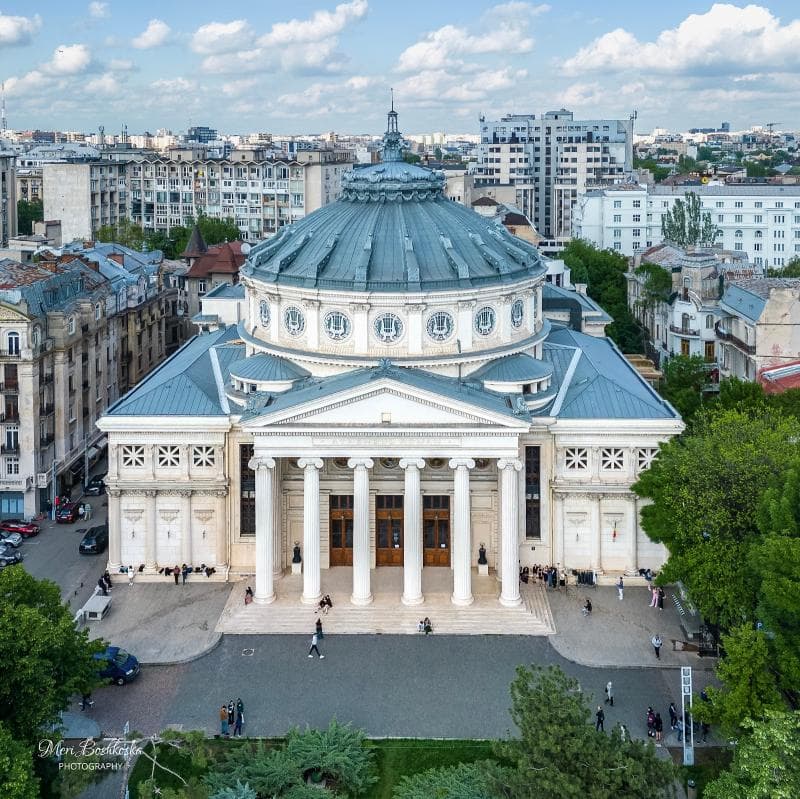
Discover the Philharmonic Stage at the Romanian Athenaeum in Bucharest, Romania. Explore its history, unique architecture, and world-class acoustics.
Overview
The Philharmonic Stage, nestled within the magnificent Romanian Athenaeum in Bucharest, Romania, stands as the pulsating heart of classical music and cultural expression in the country. This ornate, domed, circular building, inaugurated in 1888, is not merely a venue but a national landmark and the most prestigious concert hall in the city. It serves as the esteemed home of the 'George Enescu' Philharmonic Orchestra and a primary stage for the internationally renowned George Enescu Festival. Visitors are greeted by a masterpiece of Neoclassical architecture, featuring intricate columns and a grand dome that hints at the artistic treasures within. The main performance area, often referred to as the Grand Auditorium, boasts exceptional acoustics and an amphitheater-style seating arrangement for nearly 800 guests, ensuring an immersive experience for every concert-goer.
History & Cultural Background
The genesis of the Romanian Athenaeum dates back to 1865, when a group of influential cultural and scientific figures, including Constantin Esarcu, established the Romanian Athenaeum Cultural Society. Their ambitious vision was to create a dedicated hub for art and science in Bucharest. The task of designing this iconic structure fell to the French architect Albert Galleron. What makes its construction particularly compelling is that a significant portion of its funding was raised through a 28-year-long public subscription campaign, famously rallied under the slogan, 'Donate one leu for the Ateneu!' This collective effort underscores the deep-seated community commitment to the arts. An interesting historical detail is that the Athenaeum was built upon the abandoned foundation of a former American circus, a circumstance that ingeniously influenced its distinctive circular design. Although inaugurated in 1888, construction efforts continued for several years, ultimately concluding in 1897. The George Enescu Philharmonic Orchestra, initially formed as the Romanian Philharmonic Society in 1868, found its permanent residence in the Athenaeum in 1889, cementing the building's role as a cornerstone of Romania's musical heritage. The Athenaeum has gracefully withstood the passage of time, including the ravages of World War II, and its enduring significance was formally recognized in 2007 with its inscription as a European Heritage site and in 2015 as a Grade-A Romanian Historical Monument.
What Makes It Special
The Philharmonic Stage within the Romanian Athenaeum is celebrated for a confluence of features that elevate it beyond a mere performance space. Foremost among these are its widely acclaimed, exceptional acoustics, which have been meticulously preserved to ensure the integrity of every musical performance. Architecturally, the building is a stunning example of Neoclassical design, characterized by its intricate columns, elegant arches, and the majestic dome that crowns it. Inside, visitors are transported to a world of opulence, with lush decorations, golden accents, a grand staircase, and marble columns creating an atmosphere of refined grandeur. Perhaps one of its most breathtaking artistic elements is the monumental circular fresco, painted by Costin Petrescu, which adorns the hallway leading to the concert hall. This 'Great Fresco' vividly depicts twenty-four significant moments in Romanian history, offering a visual narrative of the nation's past. The amphitheater-style arrangement of its seating not only optimizes sightlines but also contributes to the intimate connection between audience and performer. As a symbol of Romanian culture and national identity, the Athenaeum is regarded as one of Europe's most beautiful and important concert halls.
Stories, Fun Facts & Local Details
Behind the majestic facade of the Athenaeum lie captivating stories and charming local details. The prolonged fundraising campaign, 'Donate one leu for the Ateneu!', epitomizes the profound collective spirit that brought this cultural edifice to life. This 28-year public endeavor secured its construction and remains a cherished piece of Bucharest's lore. The Athenaeum's unique circular form is often attributed to its unconventional foundation: it was built on the remains of an abandoned American circus, a quirky detail that adds to its distinct character. The stunning 'Great Fresco' above the stage is not just art but a historical chronicle, with scenes ranging from the Roman Emperor Trajan's conquest of Dacia to the modern unification of Romanian regions. The venue has been a stage for some of the world's most illustrious musical talents, hosting legendary musicians and conductors throughout history, including Jacques Thibaud, Pablo Casals, Igor Stravinsky, Richard Strauss, Yehudi Menuhin, and Herbert von Karajan. Locals often emphasize that the Athenaeum is a living, breathing cultural institution, not a static museum, constantly hosting active performances. Interestingly, some visitors have reported experiencing informal 'tours' given by security personnel for a nominal fee, though official tours are typically arranged through the philharmonic.
Visitor Perspective
For a curious traveler, experiencing the Philharmonic Stage at the Romanian Athenaeum offers more than just a performance; it provides a deep dive into Romanian culture. The most recommended way to appreciate this architectural and acoustic marvel is to attend a live concert by the 'George Enescu' Philharmonic Orchestra. This offers a chance not only to witness world-class music but also to engage in a cultural immersion, observing local customs and the reverent appreciation for classical traditions that have thrived here for over 130 years. Upon entering, the grand marble hall with its Doric columns immediately sets a tone of elegance, serving as a magnificent prelude to the main concert space. Inside, the awe-inspiring acoustic quality truly brings the music to life, an experience often described as giving 'goosebumps'. Even without attending a concert, the Athenaeum's exterior, especially when illuminated at night, is a sight to behold, and the surrounding gardens offer a pleasant setting for a leisurely stroll. The central location of the Athenaeum in Bucharest ensures easy accessibility, making it a convenient and essential stop on any cultural itinerary. From the visual splendor of the Great Fresco to the auditory delight of its performances, a visit to the Philharmonic Stage promises a memorable and enriching encounter with Romania's vibrant artistic soul.
Coordinates: 26.0973, 44.4413
View on Google Maps💬 How Travelers Describe This Place
Based on community votes
Interesting
685Unique
446Photogenic
399Must See
152Beautiful
33
Traveler Stories
Discover memorable experiences shared by travelers who have visited this place.
No traveler stories yet.
Be the first traveler to share what made this place memorable.

Tour
By
Spot
Discover amazing places around the world. Your journey starts here.
Explore
© 2026 TourBySpot. All rights reserved.