Peribolos Wall
Athens, Greece
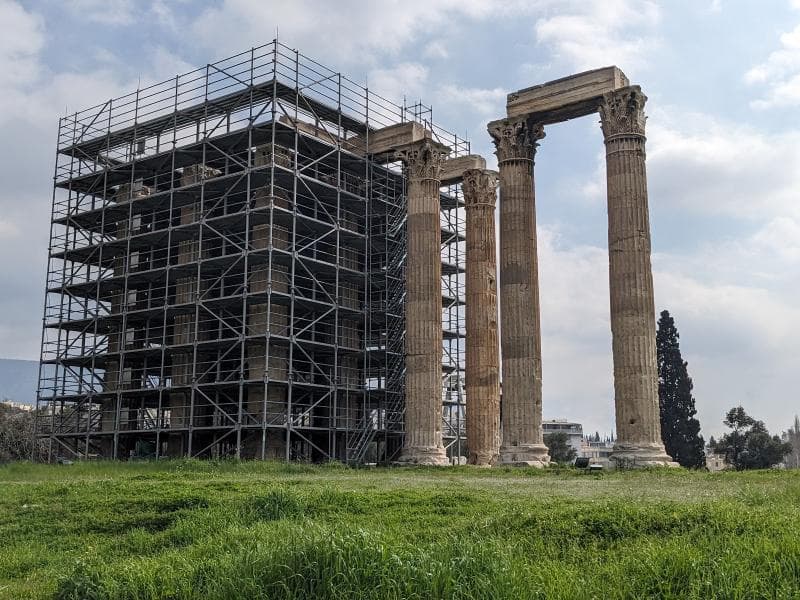
Explore the Peribolos Wall of the Temple of Olympian Zeus in Athens, Greece. Discover its Roman-era history, cultural significance, and what remains today.
Overview
Stepping into the archaeological site of the Temple of Olympian Zeus in Athens, your gaze is immediately drawn to the colossal remnants of the temple itself. Yet, a crucial, often overlooked, element that once completed this grand sanctuary was its Peribolos Wall. This monumental enclosure, built during the Roman period under Emperor Hadrian, was far more than a simple fence; it was a thoughtfully designed boundary that demarcated the sacred precinct, enhancing the temple's majesty and setting it apart from the bustling ancient city. Encompassing a vast area, the Peribolos Wall framed the largest temple in Greece, creating a visual and spiritual separation for the worship of Zeus.
History & Cultural Background
The history of the Peribolos Wall is intrinsically linked to the Temple of Olympian Zeus, a project spanning centuries. While the temple's foundations were laid as early as the 6th century BC by Athenian tyrants, it remained unfinished for an astonishing 638 years. It was during the reign of the Roman Emperor Hadrian, a great admirer of Greek culture, that the temple finally reached completion around 132 AD. Hadrian envisioned not just the temple's completion but also the creation of a magnificent setting befitting such a colossal structure. Between 124 and 132 CE, he oversaw the construction of a walled, marble-paved precinct, which transformed the area into a central focus of the ancient city. This Peribolos Wall, also referred to as a temenos wall, was essential in defining the sacred space (temenos) around the temple, marking it as a special area dedicated to the king of the Olympian gods. Its construction reflects a shift in architectural and religious mentality, where solid, monumental enclosures became a more prominent feature around sanctuaries, moving beyond earlier, more symbolic boundary markers.
What Makes It Special
What made the Peribolos Wall truly special was its scale and sophisticated design, complementing the immense temple it embraced. It enclosed an expansive open space measuring approximately 250 by 130 meters, providing a suitable stage for one of the ancient world's most ambitious architectural endeavors. The wall itself was typically described as a low poros wall, a type of porous limestone, buttressed with regularly spaced Corinthian columns along its interior face. An elegant propylon gate, crafted from lustrous Hymettan marble, served as the grand entrance in the north-west corner, welcoming pilgrims and visitors into the hallowed grounds. Within this carefully defined precinct, numerous statues once stood, depicting Emperor Hadrian himself, various gods, and allegorical representations of Roman provinces, further solidifying the cultural fusion of Greek reverence and Roman imperial grandeur. This blend of materials and artistic elements made the Peribolos not just a boundary, but an integral part of the sanctuary's aesthetic and symbolic power, setting a precedent for large-scale temple architecture.
Stories, Fun Facts & Local Details
The concept of a 'peribolos' in ancient Greek architecture carried significant meaning, representing the demarcation of a sacred space. Initially, these boundaries might have been simple markers, but over time, they evolved into more substantial structures like the one seen at the Temple of Olympian Zeus. The Peribolos Wall, constructed under Hadrian, speaks volumes about the emperor's deep respect for Greek culture, earning him the title of 'Panhellenios.' It was here, within this sacred enclosure, that delegates of a 'newly restored Hellas' were intended to gather, forming a Panhellenion, a testament to Hadrian's vision of a unified Greek identity under Roman patronage. Imagine the atmosphere within these walls: the reverence, the hushed anticipation of approaching the colossal statue of Zeus inside the temple, and the visual impact of the surrounding statuary. Sadly, like the temple itself, the Peribolos Wall also faced a period of decline. After the temple fell into disuse following a Germanic invasion in 267 AD, its materials, including those from the Peribolos, were often repurposed for other building projects in Athens, a common practice in subsequent centuries.
Visitor Perspective
Today, as you wander through the archaeological site, the remnants of the Peribolos Wall may appear as humble foundations or scattered stones compared to the towering columns of the Temple of Olympian Zeus. However, with a little imagination, these vestiges tell a powerful story. You can still trace the outline of its vast perimeter, sensing the immense scale of the sacred precinct it once enclosed. Standing within these ancient boundaries, it's possible to envision the solemn processions, the vibrant statuary, and the sense of awe that ancient visitors must have experienced as they approached the magnificent temple. The Peribolos Wall served to filter the outside world, preparing the devotee for a profound encounter with the divine. It provided a structured, monumental transition from the mundane to the sacred, a silent guardian of the spiritual heart of ancient Athens. While much of its grandeur has faded, the very presence of these surviving elements allows a curious traveler to connect with the rich history and cultural ambition that shaped this extraordinary Athenian sanctuary.
Coordinates: 23.7265, 37.9683
View on Google Maps💬 How Travelers Describe This Place
Based on community votes
Photogenic
872Interesting
846Must See
201Beautiful
121Unique
87
Traveler Stories
Discover memorable experiences shared by travelers who have visited this place.
No traveler stories yet.
Be the first traveler to share what made this place memorable.

Tour
By
Spot
Discover amazing places around the world. Your journey starts here.
Explore
© 2026 TourBySpot. All rights reserved.