Parliament Chambers
Copenhagen, Denmark
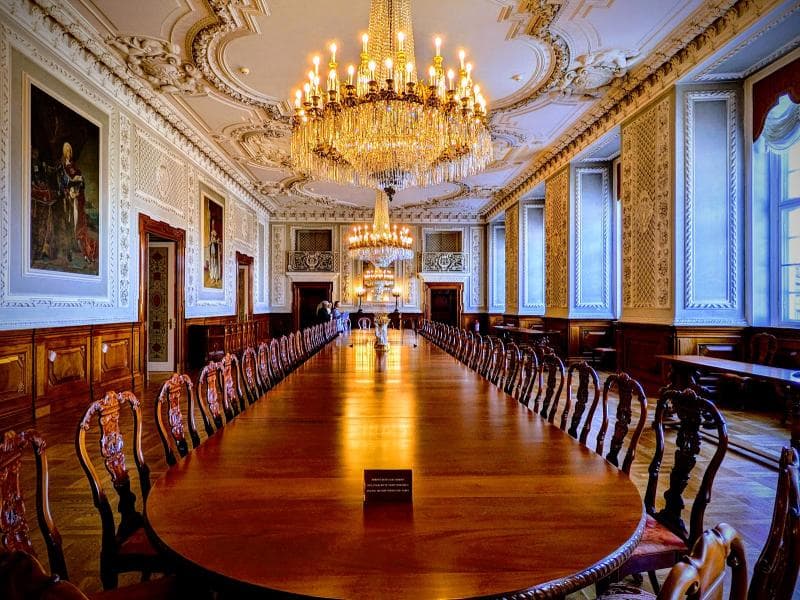
Explore the Parliament Chambers (Folketinget) in Copenhagen's Christiansborg Palace, the heart of Danish democracy and government. Discover its rich history.
Overview
Nestled on the historic islet of Slotsholmen in central Copenhagen, Denmark, the Parliament Chambers, housed within Christiansborg Palace, represent the vibrant heart of Danish democracy. This exceptional complex serves as the seat for all three supreme powers of Denmark: the legislative (the Folketinget, or Danish Parliament), the executive (the Prime Minister's Office), and the judicial (the Supreme Court). Uniquely, it is the only building in the world to accommodate all three branches of government, alongside royal reception rooms still utilized by the Danish monarchy.
The Folketinget itself is a unicameral national legislature, comprising 179 members. These representatives include two from Greenland and two from the Faroe Islands, underscoring Denmark's broader kingdom. The chambers are where laws are debated and passed, cabinets are approved, and the government's work is overseen, embodying the nation's parliamentary democracy.
History & Cultural Background
The ground upon which Christiansborg Palace stands boasts a rich and layered history stretching back over 800 years. The first structure, Bishop Absalon's fortified castle, was erected in 1167 to defend Copenhagen. This medieval fortress eventually evolved into Copenhagen Castle, serving as a royal residence for centuries.
The current Christiansborg Palace is actually the third iteration to bear its name, a testament to resilience in the face of adversity. The first grand Baroque palace, completed in 1745, was largely destroyed by fire in 1794. A subsequent Neoclassical palace, finished in 1828, also succumbed to a devastating fire in 1884. The present Neo-baroque structure was constructed between 1907 and 1928, specifically designed to house Denmark's democratic institutions.
Denmark's democratic journey formally began with the signing of its first constitution, the Grundlov, in 1849, establishing a parliamentary system. Initially, the Danish Parliament, known as the Rigsdag, was bicameral, consisting of the Folketing and the Landsting. However, a constitutional amendment in 1953 abolished the Landsting, leading to the unicameral Folketinget we know today.
What Makes It Special
The unique concentration of executive, legislative, and judicial powers within Christiansborg Palace makes it a singular site globally, offering an unparalleled insight into the workings of a modern state. The main Chamber of the Danish Parliament is an imposing, three-storey space designed for intense legislative activity. The seating for Members of Parliament is arranged in a horseshoe shape, centered around the Speaker's seat, subtly reinforcing principles of equality.
Connecting the main Chamber to other parliamentary spaces is the Vandrehallen, or Lobby, famous for its extraordinary 268-meter long floral frieze by artist Rasmus Larsen. This frieze, painted between 1918 and 1921, subtly comments on political life and adds a distinctive artistic and historical layer to the parliamentary environment.
For many visitors, the Christiansborg Palace Tower stands out. As Copenhagen's tallest tower, reaching 106 meters, it offers breathtaking panoramic views of the city and, on a clear day, even a glimpse of Sweden.
Stories, Fun Facts & Local Details
The palace's dramatic history, marked by two major fires, has cemented its place in Danish national consciousness. The recurring theme of rebuilding from ashes highlights a national resilience. Colloquially, Christiansborg is often referred to simply as 'Borgen' (the castle), a term that has become a metonym for the Danish political system itself, reflecting its deep cultural resonance.
An amusing anecdote surrounds the Palace Tower's construction. Initially, the architect Thorvald Jørgensen's design featured only one crown atop the tower. However, a witty Interior Minister, Bertel Dahlgaard, reportedly quipped that with just one crown, the tower resembled a railway station. To ensure the tower surpassed the height of Copenhagen Town Hall's spire, two more crowns were added, demonstrating a blend of national pride and good-humored competition in its final design.
Below the modern palace, visitors can explore the archaeological ruins of earlier castles, including Bishop Absalon's original fortress, offering a tangible connection to centuries of history beneath their feet.
Visitor Perspective
Visiting the Parliament Chambers offers a profound opportunity to engage with Danish democracy firsthand. Guided tours are available, providing insights into the palace's history and the evolution of Denmark's parliamentary system. These tours often cover the Chamber, the impressive Lobby, and various meeting rooms, showcasing both historical artifacts and modern parliamentary operations.
For those interested in seeing democracy in action, it is often possible to attend parliamentary sittings from the public gallery, observing debates as they unfold. Security measures, similar to airport procedures, are in place for all visitors entering the Parliament, so it is advisable to arrive approximately 15 minutes before any scheduled tour or sitting.
The Tower offers a readily accessible and free experience, providing spectacular views without the need for booking. While public parking is limited around Christiansborg Palace, it is conveniently located and easily reachable by public transport, with the Gammel Strand metro station situated nearby. A comprehensive visit, including a tour and a trip up the Tower, can comfortably take between three to four hours.
Coordinates: 12.5803, 55.6763
View on Google Maps💬 How Travelers Describe This Place
Based on community votes
Photogenic
998Must See
685Unique
472Beautiful
399Interesting
92
Traveler Stories
Discover memorable experiences shared by travelers who have visited this place.
No traveler stories yet.
Be the first traveler to share what made this place memorable.

Tour
By
Spot
Discover amazing places around the world. Your journey starts here.
Explore
© 2026 TourBySpot. All rights reserved.