Parliament Building
Tbilisi, Georgia
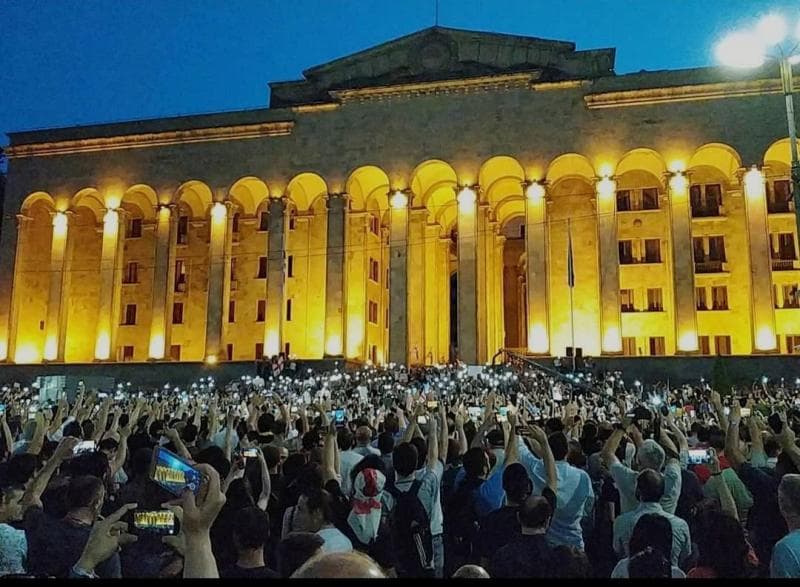
Explore the Parliament Building in Tbilisi, Georgia – a landmark on Rustaveli Avenue, rich in history and striking Soviet-Georgian architecture.
Overview
The Parliament Building, majestically situated at 8 Rustaveli Avenue in Tbilisi, Georgia, stands as a profound symbol of the nation's legislative power and historical resilience. This grand complex, a prominent feature of Tbilisi's main boulevard, serves as the primary meeting place for the Parliament of Georgia, the country's highest representative body. Its imposing architecture and central location make it a recognizable landmark, embodying the very heart of Georgian political life. While it is an active government building and not typically open for public tours, its facade and the vibrant civic space in front are always accessible, offering a powerful glimpse into Georgia's past and present.
The Parliament Building comprises two main structures, skillfully connected by an inner courtyard, featuring staircases and fountains. Its design, a compelling blend of Soviet monumentalism and traditional Georgian architectural motifs, commands attention with a monumental arcade, massive eaves, and distinctive 'arch' pediment.
History & Cultural Background
The site upon which the Parliament Building stands is steeped in history. Originally, it was home to the 19th-century Alexander Nevsky Cathedral and its adjacent churchyard, which tragically held the burials of Georgian cadets who lost their lives during the Bolshevik invasion of 1921.
The construction of the current complex began in 1933, initially as the House of Government of the Georgian SSR during the Soviet era. The 'upper' building was designed by Viktor Kokorin and Giorgi Lezhava and completed by 1938. The 'lower' building, facing Rustaveli Avenue, was later constructed between 1946 and 1953 by the same architects, with contributions from Vladimer Nasaridze. The buildings were primarily constructed of lightweight reinforced concrete, adorned with exterior cladding of tufa rock, granite, and notably, golden tuff, incorporating elements intrinsic to traditional Georgian aesthetics.
The Parliament Building has been a silent witness to some of Georgia's most pivotal moments. Most notably, it was the focal point of the tragic events of April 9, 1989, when Soviet troops violently dispersed a peaceful demonstration advocating for Georgian independence, resulting in casualties. A memorial dedicated to the victims of this somber day now stands prominently in front of the building. The building also played a significant role during the Rose Revolution in November 2003, further cementing its status as a historical stage for the nation's fight for freedom and democracy.
Although the Parliament temporarily relocated to a newly constructed edifice in Kutaisi in 2012 as part of a decentralization initiative, it fully returned to its historic seat in Tbilisi in January 2019, following a constitutional amendment in 2017.
What Makes It Special
What truly sets the Parliament Building apart is its unique architectural synthesis. It masterfully blends the grandeur and imposing scale characteristic of Soviet-era state architecture with intricate motifs and decorative elements drawn from traditional Georgian design. This combination creates a distinctive visual language that is both powerful and deeply rooted in Georgian cultural identity.
Beyond its aesthetic appeal, the building holds immense symbolic value. It is not merely a governmental structure but a poignant emblem of Georgia's protracted struggle for independence and its ongoing journey towards democratic self-determination. The events that unfolded on its doorstep have indelibly marked the nation's conscience, making it a site of national memory and pride.
Its strategic position on Rustaveli Avenue, Tbilisi's cultural and political artery, ensures its continuous engagement with the city's pulse. Flanked by other significant institutions and cultural sites, it remains a vibrant hub for public discourse and gatherings, often hosting peaceful demonstrations that underscore its role as a living monument to freedom of expression.
Stories, Fun Facts & Local Details
One profound, yet somber, local detail is the belief that the graves of the Georgian cadets killed during the 1921 Bolshevik invasion are interred beneath the very foundation of the Parliament Building, tying its existence directly to the nation's sacrifices for sovereignty.
Architecturally, the integration of golden tuff as a facing material not only adds a distinctive warmth to the facade but also highlights the conscious effort to incorporate national architectural elements into a Soviet-era design. The thoughtful layout includes two buildings united by an inner courtyard, complete with elegant staircases and fountains, showcasing a blend of functional and aesthetic considerations.
The civic space in front of the Parliament Building, especially around the April 9 Memorial, has historically served as a vital arena for public expression. It's a place where Georgians gather to commemorate, celebrate, and voice their opinions, making it a dynamic part of the city's social fabric. At night, the building's impressive architecture is beautifully illuminated, offering a striking view against the Tbilisi skyline.
Visitor Perspective
For visitors to Tbilisi, the Parliament Building offers a compelling, albeit external, experience. While internal access to this working government institution is generally not permitted, its exterior is an absolute must-see for anyone interested in Georgia's rich history and vibrant political landscape.
The best way to appreciate the Parliament Building is as part of a leisurely stroll along Rustaveli Avenue. Its broad, colonnaded facade and wide ceremonial steps create a sense of grandeur that is best absorbed from the avenue itself. Taking a moment to read about Georgia's recent history before your visit can significantly deepen your appreciation for this monumental structure and the pivotal events it has witnessed.
The area around the Parliament is well-maintained, providing wide sidewalks and benches for visitors. Its central location also places it within easy walking distance of other key attractions, including Liberty Square, various museums, and the historic Kashveti Church directly opposite. Photography of the exterior is encouraged, allowing visitors to capture the enduring symbol of Georgian democracy.
Coordinates: 44.798026, 41.696765
View on Google Maps💬 How Travelers Describe This Place
Based on community votes
Photogenic
948Unique
595Beautiful
358Interesting
196Must See
19
Traveler Stories
Discover memorable experiences shared by travelers who have visited this place.
No traveler stories yet.
Be the first traveler to share what made this place memorable.

Tour
By
Spot
Discover amazing places around the world. Your journey starts here.
Explore
© 2026 TourBySpot. All rights reserved.