Parks
Prague, Czech Republic
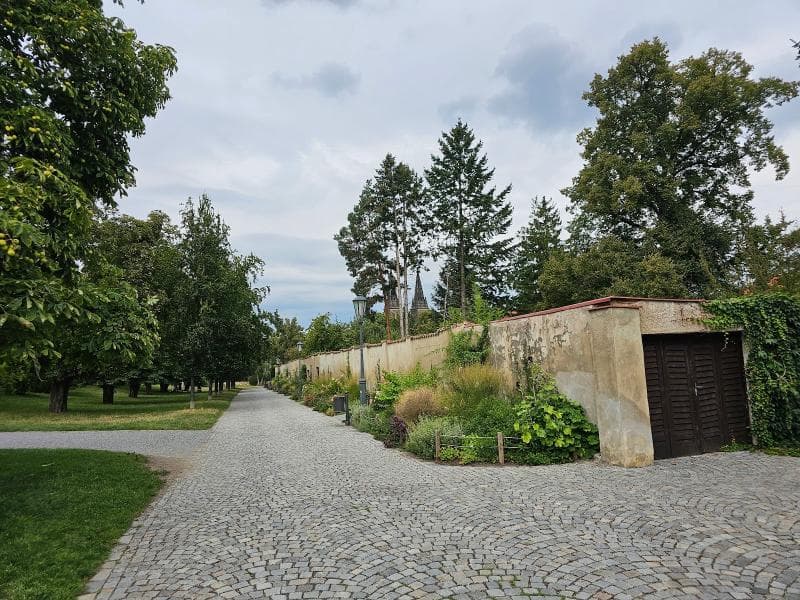
Discover the tranquil parks of Vyšehrad in Prague, Czech Republic. Explore historic gardens, legendary statues, stunning views, and ancient monuments.
Overview
Perched majestically on a rocky promontory overlooking the Vltava River, Vyšehrad in Prague, Czech Republic, is more than just a historical fortress; it is a sprawling national cultural monument, renowned for its tranquil and scenic parks. These green spaces offer a refreshing escape from the bustling city center, inviting visitors to immerse themselves in history, culture, and breathtaking panoramic views. While many associate Prague with its iconic castle, Vyšehrad provides an equally rich, yet more serene, experience, often described as a 'monument, a park, and a village all in one'.
The parks within Vyšehrad are characterized by their lush greenery, expansive lawns, and winding paths that lead to various architectural gems and historic landmarks. It is a favored spot for both locals and discerning travelers seeking quiet contemplation, leisurely strolls, and picturesque picnic locations.
History & Cultural Background
Vyšehrad's history intertwines deeply with the very foundations of the Czech nation. Believed by some legends to be the original seat of Czech princes and the mythical birthplace of Prague itself, its origins date back to at least the 10th century, roughly 70 years after Prague Castle's establishment. For a period in the 11th and 12th centuries, it served as a royal residence under King Vratislav II, who moved his seat from Prague Castle to Vyšehrad.
Over centuries, Vyšehrad transformed from a royal castle into a formidable Baroque fortress. Its military significance, however, began to decline in the 1880s, paving the way for the development of its beautiful parks. This transformation was largely spearheaded by Vyšehrad provosts Václav Štulc and Mikuláš Karlach in the 19th century, whose initiatives led to the creation of the formally designed areas and tree-lined avenues visible today. In 1962, Vyšehrad was officially declared a national cultural monument, preserving its unique blend of nature and heritage for future generations.
What Makes It Special
The parks of Vyšehrad offer a unique combination of natural beauty and historical grandeur. At the heart of the complex lies the stunning Basilica of St. Peter and St. Paul, a neo-Gothic masterpiece with twin spires that dominate the Prague skyline. Adjacent to the Basilica is the revered Vyšehrad Cemetery, known as Slavín, the final resting place of many illustrious Czech artists, composers, writers, and scientists, including Antonín Dvořák, Bedřich Smetana, Karel Čapek, and Alfons Mucha. Its Art Nouveau graves make it an open-air art gallery and a place for quiet remembrance.
Visitors can also explore the ancient Rotunda of St. Martin, dating from the 11th century and one of Prague's oldest preserved buildings. Beyond these architectural marvels, the parks themselves are dotted with statues, including monumental sculptures by Josef Václav Myslbek, originally from Palacký Bridge, depicting figures from old Czech legends. The elevated position of the parks provides unparalleled, breathtaking views of the Vltava River, Prague Castle, and the surrounding cityscape, making it an ideal spot for photography or simply soaking in the beauty of Prague.
Stories, Fun Facts & Local Details
Vyšehrad is steeped in legends that weave through its ancient stones and serene landscapes. One of the most famous legends is that of Princess Libuše, a mythical ancestress of the Přemyslid dynasty, who prophesied the glory of Prague from this very hill. Her statue, along with those of other legendary heroes like Přemysl the Ploughman and the warrior Šemík, can be found within the parks, bringing these ancient tales to life.
A particularly intriguing feature is the Devil's Column, located in the Karlach Gardens. This formation of three stone columns has a captivating legend attached to it: a priest allegedly wagered with the Devil that he could finish Mass before the Devil could bring a column from St. Peter's Basilica in Rome. The Devil lost the bet in a rage, throwing the column down, creating the present formation. The parks also feature a playground for children, imaginatively designed with themes from ancient Czech legends, including a symbolic representation of the knight Horymír's legendary leap with his horse Šemík from Vyšehrad's ramparts.
Visitor Perspective
The parks of Vyšehrad offer a distinct experience for visitors. Unlike the often-crowded Prague Castle, Vyšehrad provides a more peaceful and relaxed atmosphere, allowing for a slower-paced exploration. It is an ideal destination for those seeking tranquility, scenic walks along the ramparts, or a quiet spot for a picnic with stunning vistas. Many areas, including the grounds and the cemetery, are free to enter, making it an accessible and budget-friendly attraction.
Visitors can easily spend a few hours, or even an entire afternoon, wandering through the well-maintained gardens, discovering hidden corners, and enjoying the combination of history and natural beauty. The presence of pleasant cafés within the complex provides opportunities for refreshments. Vyšehrad is well-connected by public transport, with a metro station and tram stops nearby, making it convenient to reach this historic and picturesque haven.
Coordinates: 14.41944, 50.06417
View on Google Maps💬 How Travelers Describe This Place
Based on community votes
Must See
545Unique
211Photogenic
123Interesting
74Beautiful
20
Traveler Stories
Discover memorable experiences shared by travelers who have visited this place.
No traveler stories yet.
Be the first traveler to share what made this place memorable.

Tour
By
Spot
Discover amazing places around the world. Your journey starts here.
Explore
© 2026 TourBySpot. All rights reserved.